Irenic Thoughts

Irenic. The word means peaceful. This web log (or blog) exists to create an ongoing, and hopefully peaceful, series of comments on the life of King of Peace Episcopal Church. This is not a closed community. You are highly encouraged to comment on any post or to send your own posts.

3/23/2010

The Way, The Truth and The Life

Archbishop of Canterbury Rowan Williams gave a recent talk The finality of Christ in a pluralist world during a visit to the Diocese of Guildford. He was speaking on the texts of Jesus saying (John 14:5-6) that he is The Way, The Truth and The Life and Peter later saying (Acts 4:8-13), " This Jesus is 'the stone that was rejected by you, the builders; it has become the cornerstone.' There is salvation in no one else, for there is no other name under heaven given among mortals by which we must be saved." Williams taught,
What the New Testament does not say is, 'unless you hold the following propositions to be true there is no life for you'. What it does say is, 'without a vital relationship with Jesus Christ who is the word of God made flesh, you will not become what you were made to be. You will not live into the fullness of your human destiny.' And it's this claim—not so much about unique truth in a form of words but about unique relationship with Jesus—which I want to explore a little with you.

My photo of Rowwan Williams from the General Convention in 2009'No one comes to the Father except through me', says Jesus. In other words if you are to be reconciled as a son or daughter with the God that Jesus calls 'Father' then it is in association with him and in walking his way that that becomes a reality: walking his way, not just having the right ideas about him, not even just repeating what he says, but following him. Then if we turn to Acts put into slightly plainer English, what Peter is saying to the authorities in Jerusalem is something like this: 'If you are to find life and healing, you must turn towards the one you rejected and despised; because there is no name on which you can call for rescue, except the name of the one you crucified'. I emphasize the word 'you' there. Peter is not preaching in the abstract. He is saying to those who crucified Jesus, 'If you want to be rescued from the trap in which you have locked yourself, the only name on which you may call for rescue is the name of the one you killed.' And that is the conversion or repentance he asks for.

Now I say this about the texts before us not to try and evacuate them of the meaning that has traditionally been given, but to note how both of them in their different way are presented as a challenge to change your life. What is the way to the Father? The Father cannot be shown as an object in the sky—something you can point to. The Father is discovered as you walk with Jesus towards cross and resurrection, and the challenge in Acts is the challenge, 'turn towards the one you have rejected and there you will find your hope'.
Then jumping to the end without all the middle parts that make the connection (which is always dicey), I will share his concluding words:
In short and in conclusion, belief in the uniqueness and finality of Jesus Christ—for all the assaults made upon it in the modern age—remains for the Christian a way of speaking about hope for the entire human family. And because it's that, we are bound to say something about it. We are very rightly suspicious of proselytism, of manipulative, bullying, insensitive approaches to people of other faith which treat them as if they knew nothing, as if we had nothing to learn and as if the tradition of their reflection and imagination were of no interest to us or God. God save us from that kind of approach. But God save us also from the nervousness about our own conviction which doesn't allow us to say that we speak about Jesus because we believe he matters. We believe he matters because we believe that in him human beings find their peace. Their destinies converge and their dignities are fully honoured. And all the work that we as Christians want to do for the sake of convergent human destiny and fullness of human dignity has its root in that conviction that there is no boundary around Jesus—that what he is and does and says and suffers is in principle liberatingly relevant to every human being; past, present and future.

The challenge is partly re-connecting our christology (what we say about Jesus and the Trinity) with our anthropology (our sense of what belongs properly to human beings); and rightly understood, I think that the belief in Jesus' uniqueness and finality allows us to do this. And, rightly understood, I believe it also allows us to encounter both the religious and the non-religious other with the generous desire to share, and the humble desire to learn, and the patience to let God work out his purpose as is best in his eyes.
The full text of his lecture is online here: The finality of Christ in a pluralist world. While not on parr with Williams, I have written along similar themes, such as in the sermon God Shows No Partiality or the religion column Can Other Religions Be True?.

That's what the archbishop and I believe. Where do you stand on the uniqueness of Christ in a pluralistic culture?

peace,
Frank+
The Rev. Frank Logue, One who tries to stay on The Way

Labels:

1 Comments:

Post a Comment

<< Home

2/02/2010

God and Wall Street

Archbishop of Canterbury Rowan Williams, writes the following for Newsweek:
Recently I went to New York City to participate in a conference at Trinity Wall Street. It was called "Building an Ethical Economy: Theology and the Marketplace." In my view, the contribution of theology to economic decision making is not only about raising questions concerning the common good—questions that deal with how this or that policy grants or withholds liberty for the most disadvantaged. Obviously, these are important issues. But we need to look with great care as well at what our economic practices are assuming and promoting about human motivation and integrity.

In our culture, we have become used to an attitude in which economic motivations, relationships, and conventions are fundamental: the language of seller and customer has wormed its way into practically all areas of our social life, even education and health care. The implication is that the most basic interaction between one human being and another is the carefully calibrated exchange of material resources.
In our culture, we have become used to an attitude in which economic motivations, relationships, and conventions are fundamental: the language of seller and customer has wormed its way into practically all areas of our social life, even education and health care. The implication is that the most basic interaction between one human being and another is the carefully calibrated exchange of material resources.

But we must hang on to the idea that not everything reduces to one standard of value. Treat economic exchanges as the only "real" thing that people do, and you face the same problems confronted by the evolutionary biologist (for whom the only question is how organisms compete and survive) or the Freudian fundamentalist (for whom the only issue is how we resolve the tensions of infantile sexuality). Traditional religious ethics—traditional ethics of any kind, in fact—do not require you to ignore the hidden forces that may be at work in any particular setting. Being human is learning how to ask critical questions of your own habits and compulsions, and it's learning how to adjust them against a model of human behavior—an idealized truth about the purpose of our humanity.

It is possible to see the various balancing acts we engage in—the calculations of self-interest and security, the resolution of buried tensions—as a means to finding our way to a life that manifests something, a life that doesn't just solve problems of survival and profit. Our job as human beings is to imagine ourselves—using all the raw materials that science, psychoanalysis, and economics provide us—in the hope that the images we discover and shape will have resonance and harmony with the rhythms of what Christians, and others, call the will and purpose of Almighty God.

Labels:

0 Comments:

Post a Comment

<< Home

12/16/2008

The Vulnerable Pay the Price

The following is the Christmas Letter from Archbishop of Canterbury Rowan Williams:

Human beings, left to themselves, have imagined God in all sorts of shapes; but—although there were one or two instances, in Ancient Greece and Ancient Egypt, of gods being pictured as boys—it took Christianity to introduce the world to the idea of God in the form of a baby: in the form of complete dependence and fragility, without power or control. If you stop to think about it, it is still shocking. And it is also deeply challenging.
God chose to show himself to us in a complete human life, telling us that every stage in human existence, from conception to maturity and even death, was in principle capable of telling us something about God.

Although what we learn from Jesus Christ and what his life makes possible is unique, that life still means that we look differently at every other life. There is something in us that is capable of communicating what God has to say—the image of God in each of us, which is expressed in its perfection only in Jesus.

Hence the reverence which as Christians we ought to show to human beings in every condition, at every stage of existence. This is why we cannot regard unborn children as less than members of the human family, why those with disabilities or deprivations have no less claim upon us than anyone else, why we try to makes loving sense of human life even when it is near its end and we can hardly see any signs left of freedom or thought.

And hence the concern we need to have about the welfare of children. As we look around the world, there is plenty to prompt us to far more anger and protest about what happens to children than we often seem to feel or express. In the UK this year there have been several public debates about childhood, as research has underlined the lack of emotional security felt by many children here, the high cost of divorce and family breakdown, the disproportionate effect of poverty and debt on children, and many other problems. We look forward to the publication here in the New Year of a nationwide survey about what people think is a 'good childhood'—sponsored by the Children's Society, with its long association with the Anglican Church.

Elsewhere we see far more horrendous sights—child soldiers still deployed in parts of Africa and in Sri Lanka, the burden laid on children in places where HIV and AIDS have wiped out a whole generation, leaving only the old and the young, the fate of children in areas of conflict like Congo and the Middle East and the insensitive treatment that is so often given to child refugees and asylum seekers in more prosperous countries.

'Though an infant now we view him, He shall fill his Father's throne' says the Christmas hymn. If it is true that the child of Bethlehem is the same one who will come again in glory to judge the living and the dead, how shall we stand before him if we have allowed his image in the children of the world to be abused and defaced? In the week I write this, the British public is trying to cope with the revelation of the shocking killing of a very small child. Recently I accompanied a number of students and British faith leaders on a pilgrimage to the extermination camps at Auschwitz, where some of the most unforgettably horrifying images have to do with the wholesale slaughter of Jewish children—their toys and clothes still on display, looted by their killers from their dead bodies.

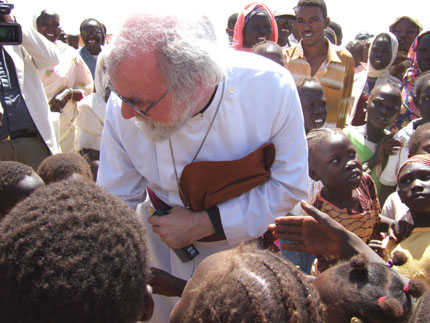
Rowan Williams with children in the SudanChristmas is a good time to think again about our attitudes to children and about what happens to children in our societies. Christians who recognise the infinite and all-powerful God in the vulnerability of a newborn baby have every reason to ask hard questions about the ways in which children come to be despised, exploited, even feared in our world.

We all suspect that in a time of economic crisis worldwide, it will be the most vulnerable who are left to carry most of the human cost. The Holy Child of Bethlehem demands of us that we resist this with all our strength, for the sake of the one who, though he was rich, for our sake became poor, became helpless with the helpless so that he might exalt us all through his mercy and abundant grace.

With every blessing and best wish for Christmas and the New Year.

+Rowan Cantuar

Labels:

1 Comments:

  • At 12/17/2008 8:17 AM, Blogger Sie.Kathieravealu said…

    Please find below my opinion of solving the problem in Sri Lanka.The suggestions can be applied to any country including India. Anyone is free to comment on it because it is my firm belief that if a sustainable society is to be reached, it will not be political leaders who would show us the way. More likely, small groups of us will emerge who have found the way, and spread that message to others. When a critical mass of the electorate has already adopted a more developed sense of society, only then will our leaders follow.

    The main cause for all the ills of any country and every country is the present democratic system of governance which allows "corruption" of all forms to thrive unchecked.

    In my opinion "Corruption" includes any kind of waste, neglect and every form of malpractice, dishonesty, abuse, misuse, unreasonable exercise of power, failure or refusal to exercise power, anything and everything left undone which results in the right of the people being denied or impaired.

    Without a "just society" in existence much talked about "terrorism" cannot be eradicated. For the creation of a "just society" there should be "good governance" in the country. For the creation of "good governance" in the country "corruption" of ALL forms must be eradicated. And to eradicate "corruption" the present democratic system of governance, where full power to make final decisions ultimately rests in the hands of one person, must be changed.

    So the only way to salvage a country is to change the present system of governance to one that is truly democratic where the final decision-making power will NOT be in the hands of ONE person BUT shared by as many people as possible. Thus restricting individual and hasty decisions leading to trouble everywhere.

    To make a country truly democratic, the powers of the Parliament (the decision making supreme body of a country) should be split and separated and each of the separated powers must be handled by separate groups of persons selected and elected by the people for the purpose of administering EACH SET OF POWERS or duties as the case may be. Particular care should be taken to see that all powers are NOT CONCENTRATED in one place and that they do not overlap and there must not be a secret budget to be handled by a single person.

    All transactions should be transparent including Diplomacy which has to be diplomatically transparent.

    One set of powers dealing with the development of the country should be given to the set of representatives at the village level. The people of each and every village must be empowered to determine their way of life (lifestyle). The life-style of a village, its lands and resources shall not be disturbed by external forces. All plans of development of a village or remotely/indirectly affects the village must have the concurrence of the people of that village concerned.

    Even now the administration is from village level unto National Level in many countries with many stages in between - one above the other - with powers overlapping and the final decision-making power is at one place - the top. That is the problem and so that system must be changed.

    The decision-making powers with regard to every set of powers must be spread through-out the country.
    We can lead the world with such a REAL DEMOCRACY with a parliament encompassing representatives from all the villages and starting the administration of the country at the village level and going unto national level.

    Mahatma Gandhi wanted the villages of India to be empowered but it has not implemented by the government of India yet due to human nature of not willing to lose the little power each person (office) is already in possession.

    A change in the people's attitude and understanding of the problem is important. They must be made aware of the benefits it will bring to them in the long run. Now they are after short-term profits. They are not considering the future generations. A corruption-free society will bring-in good-governance that will benefit everyone other than the crooked politicians.

    In my opinion the people are ready to change the present system but they are not being given the opportunity by power hungry politicians. I think the countries of the World must move towards this goal and like-minded persons from all walks of life must join the movement and strengthen it. Only then can the people be able to give a send-off to ALL the corrupt politicians of ALL political parties and usher-in a new era of a corrupt-free society in any country. Rajaji (the last Governor-General of India) tried it in India but was not successful.

    Rather than continuing to express and analyze the problem of the day we must move towards a solution.

    They (the people) should move away from race/religion/language/class-centered/oriented politics and move towards a needs-focused administration that which is race-blind, religion-blind, language-blind and class-blind for sustainable peace, prosperity and a pleasant living for ALL the people in a country.

    Sie.Kathieravealu


Post a Comment

<< Home

1/01/2008

God "doesn't do waste"

In his New Year's message, Archbishop of Canterbury Rowan Williams writes in part,
Archbishop Rowan WilliamsDespite constant talk about recycling and thinking "green" - we're still a society that produces fantastic quantities of waste. From the big issues around toxic industrial and nuclear waste to the domestic questions of managing day-to-day waste and the build-up of stuff around us that can't be recycled, it's not something we can ignore. Look at the number of plastic bags flapping around by the roadside, in town and country alike - and you see what I mean.

What I wonder is – how much this influences attitudes in other parts of our lives?

In a society where we think of so many things as disposable; where we expect to be constantly discarding last year's gadget and replacing it with this year's model - do we end up tempted to think of people and relationships as disposable?

...And if we live in a context where we construct everything from computers to buildings to relationships on the assumption that they'll need to be replaced before long – what have we lost?

Christians, like Jews and many other religious people too, talk a lot about God as 'faithful'. God is involved in 'building to last', in creating a sustainable world and sustainable relationships with us human beings. He doesn't give up on the material of human lives. He doesn't throw it all away and start again. And he asks us to approach one another and our physical world with the same commitment. The life of Jesus, the life in which God identifies completely with our flesh and blood is the supreme sign of that commitment.

God doesn't do waste.

He doesn't regard anyone as a 'waste of space', as not worth his time – from the very beginnings of life to its end, whether they are successful, articulate, productive or not. And so a life that communicates a bit of what God is like, is a life that doesn't give up – that doesn't settle down with a culture of waste and disposability – whether with people, or with things.

Perhaps a good resolution for the New Year would be to keep asking what world we want to pass on to the next generation – indeed, to ask whether we have a real and vivid sense of that next generation.
The full text is online here: God Doesn't Do Waste.

Labels:

0 Comments:

Post a Comment

<< Home

12/26/2007

Allow God to speak through the things of creation

In his Christmas sermon at Canterbury Cathedral yesterday, Archbishop of Canterbury Rowan Williams said,
The world around us is created as a framework within which we may learn the first beginnings of growing up towards what God wants for us. It is the way it is so that we can be directed towards God. And so this is how we must see the world. Yes, it exists in one sense for humanity's sake; but it exists in its own independence and beauty for humanity's sake – not as a warehouse of resources to serve humanity's selfishness.

To grasp that God has made the material world, 'composed', says John of the Cross, 'of infinite differences', so that human beings can see his glory is to accept that the diversity and mysteriousness of the world around is something precious in itself. To reduce this diversity and to try and empty out the mysteriousness is to fail to allow God to speak through the things of creation as he means to. 'My overwhelming reaction is one of amazement. Amazement not only at the extravaganza of details that we have seen; amazement, too, at the very fact that there are any such details to be had at all, on any planet.'
The full text of his sermon is online here: Archbishop of Canterbury's Christmas Day sermon

Labels:

0 Comments:

Post a Comment

<< Home

4/18/2007

Thinking about Scripture

Rowan Williams, the Archbishop of Canterbury, gave a lecture on scripture this week to a group of theology students, beginning with the point,
One of the things that most clearly and universally identifies Christians as Christians is that they habitually read the Bible.
He went on to note that for most of its history, the Bible has been primarily a public document, one encountered through hearing it read. He said,
Archbishop of Canterbury Rowan Williamsthe Church's public use of the Bible represents the Church as defined in some important way by listening: the community when it comes together doesn't only break bread and reflect together and intercede, it silences itself to hear something. It represents itself in that moment as a community existing in response to a word of summons or invitation, to an act of communication that requires to be heard and answered.
Interesting. We are primarily a community who gathers to hear. And what we gather to hear is God speaking to us in a fresh way through the scripture read in our midst. Not new thoughts, but interesting to put together. I feel worship is our primary purpose to come together and still think so, but in our worship we primarily listen.

The archbishop said, "all this is essentially about seeing Scripture as the vehicle of God's act to bring about conversion." He made 6 key points:
  1. Scripture is something through which the community affirms its identity and seeks its renewal;

  2. we need to develop the skills needed to avoid the misuse of texts by abstracting them from the questions they actually put;

  3. thus also, the discernment of what are the changes a reading sets out and proposes for the reader/hearer;

  4. an understanding that this last is decisively and authoritatively illuminated by hearing scripture in the setting of a communion service;

  5. the consequent holding together of our communion service and the Scripture read in it through a strong doctrine of the Spirit's work in constructing the community of Christ's Body; and

  6. the recognition that neither Scripture nor communion make sense without commitment to the resurrection of Jesus as the fundamental condition of a Church whose identity is realised in listening and responding.
The full text of his lecture is online here: The Bible Today: Reading & Hearing

Thoughtful Blogs
If this seems a little heavy, perhaps it is because I am trying to honor the Thinking Blogger Award given to Irenic Thoughts. It's awkward in that the first blog that comes to mind for this award is the one that gave it to me, November in My Soul, but here are five I follow and want to recommend (not already awarded that I know of):

Biblische Ausbildung
Dr. Stephen Cook's Blog from Virginia Seminary

Questing Parson
The Rev. Guy Kent's Blog

World of Your Making
The Rev. Rick Lord's blog at Holy Comforter in Vienna, Virginia

Father Steve+ Blog
from Waynesboro, Georgia

Sunrise on the Marsh
The Rev. Linda McCloud's blog at Our Savior Honey Creek

Here are the instructions:1. If, and only if, you get tagged, write a post with links to 5 blogs that make you think.2. Link to this post so that people can easily find the exact origin of the meme.3. Optional: Proudly display the ‘Thinking Blogger Award’ with a link to the post that you wrote.

peace,
Frank+
The Rev. Frank Logue, Pastor

Labels: ,

5 Comments:

Post a Comment

<< Home