I don’t want to walk past
Yesterday, I told of a connection made between King of Peace and the Melanesian Brotherhood in a time of crisis and death in the Solomon Islands.
Today, I want to share what the Rev. Richard Carter has been up to more recently. He has returned to England and serves as an Assistant Priest at St. Martin in the Fields Church in London.
On March 18, he preached a sermon Exploring God's Parable of the Lost and Found on the parable usually referred to as The Prodigal Son. He wrote in part:
Today, I want to share what the Rev. Richard Carter has been up to more recently. He has returned to England and serves as an Assistant Priest at St. Martin in the Fields Church in London.
On March 18, he preached a sermon Exploring God's Parable of the Lost and Found on the parable usually referred to as The Prodigal Son. He wrote in part:
When I toured many secondary schools performing this parable in 2005 our prodigal became a black migrant in the UK with all the temptations facing a newly arrived youth in a modern city.The full text of the sermon is online in PDF format here: Exploring God's Parable of the Lost and Found.The dissolute living for those who performed the story became the unremitting message of a consumerist society that “to be is to have” - have money, have instant gratification, have mobile, have ipod, have alcohol, have drugs, have who you want, have what you want 24/7. And it left our prodigal like the original without anyone or anything, alone on the streets.
In the drama I told the kids to walk past our prodigal. He was lying on the ground without anything, like the homeless people we often see on our city pavements. “Walk past him” I said, “like we do.” Walk past him like when someone wants to sell you The Big Issue. And in our drama we did. And then in one school where we were performing the drama in Merseyside one young boy aged eleven confronted me:
“I don’t want to walk past”.
“What?” I asked.
“I don’t want to walk past him, I want to help him.”
“You can’t do that, it’s not in the script” I told him.
“But I want to help him” he said.
“Well then I suppose you better had.” I replied.
He went over and put his hand on the Prodigal sons shoulder and knelt down beside him.
“Look if your hungry I can ask my Mum to get you something to eat.”
Mothers are like that.I saw that Christ’s parable had made its journey across time and culture. And the story was being inhabited by this young boy who had had the courage to stand up to the pressure of group conformity and make his response his own. Christ’s parable was alive and continuing its work in Merseyside and there was hope in that.
Labels: The Prodigal Son
posted by King of Peace @ Friday, April 13, 2007
2 comments


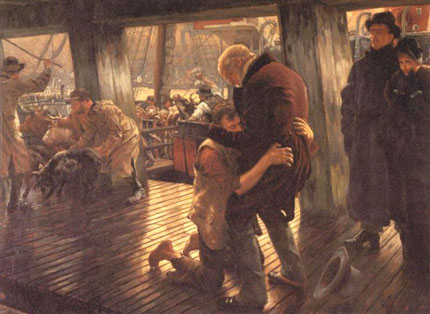
 Of course, such a view affirms our natural idea of fairness. But that's just the point. That is where the argument breaks down. It is simply too legalistic, places too much emphasis on the unfairness of the prodigal getting an additional portion of inheritance, and relies too much on the concept of rewards and punishments.







2 Comments:
At 4/13/2007 7:26 AM, Anonymous said…
Richard Carter's take on the Prodigal is so connected to the film clip you showed at King of Peace on March 17-18 when the Gospel dealt with the Prodigal Son, that I think it's time you met this guy. You have already proven that you are a great team.
At 4/13/2007 7:41 AM, Anonymous said…
I can't help but say that the boy sure sounds like a true Liverpudlian. That's how I was raised - to help. Glad to hear that's still being taught in some homes there.
Post a Comment
<< Home