Arguing for God & the Experience of the Holy
 Last night, the Fundamentals of Philosophy class I am teaching at Valdosta State University's Kings Bay Center spent one evening on Philosophy of Religion. The text we are using, Questions That Matter centers its teaching around four questions: The Question of Reality, The Question of Knowledge, The Question of God, and The Question of Morality.
 We looked at The Question of God, particularly the arguments philosophers and theologians have made concerning proofs of God's existence. We considered the Ontological Argument, the Cosmological Argument, and the Teleological Argument, as well as Thomas Aquinas Five Ways proof which overlaps the other arguments in some ways.
We also looked at the proof some use to deny God, The Problem of Evil, and showed how people of faith have long reconciled the fact that there is evil in the world with the knowledge that God is all powerful, all good and ever present. We also considered whether religious experiences qualify as evidence for God's existence. Most philosophers have said "No" as religious experience is personal and so may offer proof for the one having the experience, but is not helpful as evidence for others. In this regard, we consider Sigmund Freud, the pioneering psychiatrist who was a convinced atheist and saw religions as something of a communal neurosis, a shared delusion.
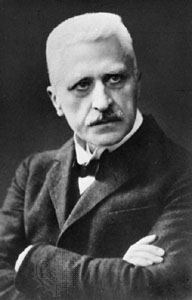 Then we looked at Rudolph Otto's 1917 work The Idea of the Holy in which he defends the use of religious experiences in talking about religions as he notes that religious experiences happen all around the world in varying cultures in a way that shares too much commonality to be dismissed. Otto (shown at left) used the Latin word numen which referred to "divine presence" or "divine power" to create the word numinous for the feeling of holiness. Otto challenges that everyone has felt this. He would say that Freud and other atheists have felt it too.
 Just to get a feel for what he wrote, Otto said this numinous feeling is
The deepest and most fundamental element in all strong and sincerely felt religious emotion.And is to be found in
in strong, sudden ebullitions of personal piety,... in the fixed and ordered solemnities of rites and liturgies, and again in the atmosphere that clings to old religious monuments and buildings, to temples and to churches.And may peaceful and:
come sweeping like a gentle tide, pervading the mind with a tranquil mood of deepest worship.or faster moving:
thrillingly vibrant and resonant, until at last it dies away and the soul resumes its 'profane', non-religious mood of everyday experienceHe called this experience Mysterium Tremendum a Latin phrase in which the mysterium refers to something wholly other, truly amazing, outside our normal experience; and Tremendum is comprised of three elements—awfulness (inspiring awe, a sort of profound unease), overpoweringness (that which, among other things, inspires a feeling of humility), energy (creating an impression of immense vigour).
For Otto, if we want to examine religion, we must take this common human experience of the Other in to account, otherwise it is as if we have torn the heart out of faith before examining and then wondering why it seems a dead and lifeless thing. For the experience of the Holy, the Other—what I would refer to as the presence of the Holy Spirit—is really at the heart of how people come to faith. We don't find faith in logical arguments like the ones we studied last night. No matter how compelling those arguments are, without some experience of the divine, there would be nothing animating our desire to believe in God.
 Rudolph Otto's idea was that everyone has had numinous experiences even if they dismiss them. I think that this common experience of God breaking into our daily (Otto would say profane) lives with a feeling of something holy and sacred beckoning us is an important part of what leads people to faith and to worship. I told my class that I agreed this feeling the numinous in cathedrals and out in nature and elsewhere is something all us humans share. Not that anyone feels it all the time or everyone feels it frequently, but that all humans at time have this experience.
 Did I tell my class the truth, or did I overstate the case from too little evidence? Have you had experiences in worship, in your daily life, in which you felt the presence of God? Do you think this is universal?
peace,
Frank+
The Rev. Frank Logue, Pastor
Labels: philosophy
posted by King of Peace @ Tuesday, April 14, 2009
1 comments













1 Comments:
At 4/14/2009 12:49 PM, The Bosom Serpent said…
I'll believe it when I see it.
or
I'll see it when I believe it.
Excellent post. It is always inspiring to see men of great intellect arguing for the reality of the divine instead of against it. And thank you Father for all the times you have helped me navigate the rocky waters of faith.
Post a Comment
<< Home