Irenic. The word means peaceful. This web log (or blog) exists to create an ongoing, and hopefully peaceful, series of comments on the life of King of Peace Episcopal Church.
This is not a closed community. You are highly encouraged to comment on any post or to send your own posts.
10/30/2008
Where the rubber meets the road
Speaking of calling oneself a Christian, Civil Rights leader Fannie Lou Hamer wrote,
If you are not putting that claim to the test, where the rubber meets the road, then it's high time to stop talking about being a Christian. You can pray until you faint, but if you're not gonna get up and do something, God is not gonna put it in your lap.
I have had this discussion many times with someone who is very near and dear to me. They seem to believe that prayer is enough, that God requires no other action on our part.
God could intervene and do everything we want done but he probably won't. I agree we need to be about His business, following up our prayer requests with action.
It is often though us that God performs his miracles, answers prayer requests and provides us with oportunities to see if we will love our enemies as our self. Prayer and faith are not passive concepts, both require some overt act on our part.
“Where there are no oxen, the manger is clean, but abundant crops come by the strength of the ox.” —Proverbs 14:4
Debbie pointed out a thought-provoking blog post from old frienda who note why Christian community is inherently messy making reference to the quote from Proverbs above. Glenn and Phyllis wrote an entry Oxen in the Stall for their blog Kingdom Come!
If our goal in ministry is neat, clean, orderly lives, forget it. Ministry is about living in the mess and understanding that the oxen – the people we have around us – are both the producers of the dirty stall as well as the harvest.
I think about this as I work with people. And that’s what I do – and have done all my life – I work with people. Mostly, people with grand ideas but no experience, or money or connections. People with tons of baggage from bad families, from bad relationships, from substance abuse, from people abuse. People who bring loads of poop from other lives, other relationships, other ways of living. These are the folks who mess up the stall.
But these are the people who also will bring in the harvest.
I get tired of using the shovel to work with people to clean the stalls. I grow weak and weary. I’m looking for people who have it all together – cool people with perfect lives! Who don’t need a lot of fix-up. As my friend Larry Nunnally says, “I’m looking for a better class of sinner.” I’m looking for people who are ok when you find them.
They go on to point out that "There are no really good people, the potential for greatness is in us all, but marred by the propensity to sin and fall short, and there are no really good functional families."
The full text of their reflection is online here: Oxen in the Stall. As we really aren't looking for a better class of sinner, the stall will get messy at times. That's OK, as if they started to throw out the really stinky folks, I'd be the first to go and you'd be right behind me, gentle readers. ;-)
Dr. Kathleen Henderson Staudt wrote recently for the Episcopal Café blog to challenge her readers with the question of what churches woud look like if they were concerned with discipleship:
Jesus tells his followers to make disciples of all nations – i.e. not only the Jewish community that they know but ALSO all nations: this is for everyone. And it’s about observing what he commanded. Love your neighbor as yourself; pray; teach, heal, feed the hungry, clothe the naked, seek forgiveness and reconciliation; look at the world through the lens of one who can say “blessed are the poor/ blessed are the meek.” This is not about convincing people to be like-minded or to join-up, nor is it a self-help project, about “becoming a better person.” Rather, the idea of discipleship gets to the heart of who Jesus is or wants to be for us. It moves us beyond worrying about the shape of institutions and back to a focus on the mission that Jesus has promised to support, if we try to follow him: “I am with you always, to the close of the age.”
What would the Church look like if we thought of “disciple-making” as our core purpose, in adult formation programs, in seminary education, in worship? The language of the baptismal covenant and baptism service in the prayer book provides some good language for this, in our tradition – though somehow or other the “ministry of the baptized” has been relegated to a category that goes with “not called to ordained ministry,” in many discussions in seminaries and vocation/formation programs. (Sometimes implying a contrast between the ministry of the ordained and the ministry of the baptized, as if the ordained were not baptized!) But discipleship: that’s something we all share, whatever office we’re called to in the church – it’s something we can reflect on within our tradition and also across denominations. How might the vision of a “disciple-making church” transform and refocus our work, worship and teaching?
What would a disciple-making church be like to be a part of? I find it an interesting idea as long as it wasn't some sort of one-size-fits-all, this is what someone is like when they are a disciple of Jesus. What interests me is to help people in a congregation to consider what gifts they have and how best to use those in ways that refelct their faith. What do you think?
This is such a great question and it is something that all churches need to be tackling.
Starting a couple of months ago, the church I attend started meeting monthly with about 70 of our key leaders. The intention is to equip and empower them in ways which, by October, will have 75% of that group involved in actively discipling at least one other individual. Spiritual multiplication.
We are trying to document the activities of this group on a website which is at
http://sfleadershipcommunity.wordpress.com/
(Yep, we are the folks who started Country Rock Church ... visiting this website I mention will help in seeing the "backend" of what we do ... to glorify our Lord and Savior and build His Kingdom.)
I am thankful to Pastor Rick Barger whose book A New and Right Spirit, I recently quoted, for dropping in to comment at the blog. I asked him to assist me in answering a question as to what he meant in the earlier quote and he was gracious enough to do so. Here is another thought of his from the same book about the tension between the worldview of Christianity and that of the rest of the world:
The world organizes itself around the story of unresolved human conflict, power struggles, greed and violence. The church organizes itself around the story of God, who comes to dwell with us, beginning as a defenseless baby, declaring peace and amnesty; being crucified, raised from the dead, and available and accessible to the church as the Living One. The distinction between the stories is the question of whether sin and death hold the last word or whether God does. Being grasped by one story necessarily requires being in tension with the other.
Today the world's story tells our teenagers that their value comes from looks, the "right clothes," sex appeal, popularity, and accomplishments. The church's story tells them they are inherently valuable just as they are. The world's story tells us to take control of our lives and eliminate uncertainty. The church's story calls us to trust in the God who raised Jesus from the dead, and to accept that living in ambiguity is not only healthy—it is also unavoidable! The world's story tells us that personal failure is greatly to be feared. The church's story lifts up Jesus Christ crucified as the one rejected by all. The world tells us that we have only limited resources. The church's story, declaring that the is enough for all, calls us to reorder our lives so that others might live.
The church's story will always be in tension with the world's.
The idea that living with ambiguity is not only unavoidable, but healthy is comforting. We can reorder out lives to accept the greys of all situations, and in doing so think spiritually of our choices. Thinkging of God's will in our choices, instead of the world's, leaves peace instead of anxiety. What a blessing!
This term, functional atheism, is one the Roger Ferlo used in his presentation on leadership for the clergy of the Diocese of Georgia. It comes from Parker Palmer's work (see post below for link) and the idea is that you live your life as if you have the ultimate responsibility for everything, then whether you believe in God or not, you are functionally an atheist. Palmer puts it this way,
Functional atheism is the unexamined conviction within us that if anything decent is going to happen here, I am the one who needs to make it happen. Functional atheism is the reason why the average group (according to studies) can tolerate only 15 seconds of silence; people believe that if they are not making noise, nothing is happening. Functional atheism is an inner shadow of leaders that leads to dysfunctional behavior on every level of our lives.
The great gift we receive on the inner journey is the certain knowledge that ours is not the only act in town. Not only are there other acts in town, but some of them, from time to time, are even better than ours! On this inner journey we learn that we do not have to carry the whole load, that we can be empowered by sharing the load with others, and that sometimes we are even free to lay our part of the load down. On the inner journey we learn that co-creation leaves us free to do only what we are called and able to do, and to trust the rest to others’ hands. With that learning, we become leaders who cast less shadow and more light.
I find the term to be challenging in a very helpful way as I consider to what degree I live into the faith that is in me. I do earnestly believe that the Gospel involves risk. I know we should do things that are so big, if God is not in the endeavor it will fail. I also know that God does not give the whole solution into the hands of one person, but to the Body of Christ.
Those risky things that involve doing something big for God are never the work for one person alone. Palmer shows that to cast more light than shadow, we have to realize that it is not our work, but God's work and our part is just that to which we are called to do and are able to do. To do our part knowing that the whole project is God's is to function as a Christian.
I also think we can push this image beyond Palmer's use of it and say this can work itself in the life of a church that professes faith in Jesus Christ, while (for example) putting its real trust in the biggest donors to the church.
I mean that a church can defer to the people who give the most money to that church in offerings. This can't happen at King of Peace as we do not take pledges from people and so there is no power in someone withholding his or her pledged giving to the church. But it does happen that some churches look to the few people who give the most money as the idea is that without them the church may fold. I was stating above that as this view of church finances depends ultimately on those givers and not God's Providence, then this too is functioning atheistically rather than from a place of faith, hope and love.
That's what I thought you meant the first time I read the last paragraph. But after reading it again, I interpretted something else that didn't quite make sense.
In defense of my confused state, I did read this BC (before coffee!)
Christian living appears as strange and shocking – You mean you really have to be kind to people, to be patient, to forgive people, to put their interests ahead of your own? You mean you really can live without being greedy and snatching at power and using other people as objects in your quest for pleasure or prestige? Most of the world has no idea you can live like that.
Hey There. I found your weblog using msn. 바카라사이트 This is an extremely smartly written article. I’ll be sure to bookmark it and return to learn extra of your helpful information. Thanks for the post. I’ll certainly return.
Just wish to say your article is as amazing. The clearness in your post is simply great and i could assume you’re an expert on this subject. Well with your permission let me to grab your feed to keep up to date with forthcoming post. 바카라사이트 Thanks a million and please continue the rewarding work.
Hey! Someone in my Myspace group shared this website with us so I came to check it out. 스포츠토토 I’m definitely loving the information. I’m book-marking and will be tweeting this to my followers!
토토 It’s really a great and helpful piece of info. I’m glad that you just shared this useful information with us. Please keep us up to date like this. Thank you for sharing.
It's excellent. You will certainly really feel that your writing is amazing even if you take a look at it. I mored than happy to see your writing as well as my sensations are still remaining. I wish you will certainly be impressed much like me when you see my writing. Would certainly you such as to find as well as see my blog post? 바카라사이트
온라인카지노사이트 You make so many great points here that I read your article a couple of times. Your views are in accordance with my own for the most part. This is great content for your readers.
I am glad to discover this page. I have to thank you for the time I spent on this especially great reading !! I really liked each part and also bookmarked you for new information on your site. 야동
After reading your article I was amazed. I know that you explain it very well. And I hope that other readers will also experience how I feel after reading your article. 국산야동
Once there was a devoted Indian Christian who was praying in his house alone, when three thieves stealthily entered and took away all they could get. When the man had finished his prayers he noticed that all his goods were gone, except for the box over which he had been bowing in prayer. This box contained all his money and valuables. He immediately took the contents and ran after the thieves calling: “Wait! Wait! You have left some valuables behind. Perhaps you need these things more than I.”
When the thieves heard this, they thought it was a trap. But when they saw that he had no weapon and that he was alone, they came back to him. The man said to them: “Why didn’t you tell me you needed these things? I would have gladly given you whatever you needed. Now, come home with me, and whatever you need you may have.” The thieves, seeing the strange life of this man of prayer, were so struck that their lives changed forever.
In writing Why Leaders Blog at D-Tour, Bob Hyatt talks about the end of keeping leaders on a pedestal:
Bob also write about this at his church's website saying We will disappoint you. He is right. The era of the leader on the pedestal is over. Not that we shouldn't respect our pastors or leaders, but too many of us grew up being allowed to think that the pastor was a cut above, on some super-spiritual plane that we should aspire to, but probably would never reach short of becoming pastors ourselves (or missionaries... missionaries were even better in some cases). The problem is that leaders are only human and the first time they show that, those who enjoy the leader-on-the-pedestal are left feeling hurt and betrayed.
Better to let people know up front- I'm just like you. I struggle with self-doubt, with identity and motivation issues just like everyone. I struggle with sin. I get angry. I'm selfish too much of the time. Sometimes I don't want to spend time with God. I hate the fact that my hair is deserting me, but my stomach seems to be hitting a growth period. But in the midst of all that God shows me grace and forgiveness, God is my center and my ground.
It's possible to live this life and not be swept away, not be pulled under. And it doesn't happen because you reach a level of spiritual perfection where the waters calm and the clouds part. It happens because through those very things you struggle with you are driven time and time again to God Himself.
Of course, we shouldn't put leaders on a pedestal. Any leader is human and will let you down. That's why Christian leadership, like the whole Christian walk with Christ is not about saying "Look at me and how wonderful I am" but "Look at Jesus and how wonderful he is."
Many people who read this blog do not go to King of Peace, so I don't know who your pastor is or what she or he is like (unless I am your pastor and in that case you already know me to be imperfect). But I know this. He or she is human and he or she will let you down. It comes with the territory. The question is not whether a pastor will dissapoint you, but in what way and how will you (and he or she) respond.
Think of it this way. Outside of church you are the Christian others look to for an example of what Christians are like. Your co-workers who know you are a Christian will look to you for a Christ-like example, especially those who look for Christians to fail so they can feel better about not being as spiritual. And like any Christian, including the pastor, you too will get it right at times and fail at times.
Yes, I think it is fair to hold leaders to a higher standard. It is also fair to try to hold yourself to a higher standard (whether you are a leader or not), knowing that you will fall short at times. The more you keep God as your center and ground, the less you will say that vicious come back or that hurtful put down and the more you will turn the other cheek and show a loving response. This is the task of all Christians, as each of us seeks to lead others to Christ by quiet example more than public proclomation. That's my take. What do you think?
No man or woman of the humblest sort can really be strong, gentle and good, without the world being better for it, without somebody being helped and comforted by the very existence of that goodness.
In his book, Who Is Jesus? Leander Keck quotes an E. Borowitz as writing this painful-to-hear-because-it-sounds-true observation,
The notion of Christian cross-bearing seems to us to die the death of 'a thousand qualifications.' By the time Christian teachers are done explaining what it means to take up ones' cross and suffer with Christ one seems only to be authorized to consider it virtue to endure one's bourgeois troubles.
These are the words of one of the original mega-church pastors, the Rev. Bill Hybels of Willow Creek Community Church in thge Chicago area. He was not speaking to the size of his congregation, but to the way the church disciples the faithful. He says now,
We made a mistake. What we should have done when people crossed the line of faith and became Christians, we should have started telling people and teaching people that they have to take responsibility to become ‘self-feeders.’ We should have gotten people, taught people, how to read their Bible between service, how to do the spiritual practices much more aggressively on their own.
I know it can be trendy to bash mega churches, but I visited Willow Creek in 1999, attending worship while there for a conference on church planting. While I didn't care to copy their church, I did like the way they were careful about thinking through what they did and why. Obviously that continues. Now the founding pastor is concerned that created a multi-million dollar Christian Education program that
did not equate into an increase in members capacity to love God more deeply or to love their neighbor in any significant way.
At least I agree with their bottom line. The thing for a church to ask is whether people are more involved in loving God and loving their neighbors as themselves than they were before coming in contact with the church (unlike the parody magazine cover to the right). In other words, are those who attend more likely to live out Jesus' teachings than not. Obviously, there will be an immense amount of indiviual differences. But what is the trend within a church?
The question is, "What can churches do to assist the people who attend not to be like Christians, but to be like Jesus?"
For Diana Butler Bass the solution is "re-basing vital congregational life on spiritual practices, including prayer, theological reflection, generosity, storytelling, discernment, shaping community, hospitality, and leadership."
I think the key is some sort of spiritual disciplines like prayer and Bible study and regular worship. But with that said, how does a church encourage these practices? What do you think?
Trunk or Treat I'm sure this is not the sort of discipleship opportunity they have in mind, but this evening we will show our love of neighbors with a free community event sponsored by our church and day school.
Vehicles are to begin gathering at King of Peace at 4:30 p.m. to set up on the grass is front of the long side of our church for Trunk or Treat. We will begin distributing candy to kids at 5 p.m. and will continue until 6:45 p.m. We will also have train and horse rides for children. At 7 p.m., we'll offer a special All Hallows Eve Communion service and coming in different forms of dress is fine. To go along with this, we have Father Steve's Thriller video:
My idea of being a Christian and being like Jesus is one in the same. Prayer, worship and Bible studies are great foundations to personal growth in Christianity.
Where I see churches falling short is teaching people how to take these disciplines beyond the walls of the church and put them into practice to where it becomes a way of life, like Jesus.
A church needs to be open to individual's desires to serve others and provide opportunity and guidance to do so. King of Peace does just that, and it is the reason I chose this church. It was seeing Father Frank and many of the members out there doing the work of Jesus that drew me to the church in the first place.
I had a strong foundation in my other church and was very disciplined in the religion, but I was trapped inside. I became extrememly frustrated not knowing how to take my desire to serve others beyond the capacity of that church. The ministries offered to us were in service to the church only. I knew what I wanted to do, but had no support from the church leaders.
I totally agree with Father Steve's video. Lets take over halloween and make it fun and safe for the kids!! That is exactly what trunk or treat is here for. It makes me very happy to see churches all over the community having Fall festivals and trunk or treat!! :-)
The following thoughtful and thought-provoking reflection is from the blog, November in my Soul. The full text of the post is here: The Work at Hand
There are times when going through a restaurant drive-through that I also pay for the order of the people in the car behind me. I believe the politically correct term is practicing random acts of kindness. Initially I believed this was a way of being generous without taking credit, almsgiving of a sort. But I did enjoy the look on the face of the person working at the window. I realize now it is still about assuaging my guilty soul, taking the road most traveled and avoiding the real work at hand.
There is a homeless man who sleeps on a bench in front of a shut down restaurant near my home. He is harmless enough but he is slowly drinking himself to death as he fights to quiet the war still raging in his mind. Not the funny Otis Campbell kind of drunk from The Andy Griffith Show. His is serious alcohol abuse. Leaving food there for him would be an act of mercy yet I do nothing. When I am called to be merciful I am instead merciless. My unwillingness to reach out, to go beyond myself is disgraceful. I am undone. Will they know I am a Christian by my love?
Some people are held back from serving others because they doubt their own abilities. They are like those recovering from a long illness. They receive nourishing food and rest and are no longer sick, but they remain weak and lethargic because they have not worked or exercised their muscles. We must simply set out in trust to bring the message of hope and faith to others.
It is useless to take swimming lessons unless we are willing to enter the water and practice – first in the shallow water and then in the deep. In this way, we can gain strength and improve our technique. In order to help those who are struggling and sinking in the dark waters of inner need, we must enter the practical school of theology – prayer and spiritual union with God.
For the hypnotically inclined, the spiining 360-degree view of King of Peace's sanctuary lives at the bottom of a page of pictures that are just half it's width at http://kingofpeace.org/180-degreeview.htm. But it slowed the home page too much to stay there for long. Did you see that you can use the mouse to move the panorama back and forth, and slightly up or down?
Picking up from yesterday's post on the changing ethos of Holy Comforter in Vienna, Virginia, here is a look at what their pastor the Rev. Rick Lord has to say about the three hallmarks of their rhythm of life—Worship, Discipleship and Mission:
On worship, that foundational element of the Christian life, he quotes N.T. Wright from Simply Christian in saying "You become like what you worship. When you gaze in awe, admiration, and wonder at something or someone, you begin to take on the character of the object of your worship" and then he writes of worship
In the Anglican tradition, worship includes two corporate practices: the Daily Office and the Eucharist, gathering in community to celebrate God through Scripture and the Breaking of the Bread. Worship also includes personal practices of silence, solitude, sacred reading, practices that enable us to live in conscious awareness of God's presence and to strive in concrete ways to bring healing and justice to the world God is redeeming.
Another word for "discipleship" is "practice." When we use the term “practice” we mean all the things we do together and individually as a way of paying attention to God and maturing in our identity as followers of Christ. They include being part of a Christian community, and taking part in its life and mission. They include worship, Christian formation, deeds of hospitality and compassion, and being nourished by faithful friendships in small groups and larger gatherings. They include personal forms of prayer and Bible study. And they include loving what God loves through the practice of compassion and justice in the world.
Christ, who is charged with restoring all things to wholeness, looks to his followers to corporately and individually, be his agents in their places of work, their homes, and their local, national and international communities. I believe that the primary form of mission does not simply involve the expenditure of a congregation's time or money. It most likely will include that, but the heart of mission is exercised by individuals and groups using their gifts and motivated abilities in their own unique vocations to make a difference in the world.
All of this could seem like too much to do, but it is not intended to. Rick writes,
It's sounds overwhelming but we're not talking about adding another life on to the one we already have. One is enough. But it underscores the need for a rhythm of life—one that is realistic yet pulls us in a new direction. A rhythm of life provides us with the encouragement we need to get on the path of intentional practice and the loving accountability we need to keep us there. We create the facilitating conditions necessary for learning the mind of Christ. Rowan Williams has it right, "Discipleship is not an intermittent state; it’s a relationship that continues."
You can read all he has to say on these three areas at his blog, Would of Your Making.
I think what he is aiming for is not a congregation with busier lives, but with richer, more fulfilling lives through meeting God each day in the balance that comes from finding a sustainable rhythm of life.
I'm not prepared to jump into changing the ethos of King of Peace as I like the groove we have even as admire the more intentional work that Rick is doing with his congregation.
At World of Your Making, the Rev. Rick Lord is writing of his church's plan for passing on the faith and deepening the level of discipleship. He writes
Benedict described his Rule as the Opus Dei, “the work of God.” That work was to be organized around a daily rhythm of Prayer, Study, and Labor. At Holy Comforter, we’ve adapted the Rule for our community and state the rhythm as a balance between practices of Worship (praying the prayer of Christ), Discipleship (learning the mind of Christ), and Mission (doing the deeds of Christ). Living into this ancient yet modern rhythm, we are enabled to respond to the radical center of Jesus' call—to love God with our whole being, to love our neighbors as well as we love ourselves (Matt. 22:37-40).
The reason for patterning their way of life following the ancient pattern that Benedict of Nursia set for the earliest religious communities is given by the Rev. Brian Taylor in his book, Spirituality for Everyday Living: An Adaptation of the Rule of St. Benedict
In ordering one’s life according to a form of spirituality that thousands of people have lived with and found freedom in for fifteen hundred years, one has a better chance of growing in grace than through any lifestyle one could dream up on one’s own.
The plan for Holy Comforter is create a change of ethos in the congregation so that this balanced life becomes the norm.
Ethos is the underlying sentiment that informs the beliefs, customs, or practices of a group as well as the character or disposition of a community, group, or person. With that true, I find it a bold plan to announce a change of ethos for a group. And yet, such a change would have to be intentional and well understood. This is why Rick writes,
Ingrained habits keep us from changing the way we are, and making the time necessary for us to live in obedience to our baptismal promises. The secret to making changes is the strength found in joining forces with others who have a similar hunger and desire to live the way of Jesus in the here and now.
He is well aware how difficult it will be to change the dominant way of being in the congregation, yet he is taking up the task.
What do y'all think? Is this a good idea? How might King of Peace and other churches be more intentional about discipleship? How can we encourage one another to more fully pattern our lives from the Gospel?
I have often said that I don't believe in Jesus for the sake of fire insurance. My faith is not merely for the purpose of obtaining a Get-Out-of-Hell-Free Card. So I liked this quote I ran across from evangelist Tony Campolo:
Even if there were no heaven and there were no hell, would you still follow Jesus? Would you follow him for the life, joy, and fulfillment he gives you right now?
I am more and more convinced each day that I would. Don’t get me wrong. I’m excited about the afterlife. We are going to party like there’s no tomorrow (umm, and there won’t be). And yet I am convinced that Jesus came not just to prepare us to die but to teach us how to live.
So what about you? Is faith for the hereafter or for now? "Both" is an easy answer, but which matters more to you?
I have faith in God and Jesus, and choose to follow as a Christian because that is what I know here and now. As far as Heaven and hell go, I can't think that far (or near) ahead.
So where do I get the Jesus LEGOs? And yes, to the point, I think that the incarnational nature of Jesus life, ministry, death, and resurrection speaks much more powerfully to what we are to be doing as followers of Jesus now and what the immediate rewards for that might be then any sort of heavenly reward.
Do not be afraid, little flock, for it is your Father's good pleasure to give you the kingdom. Sell your possessions, and give alms. Make purses for yourselves that do not wear out, an unfailing treasure in heaven, where no thief comes near and no moth destroys. For where your treasure is, there your heart will be also.
In a sermon on this passage I told of a woman I knew in another church who had been given a revelation at the country club pool in the form of someone thinking through how she lived out this passage,
I remember a Bible study in which a woman told of a life-changing conversation. She was very involved in the life of the country club. On Sundays, as soon as church was over, her family would be at the club. Everyone would eat and then change clothes. The men would golf, the women and children would lounge by the pool.
One Sunday morning, a friend confided that this would be her last Sunday at the club. The dues had recently been raised and she could not afford to pay those dues and also increase her giving to the church so that she would offer the church more than the country club. It was a line this second woman could not cross. She could not give more to the country club than to church. For the woman who related this story to me, it had been a revelation. She had never seen the church and the country club as related in any way. She gave the church a bit of her time and money as if doing God a favor. The rest she spent on the country club and her family.
The poolside encounter caused her to question where she was storing up her treasure. She did not change her giving patterns for some time, but she began to study scripture, to spend more time at the church. She began to invest in her relationship with God.
The same sermon also tells about The Disney Tattoo Guy whose website I just checked and he has 300 more Disney tattoos since I gave the sermon three years ago (he's up to 1,900 total now). The full text of the sermon is online here: Where your treasure is....
If a blind man comes groping along the road, it is only right that we who can see should step aside and avoid bumping into him. And if he, by accident, bumps into us, we should not take offense, but rather help him find his way. If we get annoyed about it, it only proves that we are blinder than the blind man himself, completely lacking both common sense and human sympathy. Similarly, if anyone persecutes us because we follow the truth, we should – instead of being offended – forgive and pray for that person in love. If we continue to experience opposition, we lose nothing, since we experience for the sake of the Master, the Truth, which is our reward. If we serve in love, then our service will eventually bear fruit. If some people speak evil of us or hurl abuse and criticism, then we should love them all the more. They may yet taste the sweet fruits of our love.
When naughty boys see a tree with delicious fruit hanging heavy from its branches, they sometimes throw stones. But the tree does not respond by hurling stones back. Instead, it drops its delicious fruit for them to enjoy. The tree does not have stones to hurl, but it freely shares what it does have – the sweet fruit – without murmur or complaint. So do not be discouraged if some hurl abuse and criticism at you for following the spiritual life. It is a sign that they actually long for the fruit God has given you. And even if they attack you out of malice and spite, still you can offer spiritual fruits and reveal God’s love.
In response to Rhonda: How much abuse and criticism did Jesus have to take? When you show God's love in the face of adversity, it will empower and strengthen you.
Rhonda, I think you misread what I quoted. "God bless THEM and change ME." Eventually, nobody will fight against a blessing and when you are changed within by God's love, those adversities become small in comparison. I certainly pray that you are not referring to physical abuse. You sound as if you are deeply hurt.
You are correct! I was hurt! I took from the post what I thought I needed and didn't take the time to take from it what I really needed. When we look at things sometimes we don't see the real message.
The Rev. Dr. John R.W. Stott (1921- ), wrote the following of the need for Christians to be like Jesus Christ. Not only is it a good idea, as Stott says, it would be revolutionary:
'The most effective preaching comes from those who embody the things they are saying. They are their message. Christians need to look like what they are talking about. It is people who communicate primarily, not words or ideas. Authenticity gets across. deep down in side people, what communicates now is basically personal authenticity.' That is Christlikeness.
Let me give you another example. There was a Hindu professor in India who once identified one of his students as a Christian and said to him: 'If you Christians lived like Jesus Christ, India would be at your feet tomorrow.' I think India would be at their feet today if we Christians lived like Christ. From the Islamic world, the Reverend Iskandar Jadeed, a former Arab Muslim, has said 'If all Christians were Christians – that is, Christlike – there would be no more Islam today.'
In his typically Questing Parson style, the post Looking for Compassion tells of the parson waiting to preach at a large church when a woman comes up in need of travel money. He talks to her of her need to get to her son who has just died and then tries to solve the problem at a church where he is the guest preacher. The Parson writes,
A few doors down he found a several men in an office. They were counting money. One of the men was the layman who’d first brought Edna to the parson. “I’m sorry to bother you folks,” said the parson. “But that lady in the parlor is in a bad fix. She needs a little gas to get to the place where her son just died. Do you have some kind of fund for that?”
“I don’t think we do parson.” said one. They continued counting.
“Looks like you’ve got a few hundred dollars in that stack,” said the parson.
“We took in a good bit in the Sunday school collection today,” said another.
“How about parting with a little of that? I could give it to the lady and your pastor, after the service, can work out the details with you.”
“I don’t think we could do that, parson,” said the man who’d brought Edna to him. “We have certain accounting procedures here.”
It ends with an ultimatum of
One of us is going to take the lady and get her help and one of us is going to preach at the service. You decide who’s doing what.
Then the senior pastor returns
the church’s pastor appeared rushing down the hall, pulling on his robe as he hurried along.
“Sorry, I got tied up, parson. Hope you got to know the folks.”
“I did,” said the parson.
“What do you think?”
“I think they outsource compassion,” said the parson.
If you liked my Reader's Digest version, you'll like his full text even better at Looking for Compassion.
By the way, we do have a fund for that sort of thing at King of Peace and provide more than $10,000 in direct aid in our community. But how do we Christians outsource compassion? In what ways do we show compassion on our own?
A Season of Healing
Click the image below
to order the book
Use the code
"SUMMERREAD305" and receive
10% off at checkout
Or download the PDF file for free
A Season of Healing





 There are times when going through a restaurant drive-through that I also pay for the order of the people in the car behind me. I believe the politically correct term is practicing random acts of kindness. Initially I believed this was a way of being generous without taking credit, almsgiving of a sort. But I did enjoy the look on the face of the person working at the window. I realize now it is still about assuaging my guilty soul, taking the road most traveled and avoiding the real work at hand.


 Do not be afraid, little flock, for it is your Father's good pleasure to give you the kingdom. Sell your possessions, and give alms. Make purses for yourselves that do not wear out, an unfailing treasure in heaven, where no thief comes near and no moth destroys. For where your treasure is, there your heart will be also.


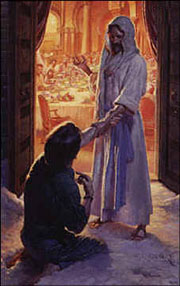 'The most effective preaching comes from those who embody the things they are saying. They are their message. Christians need to look like what they are talking about. It is people who communicate primarily, not words or ideas. Authenticity gets across. deep down in side people, what communicates now is basically personal authenticity.' That is Christlikeness.
 “I don’t think we do parson.” said one. They continued counting.








1 Comments:
At 10/30/2008 10:50 AM, The Bosom Serpent said…
I have had this discussion many times with someone who is very near and dear to me. They seem to believe that prayer is enough, that God requires no other action on our part.
God could intervene and do everything we want done but he probably won't. I agree we need to be about His business, following up our prayer requests with action.
It is often though us that God performs his miracles, answers prayer requests and provides us with oportunities to see if we will love our enemies as our self. Prayer and faith are not passive concepts, both require some overt act on our part.
Post a Comment
<< Home