Irenic Thoughts

Irenic. The word means peaceful. This web log (or blog) exists to create an ongoing, and hopefully peaceful, series of comments on the life of King of Peace Episcopal Church. This is not a closed community. You are highly encouraged to comment on any post or to send your own posts.

1/01/2010

Real Change

Hope alone is to be called "realistic," because it alone takes seriously the possibilities with which all reality is fraught. It does not take things as they happen to stand or to lie, but as progressing, moving things with possibilities of change.
—Jürgen Moltmann (1926- ), Theology of Hope

Labels: ,

0 Comments:

Post a Comment

<< Home

12/30/2009

The Existence of God

It is as impossible for man to demonstrate the existence of God as it would be for even Sherlock Holmes to demonstrate the existence of Arthur Conan Doyle.
—Frederick Buechner (1926- )

My argument against God was that the universe seemed so cruel and unjust. But how had I got this idea of just and unjust? A man does not call a line crooked unless he has some idea of a straight line. What was I comparing this universe with when I called it unjust? If the whole show was bad and senseless from A to Z, so to speak, why did I, who was supposed to be part of the show, find myself in such a violent reaction against it?... Of course I could have given up my idea of justice by saying it was nothing but a private idea of my own. But if i did that, then my argument against God collapsed too--for the argument depended on saying the world was really unjust, not simply that it did not happen to please my fancies. Thus, in the very act of trying to prove that God did not exist - in other words, that the whole of reality was senseless - I found I was forced to assume that one part of reality - namely my idea of justice - was full of sense. If the whole universe has no meaning, we should never have found out that it has no meaning: just as, if there were no light in the universe and therefore no creatures with eyes, we should never have known it was dark. Dark would be without meaning.
—C.S. Lewis (1898-1963)

If God were small enough to be understood, He would not be big enough to be worshiped.
—Evelyn Underhill (1875-1941)

Labels:

0 Comments:

Post a Comment

<< Home

12/28/2009

The Work of Christmas

When the song of the angels is stilled,
when the star in the sky is gone,
when the kings and princes are home,
when the shepherds are back with their flocks,
the work of Christmas begins:
to find the lost,
to heal the broken,
to feed the hungry,
to release the prisoner,
to rebuild the nations,
to bring peace among the people,
to make music in the heart.
—Howard Thurman

Labels:

0 Comments:

Post a Comment

<< Home

12/08/2009

Lord, Purge Our Eyes to See


Lord, purge our eyes to see
Within the seed
a tree,
Within the glowing egg,
a bird,
Within the shroud,
a butterfly.
Till, taught by such we see,
Beyond all creatures,
Thee.
—Christina Rossetti (1830-1894)

Labels: ,

2 Comments:

  • At 12/08/2009 5:53 AM, Anonymous Kelly said…

    I would click the "LIKE" button on this if blogs had them! :)

     
  • At 12/09/2009 12:04 PM, Anonymous Anonymous said…

    Didn't Christina Rossetti write the words to "In the Bleak Mid-Winter"? If your readers aren't familar with it, I suggest that they look it up, it's beautiful.


Post a Comment

<< Home

11/29/2009

Incarnate for Us

Advent, like its cousin Lent, is a season for prayer and reformation of our hearts. Since it comes at winter time, fire is a fitting sign to help us celebrate Advent…If Christ is to come more fully into our lives this Christmas, if God is to become really incarnate for us, then fire will have to be present in our prayer. Our worship and devotion will have to stoke the kind of fire in our souls that can truly change our hearts. Ours is a great responsibility not to waste this Advent time.
—Fire of Advent, from Edward Hays, A Pilgrim’s Almanac


King of Peace's Advent materials are online here: Advent Resources and we also have a very popular PDF file in our archives: Celebrating Advent in the Home which includes a simple Advent wreath service for use each evenign between now and Christmas.

Labels: ,

0 Comments:

Post a Comment

<< Home

11/22/2009

What to Expect in Heaven

Early in his ministry, Billy Graham went to a small town Baptist church to preach a revival. He needed to mail a letter and so asked a boy on the street where he could find the post office. The boy gave him the directions and Graham, wanting to be concerned about the souls of all he met told him, “If you’ll come to the Baptist Church this evening, you can hear me telling everyone how to get to heaven.” Graham loves to tell of the boy’s reply, “I don’t think I’ll be there. You don’t even know your way to the post office.”

If I ever reach heaven I expect to find three wonders there: first, to meet some I had not thought to see there; second, to miss some I had expected to see there; and third, the greatest wonder of all, to find myself there.
—John Newton (1725-1807) author of the hymn "Amazing Grace"

Labels:

1 Comments:

Post a Comment

<< Home

11/18/2009

Keep short accounts

Years ago a wise woman instructed me to keep short accounts with the Lord as a path to grow in God’s ways. By bringing my sins before him on a regular basis, I stayed current in my relationship with him, not allowing offenses to mount up inside me. Then as I consistently sought the Lord for counsel through his Word, prayer, confession, and fellowship, I was free to become more familiar with the sound of his nurturing voice, which protected me from disparaging influences like the adversary’s screeches. My friends advice has held me in good spiritual stead.
—Patsy Clairmont, Mending Your Heart in a Broken World

Labels:

0 Comments:

Post a Comment

<< Home

11/17/2009

The daily and the mundane

The Christian creeds used to seem like a ‘grocery list’ to me, and I found them very difficult to incorporate into my fledgling faith, as I made my way back to church after twenty years away. But now I see them as an admirably compact form of storytelling, and this makes me glad, for story places the creeds in the realm of the daily. It is in ordinary life that our stories unfold, tales of conceiving, bearing and giving birth, or trial and death and rising to new life out of the ashes of the old. Stories of annunciation, incarnation, resurrection, and the spirit, the giver of life, who has spoken through the prophets and enlivens our faith.

As wondrous as these mysteries are, Christianity is inescapably down-to-earth and incarnational—I say ‘inescapably,’ as most of us, at one time or another, try to avoid the implications of incarnational faith. The Christian religion asks us to place our trust not in ideas, and certainly not in ideologies, but in a God who was vulnerable enough to become human and die, and who desires to be present to us in our everyday circumstances. And because we are human, it is in the realm of the daily and the mundane that we must find out way to God.
—Kathleen Norris, The Quotidian Mysteries

Labels: ,

0 Comments:

Post a Comment

<< Home

11/15/2009

Faithfulness

Briton Roviere's painting of the jailed poacher and his faithful dog
The fruits of the Spirit get less and less showy as we go on. Faithfulness means continuing quietly with the job we have been given, in the situation where we have been placed; not yielding to the restless desire for change. It means tending the lamp quietly for God without wondering how much longer it has got to go on. Steady, unsensational driving, taking good care of the car. A Lot of the road to heaven has to be taken at thirty miles per hour. It means keeping everything in your charge in good order for love’s sake, rubbing up the silver, polishing the glass even though you know the Master will not be looking round the pantry next weekend. If your life is really part of the apparatus of the Spirit, that is the sort of life it must be. You have got to be the sort of cat who can be left alone with the canary; the sort of dog who follows, hungry and thirsty but tail up to the end of the day.

Faithfulness and Goodness—they are doggy qualities. Fancy that as a Fruit of the Spirit! But then the Spirit is Love, and doggy love is a very good sort of love, humble and selfless and enduring.
—Evelyn Underhill (1875-1941) The Fruits of the Spirit

Labels:

1 Comments:

  • At 4/01/2011 11:11 AM, Blogger Irmgarde said…

    Hope you don't mind. Used this image as an illustration for post today:

    http://irmgardebrown.com/2011/04/01/cant-disown-himself/


Post a Comment

<< Home

11/08/2009

God actually likes you

A lot of people feel, "God loves me because he has to. But does he like me?" God actually likes you. He made you, and he’s got a beautiful purpose for your life.
—Luis Palau

Labels:

0 Comments:

Post a Comment

<< Home

11/04/2009

What Will Matter Most?

When you are in the final days of your life, what will you want?

Will you hug that college degree in the walnut frame? Will you ask to be carried to the garage so you can sit in your car? Will you find comfort in rereading your financial statement? Of course not. What will matter then will be people. If relationships will matter most then, shouldn't they matter most now?
—Max Lucado

Labels:

0 Comments:

Post a Comment

<< Home

10/25/2009

Making the Sabbath Holy

Anybody can observe the Sabbath,
but making it holy surely takes the rest of the week.
—Alice Walker (1944- )

Labels:

0 Comments:

Post a Comment

<< Home

10/22/2009

All that bear me evil will

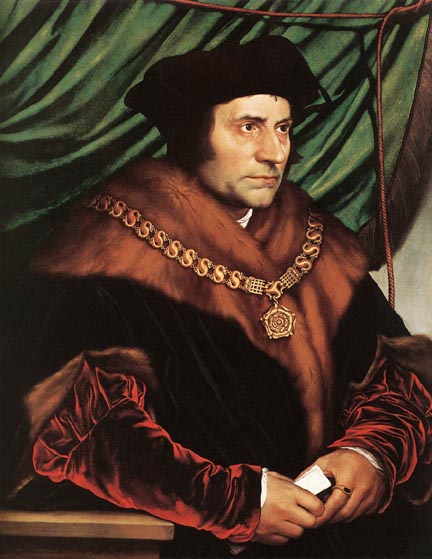
The following prayer is ascribed to Thomas More (1478-1535). He may or may not have written it, but as he said at the trial which condemned him to death that he hoped to share the joys of heaven with those who condemned him as Saints Stephen and Paul are together there, then it is safe to say the sentiment is his.

The prayer is to pray well for those who bear us evil will and would harm us, which is a very Jesus thing to do:
Almighty God, have mercy on [insert name] and [insert name] and on all that bear me evil will, and would me harm, and their faults and mine together, by such easy, tender, merciful means as Thine infinite wisdom best can divine, vouchsafe to amend and redress, and make us saved souls in heaven together where we may ever live and love together with thee and they blessed saints, O glorious Trinity, for the bitter passion of our sweet saviour Christ, amen.

Labels:

4 Comments:

  • At 10/22/2009 8:16 AM, Anonymous Anonymous said…

    How can I pray for love from God to someone who hurts me? How can I wish them peace in heaven when they give me Hell on earth??

     
  • At 10/22/2009 10:00 PM, Anonymous Kelly said…

    I understand that this is what is asked of us as Christians, but, Anonymous, you're right. I still don't completely comprehend how the Amish community forgave the murders of their children in the school house a few years back. I so admire them!

    Maybe we should pray the prayer anyway. It doesn't mean that God will ignore justice being served. Maybe the prayer is a means to self healing through forgivenss. Maybe the prayer is really for you.

     
  • At 10/23/2009 6:23 AM, Blogger King of Peace said…

    I agree Kelly. I don't think any one of us is likely to be able to pray this prayer as a heartfelt wish, but I do suspect that praying the prayer could help effect that change within just the same. Yet, forgiveness is not usually an act, but a process, which begins with an act of will.

     
  • At 10/23/2009 8:56 AM, Anonymous Anonymous said…

    I just don't understand, I'm trying to but how do I forgive for the pain given? How do I forgive every time he is mad and...When he is the man he is.

    I can’t forgive the man he is, I can’t pray for his peace in heaven when he does not care that he is hurting another, the one he is supposed to love without condition.
    I’m just tired is all; thank you both for your comments.


Post a Comment

<< Home

10/21/2009

The Gift of Children

Children are a wonderful gift. They have an extraordinary capacity to see into the heart of things and to expose sham and humbug for what they are.
—Desmond Tutu (1931- )

Labels: ,

0 Comments:

Post a Comment

<< Home

10/14/2009

Agnostic


Agnostic comes from the Greek meaning "Not Know." It is the decision that whatever is being considered is something one can't know. Yann Martel wrote about having a problem with those who remain agnostic in his novel Life of Pi,
I'll be honest about it. It is not atheists who get stuck in my craw, but agnostics. Doubt is useful for a while. We must all pass through the garden of Gethsemane. If Christ played with doubt, so must we. If Christ spent an anguished night in prayer, if He burst out from the Cross, "My God, my God, why have you forsaken me?" then surely we are also permitted to doubt. But we must move on. To choose doubt as a philosophy of life is akin to choosing immobility as a means of transportation.
Jean Paul SartreThe French philosopher (and atheist) Jean Paul Sartre taught that to do nothing is itself a choice. And so remaining agnostic, continually saying that one can not know whether there is a God is to effectively be an atheist.

Jesus comes into our lives as a point of decision. Was he God made man? If this is possible, it is a fact about which any person has a stake in not remaining neutral. But not to decide Jesus is the Son of God is the same as deciding he is not. If the early church got it right and Jesus of Nazareth was and is the Son of God, then there is an obligation in terms of how we live our lives. Right?

What did it take for you to believe in the truth claims of Christianity? If you don't yet, what would it take?

Is this something about which one can or should remain neutral? Can one be Agnostic without effectively being an atheist? Does the difference matter?

peace,
Frank+
The Rev. Frank Logue, Pastor

Labels: ,

3 Comments:

  • At 10/14/2009 6:41 AM, Anonymous Kelly said…

    Here's one for you: My brother in law calls himself agnostic, but admittedly believes God exists. What he's not sure about is the physical , ie Jesus,the Bible, religion, etc...

    Obviously he is not a Christian or of any religion. (He has the heart and actions of a Christian though. :) )

    So, what would we call him? A backwards agnostic? Sideways maybe? Is the fact that he can grasp the abstract over the physical considered faith?

     
  • At 10/14/2009 1:30 PM, Blogger The Bosom Serpent said…

    Did not Christ Himself say that we must be for or against him and that lukewarm we could not be? To be lukewarm is to be cold. I think many agnostics say they doubt because they are trying to hedge their bets. To say, "Yes I believe" would mean they would have to change their lives, their actions, their relationships. To believe, to act in faith requires courage because we are stepping out into the realm where science and reason do not have all the answers. Perhaps they don't realize how much believers doubt their faith. I constantly find myself questioning my decisions, church practices, church traditions, the possibility of a virgin birth, of a life lived without sin.

    The antidote to the doubt is the changes I see in myself. As an agnostic I could only chalk it up to me becoming a better person through my own actions. As I believer I know it is Christ in me making the changes.

    I pray that those on the proverbial fence would realize it is not about them..

     
  • At 10/14/2009 5:49 PM, Anonymous cmbaxrtersr said…

    I was in the Episcopal church before I was born. However that did not make me a Christian. In my 50's I woke up with such filth in my head, and could not dispel it. And Scriptures says flee from evil, so I went out side at about 3:AM, and ran from there, one sock on and pants and nothing else, and pleaded for this anguesh in my head to stop, and I could not even remember the name of Jesus. But the name of Jesus came to me and I pleaded for the pain to stop. I came to my senses in the cemetery draped over a tomb stone, cut up and bleeding. My feet packed with sand spurs. I leaned up against a cool tomb stone till daylight and got enough of the sand spurs out of my feet to make it home. If the filth in my head had not stopped, I would have agreed to anything. What about them what do not believe, and this happened to them, where would they end up. I'll follow Jesus so I will never have to find out.

    C.M.Baxter.


Post a Comment

<< Home

10/13/2009

Famous Last Words

Here are some recorded dying words of noted people:

St. John Chrysostom (347-407) was the most famous preacher of his day. He preached an Easter sermon read each year to this day in orthodox churches. His final sermon was also his last words. He took to the pulpit and said simply,
Glory to God for all things!
John Newton, former slave trader, turned minister who wrote Amazing Grace:
I am still in the land of the dying; I shall be in the land of the living soon.
Augustus Montague Toplady (1710-1778) wrote the hymn Roacks of Ages and died saying,
No mortal man can live after the glories which God has manifested to my soul.
Clergyman Henry Ward Beecher (1813-1887) said:
Now comes the mystery.
Sir Isaac Newton (1642-1727), the great scientist said,
I don't know what I may seem to the world. But as to myself I seem to have been only like a boy playing on the seashore and diverting myself now and then finding a smoother pebble or a prettier shell than the ordinary, whilst the great ocean of truth lay all undiscovered before me.
The philosopher and economist Karl Marx (1818-1883) told his housekeeper as he lay dying,
Go on, get out - last words are for fools who haven't said enough.
The writer W. Somerset Maugham (1874-1965) said,
Dying is a very dull and dreary affair. And my advice to you is to have nothing whatever to do with it.
The Mexican revolutionary Pancho Villa (1878-1923) did not get his last wish as his final words were:
Don't let it end like this. Tell them I said something…
The first martyr, Deacon Stephen, said as he was stoned to death,
Lord Jesus, receive my spirit....Lord, do not hold this sin against them.
Jesus last words in Luke's Gospel are,
Father, into thy hands I commend my spirit.
Though maybe all this is beside the point as Maya Angelou put it:
I've Learned That People Will Forget What You Said, People Will Forget What You Did, but People Will Never Forget How You Made Them Feel.
Thankfully she us still with us and those are not her final words, as fitting as they are.

Labels:

1 Comments:

  • At 10/13/2009 8:46 AM, Anonymous Anonymous said…

    Some last words of others...

    "See in what peace a Christian can die". Joseph Addison

    "I have tried so hard to do the right". Grover Cleveland

    "Adieu, mes amis. Je vais la gloire". (Goodbye my friends, I go to glory). Isadora Duncan

    "Either that wallpaper goes, or I do". Oscar Wilde


Post a Comment

<< Home

10/11/2009

Jesus' spirit in me...

It is no good giving me a play like Hamlet or King Lear and telling me to write a play like that. Shakespeare could do it, I can't.

And it is no good showing me a life like the life of Jesus and telling me to live a life like that. Jesus could do it, I can't.

But if the genius of Shakespeare could come and live in me, then I could write plays like this. And if the Spirit could come into me, then I could live a life like His.
—William Temple (1881-1944), Archbishop of Canterbury

Labels: ,

0 Comments:

Post a Comment

<< Home

10/08/2009

Better Justice

Forgiveness is an act of faith. By forgiving another, I am trusting that God is a better justice-maker than I am. By forgiving, I release my own right to get even and leave all issues of fairness of God to work out. I leave in God's hands the scales that must balance justice and mercy.
—Philip Yancey

Labels: , ,

0 Comments:

Post a Comment

<< Home

10/04/2009

Peace and Joy

Compassion is sometimes the fatal capacity for feeling what it is like to live inside somebody else's skin. It is the knowledge that there can never really be any peace and joy for me until there is peace and joy finally for you too.
—Frederick Buechner

Labels: ,

0 Comments:

Post a Comment

<< Home

9/29/2009

What Love Looks Like

What does love look like? It has the hands to help others. It has the feet to hasten to the poor and needy. It has eyes to see misery and want. It has the ears to hear the sighs and sorrows of men. That is what love looks like.
—Augustine of Hippo (354-430)

Labels: , ,

0 Comments:

Post a Comment

<< Home