Who would they blame?
In this weekend's Gospel reading Jesus meets a man living among the tombs. We are told that he is possessed of so many demons that they call themselves Legion. Jesus sends the demons into a herd of pigs who promptly run into the sea. Luke tells us,
peace,
Frank+
The Rev. Frank Logue, Pastor
When the swineherds saw what had happened, they ran off and told it in the city and in the country. Then people came out to see what had happened, and when they came to Jesus, they found the man from whom the demons had gone sitting at the feet of Jesus, clothed and in his right mind. And they were afraid. Those who had seen it told them how the one who had been possessed by demons had been healed. Then all the people of the surrounding country of the Gerasenes asked Jesus to leave them; for they were seized with great fear.The Preaching Helps page of the United Methodist Church's General Board of Discipleship offers that,
Often a problem someone in recovery faces is that their friends and family are accustomed to him or her as a drug addict or alcoholic and don't know how to deal with healing. I think that without meaning to, we can put a stumbling block in front of those trying to change their lives by not giving them room to be transformed. What do you think?The healing of the Gerasene demoniac was a major event that frightened the local people. They were, in fact, so frightened that they asked Jesus to leave them. When the former demoniac, now in his right mind, begged to go with Jesus, Jesus commanded him to remain in that town as a witness. Mark's account confirms that the former demoniac did just as Jesus suggested. He proclaimed the great things that Jesus had done for him, and those who heard him were amazed (Mark 5:20). What profound lessons do we learn from this?
Can't live with 'em and can't live without 'em?—I once heard a preacher speak harshly about the pig farmers' request for Jesus to leave. He spoke of the issue in economic terms. It is quite true that they suffered economically, and maybe they did want the troublemaker to leave before they suffered any further losses. But what if there were something more familiar at play? What if Legion, the man in his demonized state, fulfilled a function in his local community? What would they do without their resident demon? Who would they blame for things that went awry; how would they justify their nighttime fears without Legion? Humans often find it more comfortable to live with their demons than to exorcise them and live in peace. I wonder if they invented, or created another Legion after this man was healed?
peace,
Frank+
The Rev. Frank Logue, Pastor
Labels: healing
posted by King of Peace @ Saturday, June 23, 2007
0 comments


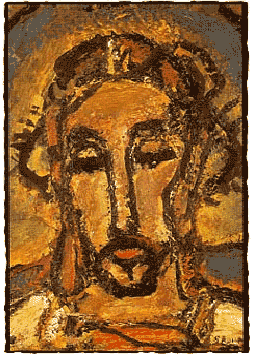 What will happen is that I will go in on Sunday morning in full touch with the absurdity of the situation, feeling like a faker and a hypocrite. Then, during Eucharist, I will lay hands on the first head that comes before me, and I will say the prayer for healing. And I will be completely present in the moment, which is transported outside of space and time while still being firmly rooted in the here and now, and God's grace will flow through me. I will do this again and again, for each person who comes to me. When it is over, I will realize once again why I continue in this ministry. I am not a faker and a hypocrite. I do not have healing power. All I can do is humble myself, put myself into the background, and let God work through me.
 On the other hand, it would be very easy to misuse the concept of the wounded healer by defending a form of spiritual exhibitionism. A minister who talks in the pulpit about his own personal problems is of no help to the congregation...Making one's own wounds a source of healing, therefore, does not call for a sharing of superficial personal pains but for a constant willingness to see one's own pain and suffering as rising from the depth of the human condition which all men share.










0 Comments:
Post a Comment
<< Home