Irenic Thoughts

Irenic. The word means peaceful. This web log (or blog) exists to create an ongoing, and hopefully peaceful, series of comments on the life of King of Peace Episcopal Church. This is not a closed community. You are highly encouraged to comment on any post or to send your own posts.

6/15/2010

There are no goodbyes

The following is my religion column for the Friday, June 18, 2010 issue of the Tribune & Georgia.

When my wife, Victoria, and I hiked the Appalachian Trail, we enjoyed a lot of single-serving friendships. As we were hiking north for six months, we often ran into someone hiking south. We would sometimes just nod and keep walking, but more typically a brief conversation would ensue. And in these brief snippets we would often just learn the basics of who someone was, where they were coming from and how far they were going.

We did use these short meetings to find out about folks further up ahead and to share news of others we had passed along the way. Then one such single serving friendship was transformative. A hiker I will never forget, whose name we never heard appeared out of a dense fog one morning to say that he decided that these brief exchanges didn’t have to start at the beginning “Hi, I’m Frank and this is my wife, Victoria.” Instead, we could begin in the middle. Then without a name or other introduction, he shared how the morning was more science fiction than trail fact and people just appeared from the fog as if transported from no where. With that, he vanished into that same fog and we learned to take conversations further, faster if we wanted to really benefit from our short-lived exchanges in days full of hiking. That briefest of conversations left us changed for the better.

This is my farewell column for the Tribune and Georgian and as such, the last brief conversation we will have through this newspaper. I am thankful for you, gentle readers. Many of you have been with me for the more than 200 columns I have written. We have been through a lot together since my first column “How much sin is too much to forgive?” debuted in this space on June 22, 2001 to wonder aloud about American terrorist Timothy McVeigh’s last minute confession.

Since then, the worldwide tragedy of September 11 and smaller, closer to home grief of dealing with the paper mill closing and taking with it hundreds of jobs as well as the many other events large and small have taken up our thoughts and been in our prayers. We have considered cloning, stem cell research, just war theory and the ethics of torture alongside forgiveness, stewardship and how to live more fully into the faith that is in us.

Writing a column can be a one-sided affair, with me off writing in my little office in my home in Sugarmill and y’all reading wherever you make time for the paper. There is no reason that the writing and the reading need intersect. But it has never worked that way in Camden County. I have often been stopped at Publix or WalMart or Blockbuster to continue a conversation begun in this column. Many readers have shared with me favorite thoughts, including the columns that were hung on the refrigerator or laminated. I have also enjoyed it when someone emailed to let me know how the follow-up discussion went in a Bible Study at their church.

Rather than a column in which I write and you read, the column evolved into something more like a conversation. The word conversation comes from Latin root, which literally means “to turn about with.” The same root gives us “conversion.” Real conversation is a genuine back and forth in which those conversing change direction together. I thank you for being conversation partners with me and for the ways you have helped me to change direction over time. I hope that even if you haven’t agreed with me, that you were given pause to think about your own beliefs.

In this idea of conversion through conversation, we see that it has not just been a conversation between writer and reader, but the Holy Spirit has been in the conversation as well. For my words alone do not have the power of conversion unless God uses my words to get one’s attention and then do something with them beyond the ability of words alone.

This is just like what happens in a sermon. Each week, more than 100 pastors prayerfully consider how to share the Gospel of Jesus Christ with those in the pews in Camden County. Certainly the God-given skill of the preacher comes into play. But even more important is what God does with the words as they are spoken.

I have never spoken to a pastor about preaching who has not been able to tell of a time when someone referred to something not said outright in the sermon, which proved significant to the hearer. What is heard is not identical with what is preached and thanks be to God that this is so. The rest of what happens in sermon (and the most important part) is what the Holy Spirit does in the heart of the hearer. And so it is with the readers touched by something they read from me in this space.

Now this conversation comes to an end. I begin work July 1 as Canon for Congregational Ministries of the Episcopal Diocese of Georgia. That mouthful of words means that I will share with our bishop in the task of tending the clergy and congregations of south Georgia. I feel called by God to this vocation. Yet every call to something is a call away from something else. In part, it is a call away from this conversation carried on through the newspaper. Someone new will take over this column, just as I took up where Bob Moon left off. The conversation continues with a new person writing alongside my conversation partner Donna Grice.

But this is not goodbye. There is no such thing as goodbye in the Kingdom of God, in the sense of a final parting. For as the faith we have is not in vain, we will see one another again, if not on earth, then in heaven. It is only farewell we say, or ta ta for now. For if the words I have written have been used by God to good effect, then we will be together again.

(The Rev. Frank Logue was the founding pastor of King of Peace Episcopal Church in Kingsland, serving that congregation from its beginning in 2000 until this past Sunday.)

Labels:

5 Comments:

  • At 9/04/2018 8:30 AM, Blogger Unknown said…

    There is no such thing as goodbye in the Kingdom of God, in the sense of a final parting. For as the faith we have is not in vain, we will see one another again, if not on earth, then in heaven. It is only farewell we say, or ta ta for now.
    Event Planning Template

     
  • At 11/17/2018 10:08 AM, Blogger John Hilston said…

    There should be no good byes, that may made life easier.
    cheap heathrow airport parking

     
  • At 6/19/2019 12:06 AM, Blogger Đại Lý Thiết Bị Vệ Sinh Cao Cấp Chính Hãng said…

    Since I'm assuming you're turning over the Irenic Thoughts keyboard to your successor or designee, where are you blogging next? believe this change sends a very powerful message and is certainly part of the antidote to the complete commercialization of Advent.

    ============================================================

    Inax
    TOTO
    Caesar
    Viglacera

     
  • At 12/22/2021 12:56 AM, Blogger Pedro Taylor ✅ said…

    Investing online has been a main source of income, that's why knowledge plays a very important role in humanity, you don't need to over work yourself for money.All you need is the right information, and you could build your own wealth from the comfort of your home!Binary trading is dependent on timely signals, assets or controlled strategies which when mastered increases chance of winning up to 90%-100% with trading. It’s possible to earn $10,000 to $20,000 trading weekly-monthly in cryptocurrency(bitcoin) investment,just get in contact with Mr Bernie Doran my broker. I had almost given up on everything about binary trading and never getting my lost funds back, till i met with him, with his help and guidance now i have my lost funds back to my bank account, gained more profit and I can now trade successfully with his profitable strategies and software!!
    Reach out to him on Telegram: (@BERNIE_DORAN_FX) t.me/bernie_doran_fx or +1(424)285-0682 for inquires

     
  • At 2/27/2026 2:14 AM, Blogger peter parker said…

    Fenway Wears stands for originality, comfort, and forward-thinking fashion each piece is created to enhance presence and personality because real style leaves a lasting impression.


Post a Comment

<< Home

6/04/2010

Engineering, Faith and the Master Plan


My dad, Tom Logue, is at center above in a photo for Dixie Contractor magazine taken for an article on his innovative work in interstate construction tested in paving I-20.

I love construction. That’s why I have been more intrigued and less bothered by the construction project many of us in Camden County have been driving through lately as they rework the intersection of Laurel Island Parkway and Gross Road.

I am fascinated not just by the end product. I enjoy watching how the engineers plan the order of the project. I wonder at times if they know what they are up to and enjoy wondering what comes next and why this or that hasn’t been done yet.

I come by this love of watching a construction project come together honestly. My dad was a civil engineer who spent his life in building roads, bridges and tunnels. His parents were both paving contractors who spent their careers paving primarily roads and parking lots. I love few smells like that of fresh asphalt. I am reminded of the golden days of my preschool youth when I rode with my grandfather to see projects underway. Along the way, I picked up an appreciation for the proper sequence being essential to a project.

The Gospel of John shows an important sequence in the chain of events that leads to Jesus’ death on a cross. Even what can first seem like some random happening in Jesus’ life, is an essential step. For example, once Jesus was just outside of Jerusalem in the village of Bethany. He was at the home of the siblings Mary, Martha and Lazarus. Lazarus was Jesus’ good friend who died. Jesus wept at his tomb and then raised Lazarus from the dead. John’s Gospel makes it clear that raising Lazarus from the dead set in motion the sequence of events that leads Jesus to Calvary.

Lazarus’ death was well attested. His being raised to new life, therefore, caused a big stir in the village of Bethany and spilled over into nearby Jerusalem just as pilgrims were flooding into town for the Passover.

Mary of Bethany made an extravagant thank offering to Jesus. She poured out a pound of perfume on Jesus’ feet, which she wiped with her hair. The perfume was worth 300 denarii. A denarii was the usual pay for a day of work for a common laborer. Today, a minimum wage worker earns $17,400 in 300 eight-hour days.

John says Judas Iscariot proclaimed that the perfume should have been sold and the money given to the poor. Judas’ anger over the waste of perfume was significant. Within a week of this celebration as Mary, Martha and Lazarus’ home, Jesus would be dead and buried. The betrayal later that week would require this sort of event preceding it.

We can see with hindsight how God was working through human choice to bring Jesus’ life and ministry to its conclusion. Like a vast construction project, there was a sequence that was essential. The high priest Caiaphas already stated that Jesus was a threat to Israel’s tenuous relationship with Rome and “It is better for you to have one man die for the people than to have the whole nation destroyed.”

Caiaphas placed a call for anyone who was connected to Jesus to help them find him away from the crowds. Next someone would need to turn against Jesus and betray him, then others would flee, then he would die, and finally he would rise to new life. I jump ahead of the story just to say that there is a trajectory here. God’s plan is working through human actions, and while we can wreak havoc, cause pain, and even thwart God’s will for our own lives, God’s plan proceeds.

It’s not that God made Judas betray Jesus, but that Judas was always the one who would choose willingly to do so. God’s view takes in all time as well as place and so God could see that Judas always would make that choice.

None of this is merely academic. How we live our lives day to day depends on these very issues. There are times when you or I beat our heads against a wall wondering why God doesn’t make this or that thing happen. Yet, with the wisdom of hindsight we can see again and again how something else needed to occur first. God is working on the issue, but there are steps and the steps are not incidental, but essential to the ultimate success of that very thing God wills. Often we are looking for a “yes” or “no” answer from God when the true answer is “not yet.”

Equally often, there are ways in which, through our own free will or that of others lots of unnecessary suffering comes into the world. This is not because God willed it or wants it, but because love demands choice we have the ability to choose the evil as well as the good. As surely as Judas’ choice to betray led not just to death, but also resurrection, so too can and will God weave all things together for the good for those who love Him.

I can go to the construction site at Laurel Island and pull every surveyor’s stake out of the ground. It will not help the contractors who need the stakes to make the planned road widening a reality. Yet even if I were to pull all the stakes, the job will get completed. I can come back day after day to pull the stakes or otherwise try to sabotage their efforts. But I grew up with contractors and I know that they will see the job through to completion.

Like some vast construction project with plans unseen by us, God works through and in spite of human choices toward an ultimate plan. We can make our own choices, live out the consequences of our own actions, but we can not thwart God’s ultimate plans or purposes any more than individual choices could have caused or prevented either Good Friday or Easter Sunday if they had not been God’s will.

While the master engineer leaves much to your choice, the master plan is God’s alone. He is working out that plan of salvation in and through our actions. Our choice is not whether God will redeem. Our choice is whether we are redeemed and whether we will live into that redemption through our own actions and take our part in working things together for the good.

The above essay is today's religion column for the Tribune & Georgian.

Labels:

1 Comments:

  • At 6/05/2010 11:33 PM, Blogger Rod said…

    Great Post.
    It is all about choice and so many times even with the well informed plan that God has blueprinted for us, out of our own selfishness we decide to add or take away. I bet that kind of stuff drives you nuts on the job site.

    But because God is such a loving God he does give us every oppertunity to get it right. Every oppertunity to recive salvation. Judas failed, I pray we don't.

    In my newly released book titled "the sword and the Spear" I take readers to that very point of decision time and time again. They will have to decide to either stay defeated by the spear of Satan or become a warrior and pick up the mighty Sword of God.
    check it out if you get the chance.

    http://bit.ly/cfz9s2

    God bless you,
    Pastor Rod


Post a Comment

<< Home

5/21/2010

The Power of Disturbing Faith

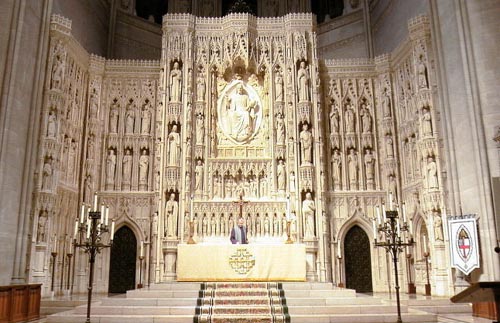
The high altar and reredos at Washington National Cathedral

Great cathedrals are by meticulous design, sermons in stone. From the overall architecture to every detail, a cathedral speaks of our faith in Jesus Christ. The sixth largest cathedral in the world, Washington National Cathedral is one such sermon in stone and what they placed at the center of the center of the church speaks to what is central to the Christian faith.

Within its inspiring Gothic edifice flanked with flying buttresses, the building houses a breathtaking array of architectural sculpture, wood carving, mosaics, leaded glass, artistic metal work, and many other works of art, including more than 200 stained glass windows. The focal point of the entire design is the high altar. Behind the altar is an intricately carved back wall piece called a reredos. The wall carving boasts 110 saints, prophets, martyrs, angels, and faithful Christians and at the center is Christ in glory—his right hand is held up making a gesture of blessing while his left hand holds a cross-topped globe signifying his sovereignty over the entire world.

The most prominent statues flanking this central figure of Christ in glory are not the apostles or other saints, but six allegorical figures. The statues show persons who are hungry, thirsty, in need of a place to stay, naked, sick and imprisoned. The persons most prominently close to Christ right at the focal point of the entire 150,000 ton cathedral are those Jesus refers to in his parable of the last judgment.
Jesus said when he comes in glory to judge the world there will be a pop quiz of sorts. But on this test, you will find no fine points of doctrine. Rather than sorting out the fine points of exactly what you believed, Jesus will want to know how you treated the least of those with whom you came in contact.

Jesus said that the faithful will be told in judgment, “Come, you that are blessed by my Father, inherit the kingdom prepared for you from the foundation of the world; for I was hungry and you gave me food, I was thirsty and you gave me something to drink, I was a stranger and you welcomed me, I was naked and you gave me clothing, I was sick and you took care of me, I was in prison and you visited me.”

The righteous will be unaware of the times they did these things, for they did not do them to impress Jesus, it just came naturally. Then, the unrighteous will discover that they never did any of these things for Jesus. It wasn’t that they meant to slight God, they just didn’t understand that, “just as you did not do it to one of the least of these, you did not do it to me.”

How would Jesus judge your life now? What about others around you? There’s the question, “If you were arrested for being a Christian, would there be enough evidence to convict you?” What if they through out church attendance as proof of your faith? Could you still get convicted as a Christian?

But what happened to faith? Don’t we teach that it is your faith that counts? Yes. But scripture also teaches that if we really have faith, our faith will be active. James wrote, “Faith with out works is dead.” And “show me your faith without the works, and I will show you my faith by my works.”

We show what we believe by the things we do. If what you read in the Bible doesn’t bother you on occasion, then you aren’t reading your Bible enough, for there is disturbing stuff in scripture. Scripture will disturb you enough to get you to want to reach out in love to those around you.

Reading your Bible, taking part in the worship of your church and praying will disturb you. They are supposed to disturb you. These practices of the Christian faith will move you from knowing about Jesus to knowing Jesus. And once we know Jesus, it is more and more difficult not to live into the faith we profess. Just believing is fine, but if you really believe, then you will also act.

Jesus wanted to know how your faith has disturbed you enough to get you to reach out to those who are hungry, thirsty, in need of a place to stay, naked, sick and imprisoned. Your checkbook and your calendar are your statements of faith. If how you spend your time, energy and money are no different from those who are not Christian, then in what sense are you Christian?

The carvings in Washington National Cathedral of the hungry, thirsty and naked are visible reminders that at the center of our faith in Jesus is Jesus teaching to not simply love God, but to love God and to love our neighbors as ourselves. The parable of the last judgment when sheep and goats are separated based on treatment of those in need shows this to be at the center of the Christian faith.

So the question commonly asked is applicable here, “When they drag you in to court for your faith in Jesus Christ, will there be enough evidence to convict you?” Jesus words in the parable of the sheep and the goats are not condemning, but fair warning. Think of Jesus’ parable of the judgment as a self test. If you ever wonder where you are on your spiritual journey, assess your life based on how you show the love Jesus’ has for those most in need. Jesus said that how you treat those in need reveals everything about where you stand before God.

If your faith has troubled you enough to change your life, it will show not in your concern for yourself, but in whether you have been disturbed enough to show love for others, even your enemies. This is Christianity. This is the faith that conquers even death. It begins with dying to yourself enough to see the world and those around you as God sees them. Find this idea disturbing? Good. It should be.

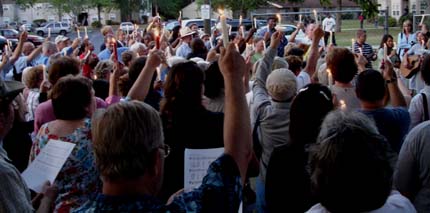
The above text is my religion column for today's Tribune & Georgia, which reminds me of this day three years ago (May 21, 2007) in which the community gathered in large numbers to pray at a dumpster in The Pines apartments because we were disturbed on behalf of our neighbors after a body was found there: Light in the Darkness

Labels:

0 Comments:

Post a Comment

<< Home

5/07/2010

Making Faith Real

If you see someone check the time on their watch, and walk up to that person moments later to ask, “What time is it?” What will that person do next?
  • tell you the current time? or
  • look at his or her watch again and then tell you the current time?
The answer is easy. Most of the time, the person will look at his or her watch a second time.
If you want someone to learn to tie a knot with a length of rope which of the following will work best:
  1. 1) tell the person how to tie the knot. For example say, “When tying a bowline, they must make a loop with the rope that forms something like a tree with a whole at its base, then pretend the opposite end of the rope is a rabbit. The rabbit goes out of the whole, around the tree and back into the whole, then pull the rope tight and you are done.” or
  2. 2) You give the same directions, but this time you take a rope and show the person the actions you are describing. or
  3. 3) You do everything in B, but now you get the person who is learning to tie the knot to actually take a rope in their own hands and do the actions alongside you, so that he or she ties the bowline while watching you both describe how to do it and tie the knot.
Once again. The answer is easy. Every human I know would learn better by doing the knot tying for his or her self rather than just hearing about it or watching it being done. That is how humans work best.

Sometimes in describing this means of learning, the term muscle memory is used. We say that doing the same action again and again gives you muscle memory. That is why a soldier drills taking apart a rifle and putting it back together over and over until he or she can do it with eyes closed or seemingly while asleep. The muscles remember the actions and taking apart a rifle and putting it back together becomes second nature.

The Book of James tells us that we are not just to be people who sit and listen to the Word of God, but we should also put the words into action. James calls it being a doer of the Word. James writes, “For is any are hearers of the word and not doers, they are like those who look at themselves in a mirror; for they look at themselves and, on going away, immediately forget what they were like” (James 1:23-24).

This is like looking at a watch and then moments later rechecking the watch if someone asks the time. You saw the time, but it didn’t sink in deep. Before you are ready to answer again, you have to check again. By comparison, James writes that those who are not “hearers who forget but doers who act—they will be blessed by their doing.”

First, you need to hear something that you should act on that comes from the Word of God. I will give you the shortest and best version of that I can. Jesus teaches that the essence of everything he taught is that we are to love the Lord our God with all our heart, mind, soul and strength and to love our neighbors as ourselves.

What would it be like to put that teaching of Jesus into action? There are several ways this could work, but we will take one that Jesus returned to over and over, loving your neighbor. Jesus taught that everyone in need is the neighbor you are to love. And as everyone is in need at some point, then everyone is your neighbor.

Let’s make it literal though. Let’s imagine that your literal next door neighbor is going through cancer treatment. You know that he usually cuts the grass himself and that there is no way his wife can do it. Sure, they probably could hire a lawn service, but who can afford that while going through cancer treatment. You walk next door and let them know that you would like to cut the grass until he gets cancer free and feeling better again. He will balk at the idea, but you insist. Then you start cutting his yard. That is a very concrete example of what I mean.

To add one more level to this, Jesus would say that this is all well and good, but if you only did this so others would see what a great guy you are then it is meaningless. If you just started cutting his lawn so that you could brag about it to others, then you were not doing it out of love. If you wave at all the neighbors as you mow to say, “Look how nice I am to mow this lawn,” and then go tell folks at work and the woman behind you in line at the grocery store how you are so nice to cut your neighbor’s grass, then your intentions are not in line with the action. But if you really are out there just caring and concerned about the guy next door who needed a hand, then you are being a doer of the word and not a hearer only.

Putting your faith into action with the right intention of heart will change you for the better. The more you put your faith into action, the more you develop the muscle memory to love your neighbor as yourself. This is why groups like Habitat for Humanity are crucial as they give us a place to make the idea of loving your neighbor real. But you can do the same thing by volunteering to be a scout leader, or by any one of a number of actions.

Notice what you are not doing. You are not doing good deeds to chalk up brownie points with God. You are not impressing God, or earning favor with God. What you are doing is teaching yourself by example. Look to Jesus life and teaching. Pattern your life after what he said and did as well as you can. And each time you take some concrete steps to actually live in to what Jesus’ taught; those teaching will become more real to you.

The above is my religion column for today's issue of the Tribune & Georgian.

Labels: ,

0 Comments:

Post a Comment

<< Home

4/23/2010

Christians Have an Essential Unity

There’s the joke that I have heard told with several different denominations inserted into the punch line. A person dies and goes to heaven. On the first-day-in-heaven tour, they see a high wall surrounding a portion of paradise. The person asks St. Peter (who is always the tour guide in jokes like this) why the wall is there. St. Peter motions the person off into the distance and then whispers, “That’s the area for the [insert name of denomination here]. They think they are the only ones here.”

It’s as if you can’t get into heaven if you don’t believe exactly what I believe. That sort of we-are-the-only-true-Christians attitude is a real turn off for folks who have not come to faith yet. Sometimes a non-Christian can get the idea that if Christians cannot even agree on what to believe, why should they bother to try to sort it out?

This attitude is a problem that Jesus saw coming. The night he was betrayed, Jesus prayed with his disciples. That prayer, recounted in John 17, ends with a prayer for “those who will believe in me through [the disciples’] word.”

That means us. We have come to believe in Jesus because of the word of the first disciples. Had they never gone out and told Jesus’ story, we never would have heard it. We believe today because of an unbroken chain of believers back to the time of those first disciples. So when Jesus prays for “those who will believe in me through their word,” Jesus is praying for those of us gathered here today and for all the Christians around the world.

Jesus prays, “that they (meaning us) may be one. As you, Father, are in me and I am in you, may they (Jesus is talking about us again) also be in us, so that the world may believe that you have sent me.” Jesus prayed for unity among all Christians. Jesus’ heart’s desire is that we may be one with God and through that oneness with the triune God we may be one with one another. This unity leads to Jesus’ true desire, that through our unity, the world may see and know that Jesus is God’s own Son, the savior of the world.

So what’s the answer? The end of denominations? A stop to all distinctions among Christian groups? If that were to happen, which denomination would we be? What exactly would we believe? How would we worship?

I believe the answer is in Jesus’ own prayer. Jesus prayed, “Father make them one as you and I are one that the world may believe.” If we are to be one as Jesus and the Father are one, then how are Jesus and the Father one? God is a Trinity of persons—one being, yet three distinct persons. God the Father, God the Son, and God the Holy Spirit are one and yet each unique. We, too, are to be unique persons, separate from one another and yet in communion with each other.

We are not all created just alike and so we will each approach God a little differently. Denominations allow us to express this diversity. Our various churches allow us each to find the best way for us to approach God within a loving community of fellow Christians. There is no need to break down the uniqueness found within various branches of the Christian faith. However, we must find some ways to show that we have an essential unity, even in our diversity.

The solution is not to squish all Christians into a one-sized-fits-all faith. The solution is to present an outward face that shows the world that we know that our similarities matter more than our differences. Churches are not in competition. Churches are allies in the cause of spreading the Christian Gospel. The Bible does not teach that all heaven rejoices when a person or family changes from one church to another. All heaven rejoices when someone trapped in a life of sin learns that God loves her or him, God wants what’s best for them, and God desires a relationship with them. A child of God coming to that knowledge is what makes all heaven rejoice. The more we show the world our unity as the Body of Christ, the more we prepare the way for more people to experience that life-changing encounter with Jesus Christ.

The above is my religion column for today's issue of the Tribune & Georgian. The same page of the paper carries news of King of Peace hosting a community-wide worship service for the May 6 National Day of Prayer with a multi-church choir singing Holden's Evening Prayer.

Labels:

1 Comments:

Post a Comment

<< Home

4/09/2010

Faith Like a Lion

Christianity is not just a thought or an idea, but a way of life. Faith in our Trinitarian God should fully involve our whole beings. However, it is easier, safer, to keep God at arms length. One would not want to go overboard with this whole faith thing.

There is a time-tested way to avoid getting carried away with faith. Get inoculated with a weak case of Christianity early in life to avoid stronger strains of the religion later. Get involved, but not too involved. Have faith, but do not really do anything about it. Don’t pray, avoid reading or otherwise studying the Bible, skip worship on Sunday and every other day. Then when someone mentions Christianity, remind people that you already are a Christian. Let the pushy people who bring up faith know that you do have faith, but that you don’t have to go to church or read the Bible to believe in God or pray. That weak form of faith will help you keep a full-blown infectious faith at bay.

The only downside is that a weak form of faith offers little comfort when the world dishes out epidemic-sized problems. A weak faith may inoculate you against catching a stronger faith, but it will offer little help when your company downsizes you out of a career or the lump in your wife’s breast proves to be malignant.

Faith that will see you through the hard times in life must be more than head knowledge. Not just, “Oh yeah, I know all about that God stuff.” Faith should be something that is part of every part of you. That level of faith is not merely a vain hope that something might be right. Deep faith that infects your whole being comes through sure and certain knowledge that the thing you believe is true. That committed faith comes through trusting God and then experiencing that you can rely on God’s promises.

Begin by talking honestly to God about your hopes and fears. Pray for the things that concern you. At first it is the empty hopeful faith wondering if there could even be a God. But as you experience the ways that prayer changes things for the better, you will gain confidence and nurture a more active faith.

There is a story from Africa of what it means to have faith that is more active. Vincent Donovan was a Roman Catholic missionary among the Masai people of East Africa. In his book, Christianity Rediscovered, he writes of the challenges of translating the Gospel into the Masai language. He did his best to learn the Masai language and to tell the Masai people of Christ in their own words. One Masai elder listened to missionary each week for many months and came to except the Christian faith. Then he challenged the missionary on the word faith itself. He told Donovan that the word he used in Masai for faith means literally, “to agree to.” The Masai elder explained that faith does not just mean to agree to something. It is much more demanding, much more personal than that.

The elder explained that faith that only means “to agree to” something is like a white hunter who comes and kills a lion with a gun. The man stands a great distance from the lion and pulls a trigger. Only his eyes and his finger take part in killing the lion. The man is in little danger and is hardly involved in the kill. The Masai elder said, “This is not faith.” For one to really have faith, to truly believe” he said, “is like a lion hunting its prey. The lion’s nose, ears and eyes all search out the Savannah for the prey. The lion’s legs give him the speed to catch the prey. The lion throws all of his body into terrible death leap and the killing blow from her front paw. As the prey falls, the lion wraps her front legs around the prey and pulls it to her and makes the prey part of her as she devours it.” The elder finished, “This is the way a lion kills. This is the way people are to believe. This is what faith is.”

The Masai elder was right. Faith is meant to be more than simple agreement with an idea. If you want your faith to stand the test of all that life has to dish out, then you will need a more active faith. Trust God. Let God in to more and more of your life and you can have lion-like faith which others will find infectious.

The above is my religion column for today's issue of the Tribune & Georgian.

Labels:

0 Comments:

Post a Comment

<< Home

3/26/2010

A How-to Guide for Responding to Tragedy

From a dreaded diagnosis or traffic accident, to a death in the family or a natural disaster, tragedies large and small send out ripples across a chain of human connections. As Christians, we are to share God’s love with those in need, but how can we make a difference in the lives of those who are hurting? While you won’t be able to take all the pain and suffering and make it go away, you can have a positive effect on those suffering emotional or physical pain.

In his Parable of the Good Samaritan (Luke 10:25-37), Jesus showed how we are to be neighbors to others. A man is beaten by bandits and left for dead on the road. A temple priest and a Levite, who was also part of the priestly tribe, pass by the man without helping. Instead it was a Samaritan, whose people were at odds with the rest of Israel, who helped the man in need.

The question Jesus asked as he finished the parable is most telling. He asks, “Which one of the three was a neighbor to him who fell among thieves?” The story started with the question of who is my neighbor and ended with the answer that it matters who acts as neighbor to the one in need.

In other words, Jesus shows that God does not start with me as the person who wants to provide aid and answer with limits on who I have to help. God begins with the person in need and asks, “Who do I have in the area who can help?” Looked at in this way, you will sometimes be the person God has in the area who can respond in a time of tragedy.

How you respond will depend on the gifts God has given you. As the Apostle Paul taught in writing about the Body of Christ (I Corinthians 12), we each have differing abilities given to us by God. The key is to discover your gifts and then use them to help others in time of need.

The most commonly heard statement in the wake of some personal tragedy is “Let me know how I can help.” It is generally sincere and largely unhelpful. This statement puts the burden on the one in need.

Try something more specific based on your abilities. For a cancer patient with young children, if you have the time and talent, offer free childcare. To the caregiver of a dying spouse, offer to mow the grass. Or to the family in grief offer meals, or to handle phone calls coming into the house, or to keep up with the help coming in to organize thank you notes. When the offer is more specific, the answer will more frequently be “Yes.” Find the way that you can best help others and then be open to making the offer as needed.

Beyond these offers of direct assistance, there is the question of how to respond. What do you say and how do you say it. When writing, opt for a hand-written note. It is generally best not to try to explain the tragedy or make it better. Words like “well at least you have other children” or “he had a long, full life” may be true, but they sometimes wound rather than heal.

Instead of trying to make it all better, you can just be honest with something more like, “I don’t know how you feel or what you are going through, but I wanted you to know I care.” This line of writing opens the connection to the person in physical or emotional pain without trying to jump to solving the problem.

With that said, I don’t want to discourage you from writing a note. Even a note that gets off track and says the wrong thing will still convey that you care. Erring on the side of being in communication is most helpful.

Even better than writing is to go in person. When you show up and are able to listen, you have offered the greatest gift of all. What a person going through medical treatment, dealing with grief, or otherwise making sense of tragedy needs most is a safe place to be able to process what he or she is thinking. Listening without judgment, and without trying to make it all better (which will take much more time than a single conversation) is the best you can offer.

Whenever you go in person or call on the phone, begin with “Is this a good time?” If the answer is no, then respect that answer. Let the person know that you are available to listen and then check in the next day or the next week. When the time is right, try to listen much more than you speak and allow for longer than comfortable pauses to make room for the other person to think. When it feels right, a hug or touch of the hand may be the most healing thing you can offer.

For men, going and listening does not come easy. But if it is a man dealing with tragedy, he may only open up and talk with another man. If you have a good friend dealing with a personal tragedy, then even if you do not think this is your gift, you may still be the person God has in the area. It may take you out of what you think you can do, but remember, you don’t have to be good at it, you just have to be present to your friend. God will make up the difference by being with the two of you.

And remember to call the pastor. Make sure that your pastor and the pastor of the people most directly affected by the tragedy knows what is happening. Do not assume that he or she already knows. But having called a pastor does not mean that your job is completed. For while a pastor can and will want to help, it is the close friends and family who will be able to stay in touch day by day and week by week for the year or years ahead. Be open to being the person who takes on that role and you will find that God will bless you as you show love to your neighbor.

The above is my religion column for today's issue of the Tribune & Georgian.

Labels:

1 Comments:

  • At 3/26/2010 11:11 AM, Anonymous Kelly said…

    After Joe's accident, my King of Peace family understood so well "Is this a good time?" They also gave me the enormous gift of "We're here for you. Just let us know what to do and when." That was the BEST gift ever!

    Unfortunately, many of our friends who meant well, and were so appreciated by us, didn't see our overwhelming need for the time and space to adjust. I became increasingly stressed from several weeks of organizing and comforting them, taking 50 to 100 phone calls a day, trying to give answers when there were none to repeated questions and pleas, "entertaining" visitors when I really just wanted to be with Joe, or rest with the boys when I got home from the hospital. I reluctantly had to turn off the phones, not answer the doors, and send out emails asking for time and space. I tried not to sound rude, but to some, it was taken the wrong way and they still look at me as ungrateful to this day--even though that was not the case.

    I guess what I'm trying to say is that sometimes responding to tragedy does not have to be immediate. Many times the gifts of friends and family are better suited to the future where there is time for hand holding, prayers, talking and the need for some return to normalcy.


Post a Comment

<< Home

3/12/2010

Soldiers’ sacrifice demands love, not hate

Patriot Guard Riders
The Patriot Guard Riders

Our nation is built on the concept of freedom. Freedom from oppression, freedom of religion, and freedom of speech are just a few of the principles etched into our national identity first through revolution to become enshrined in our Constitution. These are principles, which make us great.

No great principle goes untested, and these freedoms have never been an exception. The tests of freedom of religion cause us to continually sort out how we can be a nation primarily made up of believers, while not singling one way of believing, even one way of being a Christian, as American and all others as wrong.

Freedom of speech has been tested in many ways. Often these tests have us protecting “speech” we consider distasteful or even hurtful so that the principle of free speech continues to mean truly free speech and not that approved by those in power.

The Supreme Court has just agreed to take up the case of Snyder v. Phelps, which offers just this sort of test. Though I have written of similar cases before, I am angered anew when I read of how the Rev. Fred Phelps’ little Westboro Baptist Church picketed the funeral of Marine Lance Corporal Matthew Snyder. The 20-year old corporal was killed in active duty in Iraq. He was the gunnery on a Humvee, and died in a vehicle rollover in a non-combat related vehicle accident.

As the family was just beginning their long journey of grief for their son and brother, Phelps and his followers targeted the Snyder funeral for nothing less than hate speech. Westboro has organized and carried out 43,000 protests since 1991, most staffed with Fred Phelps’ children and grandchildren.

The funeral was held at St. John's Catholic Church, which the Phelps group picketed. Being sure to follow all applicable laws governing where they could stand and not stand, the signs that day included, “God Hates the USA/Thank God for 9/11,” “Semper Fi Fags,” “Thank God for Dead Soldiers” and “Priests Rape Boys.”

Snyder’s sexuality was not the issue in the protest and this is relevant. Westboro Baptist Church’s consistent statement on their protests is that God is punishing our soldiers because of our nation’s tolerance for homosexuality. The 75-member church says they have discovered that the publicity from funeral protests helps get out their message, so they continue to use this method.

This lack of personal attack on Snyder matters to the court case as the 4th Circuit Court in Richmond threw out a lower court award of $5 million to the Snyder family saying that the signs did not target Snyder, but, in the words of the court, contained “imaginative and hyperbolic rhetoric intended to spark debate about issues with which the defendants are concerned.” In other words, because they were not defaming the character of an individual, but seeking to spark debate on a topic of national policy, the speech was offensive, but protected.

No matter what one thinks of the wars in Iraq and Afghanistan, I trust that we are united in a desire to respect anyone who dies while serving our nation. A non-combat death in a war zone is always combat related. Combat is why the Lance Corporal was manning a gun that day. In any case, the Marine’s sacrifice and the sacrifice of his family deserves, even demands honor not hate. Yet, how can we honor his service and that of the many men and women who selflessly put themselves in harms way following the orders of our military without infringing on the freedoms our military is duty bound to protect?

When I first wrote on a similar protest in 2006 (that article is remains online here), I noted that 27 states had passed funeral laws to limit what Westboro, or other funeral-targeted protests could do. I felt then that it is probably impossible to legislate our way out of this problem. Now with 40 states having some sort of related law on the books, I still suspect that a free nation will to tolerate some level uncomfortable forms of protest in order for our rights to remain in tact.

While I will not be bothered in the least if the Supreme Court finds a way to use surgical precision to cut out the possibility of hate-filled attacks at a funeral of soldier, sailor, air warrior or Marine while preserving all other free speech, I know that might not be possible. Yet, honor demands honor. I suggest two steps be taken to minimize this problem.

Step one: We stop listening. Phelps protests only work as long as they spark debate. I am now writing about his church for the second time in four years and so I share this guilt. I will never give his church free ink again by writing about their protests. I know this solution will be little heeded, but wherever it is followed, it will help.

Step Two: Protect the families at the funerals. The Phelps protestors have been flawless in following all applicable laws. That is why their outrageous actions not only have been protected but arguably deserve protection. Law abiding protests of government policy should be covered by freedom of speech. Yet, the families need protection too. This is why the Patriot Guard Riders, a motorcycle club, have provided themselves as human shields to legally block the Phelps protestors from family view. It is not ideal, but physically shielding the family is loving and it is legal.

Why legislate around one small Kansas church when we can block their actions from families and otherwise ignore them? The physical act of standing between a grieving family and those who would inflict pain as part of a larger agenda is the honorable thing to do.

My lament is that the Supreme Court case will give more publicity to a fringe movement on the edge of Christianity. As Jesus’ greatest ire was for the holier-than-thou crowd who looked down on those in need rather than loving them, I can’t imagine his siding with these attacks on a family in grief. I find it much easier to make sense of Jesus teaching us to love our neighbors as ourselves when Christians offer their bodies as shields of protection rather than as standard bearers for hate.

The above is my column for today's religion page in the Tribune & Georgian.

Patriot Guard Riders
Another photo of the Patriot Guard Riders at a funeral of a fallen member of our Armed Forces.

Labels:

1 Comments:

  • At 3/30/2010 6:41 PM, Anonymous Anonymous said…

    We've got to find a way to help this Marine's family pay the court costs for this sorry trial. Anybody have any suggestions - maybe somebody can start a web page. We need to get this info. to Bill O'reilly..... Maybe he'll get something going for this family....


Post a Comment

<< Home

2/12/2010

Life is simpler than it seems

Every day, each of us is bombarded with choices to make. Life changing decisions to the big questions like, “Would you like fries with that?” Or which jar of spaghetti sauce will I like that everyone in the family will be willing to eat. These are the sorts of dilemmas that we face early on, beginning as a child with picking cereal based not on the nutritional value, but based on the prize inside.

Life today presents us with a dizzying array of decisions on a daily basis. Individually, they don’t seem to matter much, but taken as a whole, there is so much to decide. Life is so complicated.

This is why Olivia Ndahana’s comment surprised me. No it stunned. Olivia told me how simple life is here in America. Simple? How could it be simple? Surely she misunderstood. Life here is so very complicated.

Olivia and Daudi Ndahana are a couple that I know from working as an intern in a church in Tanzania one summer 12 years ago when I was in seminary. The Ndahanas visited Kingsland for Christmas in 2008 while in the United States for Daudi to work on advanced training at a seminary in Wisconsin.

Olivia grew up in a village in the far west of Tanzania, near its border with Burundi. She knows well the price paid in human lives when the rains don’t come or come too quickly or too hard. She knows well the havoc wreaked by injuries with no ready antibiotics and the toll disease takes with no medicine to fight its spread.

Olivia also knows what it is like to shop for food and other items here in Camden County. She is a very smart woman, with training from a seminary and experience in the field under tough conditions. Olivia is a thoughtful, Christian leader and I knew I needed to pay attention to what she was saying.

She explained how when a child gets sick here in Camden County, the parents just take him or her to the hospital and they get the medicines the child needs. Sometimes, they do not even have to do that. The parent can take a cell phone and dial a doctor’s office, get a call back and have ready advice on what to do in the middle of the night, to get the child’s fever down before bringing him or her to the office in the morning.

Compare this to a child getting sick in Kumwambu, where Daudi and Olivia lived when I met them. No one in the whole village owned a car. A sickness so severe as to need a doctor would mean someone would have to walk to find a relative or some other person with a car and beg use of it, and then get a ride to town where the small infirmary-sized hospital may or may not have on hand what is needed to bring relief. The many things it would take to try to do something to simply relieve suffering were daunting. All it would take here would be a middle of the night drive to a 24-hour pharmacy where even over the counter medicines would provide more healing than available through a day of hard effort in western Tanzania.

Even the poorest among us in Camden County does not face pressure this year on whether the crops will thrive or fail and what that means for us in terms of feeding ourselves or our children next winter.

For most of us in Camden County, our lives are so simple that when we need something, we get it without ever giving it a thought. Not the things we want or desire. I mean food, and water, and shelter, and basic medical care.

Mark Gospel tells us of a wealthy man who came to Jesus wanting to know what he must do to inherit eternal life. After running through the parts of the Ten Commandments which deal with how we treat one another, the man assured Jesus that he had kept all these commandments since his youth. Jesus then asked him something which he had asked before at least twelve times. He asks the rich man to drop everything and follow him. The man famously turns away. He went away grieving for had many possessions. He couldn’t leave it behind. The hold his possessions had on him was too strong.

Judaism had always talked about the life of faith in terms of following “hallakah,” which means literally “the way to walk.” The man wants to know what is the way to walk that will have him inheriting eternal life. Jesus, the great physician, analyzes the man’s sickness and determines that he is going have to set down many things in order to truly follow Jesus’ path.

The question is not whether you have possessions or not. Jesus teaches that your heavenly father knows you need these things. Jesus instead calls each and every one of us to radically reorder our lives. In this you and I stand alongside Daudi and. None of us, no matter how much or how little we possess are permitted to let those possessions come to possess us. Each of us is called to use what we have to live out our love of God and neighbor.

Our lives are so simple. We don’t have to get bogged down in issues of basic survival. Whether the crops do well this year or not, we will all be able to eat well. And with all our basic needs met, we have no excuses. We have the resources to give freely so that others, for example our brothers and sisters in Haiti, will enjoy some of the blessings showered on us. We have the time and energy and resources to devote to following the way of Jesus. We have the time to read the Bible. We have time to pray for ourselves and other. We have the energy to serve Christ by serving others. It’s really that simple.

This is today's religion column for the Tribune & Georgian.

Labels:

0 Comments:

Post a Comment

<< Home

1/29/2010

Where Is God in the Haitian Earthquake? (Revisited)

I am happy to be a small-town preacher. On a typical Sunday, about 130 people hear God’s Word through my words. But a recent creation for my congregation went much farther, and I think the speed and distance it traveled had nothing to do with my words and more to do with the Gospel message folks needed to hear.

Two weeks ago, I was frustrated by hearing good Christians talk about the earthquake in Haiti in ways that seemed to blame the Haitians for the disaster. Now I will concede as readily as anyone that part of the tragedy of the January 12 earthquake was caused by human choices. Choices like living on a known fault line in substandard housing. While individuals in Haiti may have had little choice in that, there has been a history of human choices that have led to Haiti being the most impoverished nation in the western hemisphere. And this history of abuse and neglect did make the results of the quake all the more devastating.

But what I heard was different. I heard it being taught that the earthquake in Haiti was the direct result of sin on the part of Haitians. And as this directly countered Jesus’ clear teaching and added unnecessary insult to unspeakable injury, I didn’t want to leave my congregation thinking this response was biblical.
What I did was to create a short video, which I posted at our church’s YouTube Channel at www.youtube.com/user/kingofpeacekingsland

I sent a link to our church’s email list and posted a link at my Facebook page. Since then, the video has been viewed more than 13,000 times on YouTube. In addition, I have sent out copies of the file so that it could be used in churches as far afield as Connecticut and Arizona. And perhaps most importantly, the video has been posted and reposted by Haitian immigrants to the U.S. on their Facebook pages.

I promise you that the video is not that good. My words fail to fully convey all I wish I could in the midst of this tragedy. And I think that a video to my congregation was seen 1,300 times more often than I expected is because the Holy Spirit used it to get the healing words out that were needed.

The heart of the message is that Jesus spoke plainly in the 13th chapter of Luke’s Gospel about this exact issue. Jesus was preaching repentance, telling the crowds that they needed to turn back from evil and turn toward God. He was warning them to interpret the present times rightly. And then some asked him about a terrible tragedy. The Roman Governor, Pontius Pilate, killed some Galileans, mixing their blood with the sacrifices they had to offer to God in the Temple in Jerusalem.
Jesus asked the crowd if they thought that these Galileans were the worst sinners in Galilee? Then he added another tragedy. Jesus asked the crowd if they thought the 18 killed when the Tower of Siloam fell on them were the worst sinners in Jerusalem. Then he answered, “I tell you, no!” Jesus then would not be diverted from his teaching on repentance. For while Pilate’s actions and the tower falling were not God’s punishment, those who died were then liable to God’s judgment that comes for all when we die. Jesus warned the crowds to repent.

This teaching of Jesus fits so directly with the earthquake in Haiti. Do you think that those killed in the earthquake were the worst sinners in the western hemisphere? Jesus would say “no.”

So then if God did not cause this tragedy, where was God when the earthquake happened? Anyone who keeps up with the news from Jesus’ day and before until the newspaper you hold in your hand has ready proof that God does not act to undo all human tragedies. Yes, God can and does enter into human history. Miracles can and do occur. But these do not happen at every turn, undoing all the harm done by nature and humans. Jesus also addressed this directly in the 4th chapter of Luke’s Gospel when he said, “There were many in Israel with leprosy in the time of Elisha the Prophet, yet not one of them was cleansed, only Naaman the Syrian.”

Don’t hear me wrongly as speaking against the power of prayer and how God can and will heal. I am not limiting what God can do. I am just acknowledging that Jesus demonstrated that not all are healed and not all tragedies are averted. But this is not to say that God is conveniently busy elsewhere when people suffer.

We know that God was present by the power of the Holy Spirit to all Haitians as the earth quaked. Those who have been rescued from the rubble after an impossible number of days have routinely reported being strengthened by their faith in God. They endured days with no food or water, knowing that God would rescue them. And how did God rescue them? Through their fellow Haitians and the many foreign rescue workers who descended on the ruined buildings to pick their way through the wreckage to those still alive.

Many times, the way God enters in to human tragedy is through the Body of Christ. That spark of the image of God within us is what has caused an outpouring of love and concern to the Haitian people. So while God was present to the people there directly in the same way that God is present to you as you read this column, God also used many human hands to accomplish a divine purpose. God has been present to our brothers and sisters in Haiti through that divine impulse that has been working through regular folk to redeem this tragedy.

I think the reason why my recent message traveled as far as New Zealand and to lots of points in between is because deep within, Christians already understood that there had to be something wrong with blaming Haitians for the earthquake. We should no more do that than we should label those who died in flooding in Atlanta earlier this winter as the worst sinners in our state.

No, God did not shake the ground under Haiti. But neither did God prevent those natural processes for taking place. As Jesus taught the crowds who gathered around him, disasters, both natural and manmade should show us how our mortal life is fleeting. This is the time for getting connected to God. And it is also the time for those of us who have that relationship with God to live into our love of God by loving our neighbors as ourselves. And now and for years to come, our neighbors in Haiti are going to need our loving support rather than condemnation.

The above is my religion column for today's Tribune & Georgian.

Labels: ,

2 Comments:

  • At 1/30/2010 9:44 PM, Anonymous 4gvn1 said…

    Thank you Pastor for taking the prodigal God approach to our brothers and sisters in Christ who blame the Haitians for that calamity. Many of us know nothing of God's permissive will.

    So many of us take the elder brother (The Pharisees) position of self righteousness. I'm not saying that the Haitian people are like the wayward younger brother (The tax collector and the sinner)in that parable (though I pray that this disaster draws the Haitian people closer to God). What I am saying is your video will help us to see the err of our ways.

    Jesus is the way, the truth and the life. Jesus is the model of the older brother we should follow. We should not judge others because we think we are more righteous than they. For none is righteous not even one.

    Let he who thinks he stands take heed,
    Lest he falls.

    Thank you for allowing God to use you. I pray that God will continue to rightly divide the word through you. May God's grace and mercy abound in your ministry.

    Your brother in Christ,
    The 4gvn1

     
  • At 3/01/2010 4:53 PM, Blogger spankey said…

    I'm revisiting your video this week. Chile has happened and now Luke 13 is on my preaching plate. Thank you. If you would be so kind, I'd like to use this video to begin a conversation with my eyc kids. Any chance you can send me a file so I can use it where there is no internet connection? steve_at_saintpaulsfoley.com

    Thanks and blessing to you Father Frank.
    Steve Pankey+


Post a Comment

<< Home

1/15/2010

How to Judge a Human

Tom felt like he was drifting, upward. His body rocked gently back and forth like a feather falling to the ground, yet Tom wasn’t falling. He was effortlessly moving upward passing through a cloud. Then the soft movement slowed to a stop and the scene came into focus. Before him, two bright beings sat on a cloud.

It made no sense at all, but there they were—with their large white wings resting against their backs as they drifted over the earth ensconced on the anvil-like top of a monstrously tall thunderhead. Tom could see them clearly, but a veil remained between the angelic beings and Tom. He heard them speaking with one another:

Angel 1, “I’ve spent an eternity in heaven, sheltered from the humans. After seeing them yesterday, I’m not sure how to know which are the ones on our side and who are the ones siding with the Rebellion? How can you judge a human?”

Angel 2, “Ours is not to judge.”

Angel 1, “Yes, I know. But how can we appraise them? How do we know them? God looks on the content of the heart, but we can’t do that. How do we tell the believers from the rest of them?”

Angel 2, “Pay no attention to their beliefs.”

Angel 1, “Pay no attention to belief. I thought it was beliefs that matter. Don’t humans just need to believe in Jesus and put their trust in him? I thought this was the essence of how humans reestablish their relationship with God. Isn’t this a matter of belief?”

Angel 2, “Of course, faith is everything. But how could you possibly know what a human believes? Think it through for yourself.”

Angel 1, “Beliefs are thoughts. Right? If you think something, you believe it.”

Angel 2, “Ponder that for just a moment. Could everything you think, be a belief in the way you mean it when you talk about a human having faith in Jesus? Isn’t there a difference between the man who says ‘I believe I will pick up some steaks for supper’ and what happens when someone comes to say ‘I believe Jesus is God in the flesh.’”

Angel 1, “I guess so. That makes sense. The one who comes to know Jesus as God made man should be changed by that belief. But what is the difference? Is it the type of thought? A thought about what someone wants to eat seems different than say their thoughts of love.”

Angel 2, “Yes. You are the right path. But what is that difference between one type of thought and the other?”

Angel 1, “It’s a matter of intensity. Some thoughts are merely thoughts, but some times humans are so passionate about things. It’s why I mentioned love. But after what I saw yesterday, I think college football might be a better example of passion.”

Angel 2, “What is the difference if you apply it to belief?”

Angel 1, “Belief in the way I mean it with faith is more than a mere thought. The intensity is different. So belief in the way you mean it in believing in Jesus is more deeply felt…more than something one simply agrees is true, right?”

Angel 2, “Right. Belief is something around which you pattern your life.”

Angel 1, “Like believing it will rain, so you take an umbrella with you?”

Angel 2, “More intense, remember. Consider the football game. What did the passion about football reveal to you about humans?”

Angel 1, “They can put their very being into someone or something beyond themselves. They didn’t just want their team to win. They needed their team to win. Those whose teams won were elated. The ones whose teams lost were so dejected, even angry. Intense is the only word for what I saw.”

Angel 2, “You couldn’t read their thoughts. How did you know which team they wanted to win?”

Angel 1, “I could have been deaf and still known the orange team won and the fans of the team in red helmets were sad. The fans had taken so much time to be there and spent so much money for the game; I knew that this must be important for them. Their actions were speaking so loudly, I didn’t need to understand their words or read their minds.”

There is a pause, and Tom sees a change of expression on the first angel’s face as the dawn of recognition comes.

Angel 2, “Yes?”

Angel 1, “We weren’t talking about football were we?”

Angel 2, “We were talking about how we can know who holds passionate beliefs and who doesn’t.”

Angel 1, “Indeed. So you don’t have to worry about what humans say they believe, you watch their actions. You observe what they do. Is that it?”

Angel 2, “That has served me well for centuries.”

Angel 1, “Why not concern ourselves with their words? Wouldn’t someone’s words reveal what they believe?”

Angel 2, “Sometimes humans lie to each other and even to themselves. They say things they wished were true or think others want to hear.”

Angel 1, “So I turn down the volume a bit on what they say and notice what they do. That worked at the football game. I could tell their beliefs about the football game by watching their actions. I imagine I could tell their beliefs about God the same way.”

Angel 2, “Well, what might you look for if you were watching a human? How could you decide for yourself if he or she is a believer in Jesus?”

Angel 1, “There are many ways now that I see the trick. I could see how they spend their time. I could watch their wallets to see how they use their money. I could watch what they do when they think no one sees.”

Angel 2, “Much is discovered in that alone.”

Angel 1, “I would see through their actions whether there is any passion behind their words about God. You can’t just say you love God with all your heart, mind and soul. To do that would change your actions. It would transform your life. Soon you would be loving your neighbor as yourself. The one always follows the other. I could watch for how they treat others, and the time and money they devote to God. Then I would know what the humans really believe.”

Angel 2, “Michael was right. You are a quick study.”

The scene before him softened and Tom began to drift downward. Then Tom was startled as he felt an elbow jabbing sharply into his side. His wife said, “Stand up.” Tom realized the preacher was finished. He jolted awake. As he stood, Tom was not quite free from the pull of his dream. He wondered, “What is it that I believe? Really believe?” He wondered how the angels would view his actions? Tom wasn’t so sure he wanted to know. But he was positive that he had some things about his life that were going to need to change.

The story above is my religion column for today's issue of the Tribune & Georgian.

Labels:

0 Comments:

Post a Comment

<< Home

12/31/2009

The Significance of the New Year

Many of us greet each year by staying awake to watch the clock turn from midnight to 12:01 a.m. New Year’s Day is an odd holiday as it is about nothing more than noting the passage of time. The hour and the day of the turning of the year are a bit arbitrary. A little history trivia helps puts the turn of the New Year and new decade in perspective.

The hour at which one day changes to the next is not consistent around the world. For countries close to the equator, where sunrise is consistently at 6 a.m. year round, mark the new day as starting at sunrise, six hours into what we call the day. For Jews, the same holds true, but the day starts at 6 p.m., six hours before what we mark as the change of day at midnight.

The date of the New Year varies as well as the hour. When Julius Caesar introduced a new calendar, all time was dated from the start of his reign in 45 b.c. In that calendar, January 1 was the first day of the year. This held true for nearly six centuries. But then New Year’s was moved to March from January, and that date was used for a millennium. This change was the decision of the church council which met in Tours, France in 567 a.d. The Council of Tours selected March 25 for New Year’s Day as that date was a day nine months before Christmas and so the date to recall Jesus’ conception by the Holy Spirit. The council viewed a new era as dawning with Jesus’ life beginning in the womb of Mary of Nazareth.

For just over 1,000 years, March 25—known in church terms as the Annunciation, for the day the Angel Gabriel visited Mary—was New Year’s Day. Some countries, including England, held out until the mid-18th century to change New Year’s back to Julius Caeser’s date of January 1.

Our current calendar with the dating of years to Jesus’ birth was the creation of Dionysius Exiguus, a 6th century monk from present-day Romania. The name translates to Dennis the Insignificant. Dionysius created our current calendar, which we call the Julian Calendar as a part of his work in fixing the date of Easter on a 532-year cycle. Dionysius was not precise on which year he thought Jesus’ birth took place as no year was labeled Zero. Either 1 a.d. or 1 b.c. are possible. Earlier historians had deduced what is now 2 b.c. and modern scholars think that 3 b.c. is most likely for the actual year of Jesus’ birth.

Around the world, countries use the Julian calendar as a common form of dating time for airline flights and other issues of international concern. Despite using this common system of dating, there are other systems of dating in common use.

The Byzantine Empire’s calendar started September 1, as they calculated the creation occurred on September 1, 5509 b.c.

The civil calendar of India began with the the Saka Era—King Salivahana’s accession to the throne. In the Saka calendar, the year 2010 a.d. is 1933. The other popular calendar in Hindu culture is Vikram era which started with the coronation of King Vikramaditya. In the Vikram system, 2010 a.d. is 2068.

On the Chinese calendar, we are now in the year 4707. In the Jewish calendar, which like the Byzantine one, purported to date from creation and is now in the year 5770.

In the Islamic calendar, which dates from Muhammad’s move from Mecca to Medina, the current year is 1431.

Buddhists calculate dates on a calendar beginning with the traditional date of the Buddha’s death at the age of 80, making it currently 2552. Though remember, all of these calendars follow a different year and so during 2010, we will turn to the Buddhist year 2553, and so on for the other calendars referenced above.

The increasingly smaller world of commerce and international relations needs a system of calculating dates to give us a common point of reference. For Christians, what is significant about Dennis the Insignificant’s work is that he moved most of the world to calculating time based on God becoming human in Jesus, rather than on the beginning of the reign of Julius Caesar or some other worldly emperor.

From any perspective, it would have been unthinkable at the time of Jesus’ birth or crucifixion that anyone would even remember the Jewish rabbi Jesus 2000 years later, much less calculate their days based on the year of his birth. Even if the system is off 2-3 years, the original intent remains to set time by this event in what Christians consider salvation history.

Not surprisingly, this system has been revised slightly in recent years. In academic settings, the system now in use avoids the designation “a.d.,” which abbreviates “Anno Domini,” Latin for “In the Year of Our Lord.” Instead, the years of the Julian calendar are referred to as either “c.e.,” for “common era” or “b.c.e.,” for “before common era.” This avoids referring to a year as being the “Year of Our Lord” in preference to simply acknowledging that we hold this dating system in common.

The years of our calendar will not hold the same significance for everyone. Yet each date is a way in which Christians can intentionally mark time based on what God has done for us in Jesus Christ. While we know the original meaning behind the dates will remain insignificant to those who do not share our faith, Christians can and should appreciate that what God has done through Jesus transformed time itself.

The text above is my religion column for today's issue of the Tribune & Georgian.

Labels:

0 Comments:

Post a Comment

<< Home

12/18/2009

Where Do You Store What Matters?

self storage auction

Looking for a reality check? Try dropping in on an auction at a self-storage facility. When someone can’t pay the rent on the storage, the contract calls for the items in storage to be sold at auction so the landlord can recover the cost of lost income from the unit. I am sure it is exciting for bidders to try their luck at salvage by buying the contents of a storage unit sight unseen. But when the locks are cut and the door slide opens, someone has lost their dream of hanging on to the stuff they stored.

The contents may be personal treasures like a family Bible, or a grandmother’s beloved set of china. The contents may also be a mildewing mattress and a pile of old books and clothes. Rarely are real treasures involved. But whatever it is, on the day the boxes went into the unit, these were items that someone wanted to hang on to badly enough to rent a storage unit.

Self storage auctionHelping people hang on to more stuff than they can fit in their houses is big business. The Self Storage Association estimates that Americans spend approximately $20 billion each year to store stuff. This number is up 81 percent since 2000 and is rising. Having more than once stored all I own, I am not knocking the industry. When Victoria and I spent two months on a honeymoon trip to Nepal, we left our things is storage. Later we stored all our belongings for six months while hiking the entire Appalachian Trail. And we even stored about half our belongings for my three years of seminary. So, I well understand and support the idea of self-storage.
Then I come back to the auctions. From the heartbreaking to the pathetic, each self storage unit lost to auction is a glimpse into a hope that could not be sustained.

In the 12th chapter of Luke’s Gospel Jesus says plainly that, “One’s life does not consist in the abundance of possessions.” Jesus goes on to tell a parable about self storage. He describes a rich man who has had such a bumper crop that he no longer has enough barns to store all his land has produced. The man decides to build larger barns so that he can live for many years off the fat of the land.

The man in the parable is convinced that he finally has it made. He finally has enough stuff to sit back and relax. Jesus warns that Judgment Day could come that very night. Or as Jesus subtly puts it, “You fool! This very night your life is being demanded of you. And the things you have prepared, whose will they be?”

When it comes to the end of life, stuff is just stuff. And in the meantime, any stuff you own will not, in and of itself, make you happier. The picture on the big flat screen TV may be nice and sharp, but that alone will not bring you any extra happiness. The Hummer may turn heads in traffic, but the driver isn’t a better person for owning that car.

“The one who dies with the most toys wins” makes a funny bumper sticker, yet we know that trying to die with the most toys is not the best strategy for a fulfilling life. Even still, the pursuit of more and better stuff has a lure that is hard to resist. If I only drove a nicer car. If I only owned a boat. If I only had an X-Box with Rock Band and all the pieces of equipment that goes with it. Stuff is great, but more and better possessions are not the key to a happy or good life. They end up possessing their owner if her or she does not guard against that possibility.

The rich man in Jesus’ parable who could not learn the lesson. He based his happiness on acquiring enough wealth to earn a chance to relax, eat drink and be merry. But what if you could already tap into that happiness? Wouldn’t it be better to find joy before you were sitting on a mountain of money? After all, some of us could come into a million or two. Shy of hitting the lottery, none of us is likely to land on a pile of gold.

Jesus offers a way out. Jesus offers a way to peace with your stuff that works whether you have a lot or a little. Jesus’ answer is to realize that your life is not made up of the abundance of possessions. Don’t even bother going down that road he warns us, it only leads to ruin.

Get the stuff you need. Take care of yourself and your family. But don’t bet your happiness or theirs on accumulating just the right stuff. Jesus said, “Do not store up for yourselves treasures on earth, where moth and rust destroy, and where thieves break in and steal. But store up for yourselves treasures in heaven, where moth and rust do not destroy, and where thieves do not break in and steal. For where your treasure is, there your heart will be also” (Matthew 6:19-21).

Right now, as at the end of your days, what matters more than stuff is making peace with yourself and working on relationships with family and friends. And yes, most importantly, making room for your relationship with God. These are investments of your time, energy and money that pay off. Work on these relationships rather than amassing possessions. These relationships with family, friends and God will pay off whether your life becomes a financial success or not. For life does not consist of the abundance of possessions.

What matters is these relationships with family, with friends and with God. These relationships in fact last into the life eternal. It is these relationships and the love that binds them which you can take to heaven. So start storing up love now. That’s what really matters. As for the stuff you are accumulating, let some of it go.

The text above is my religion column for today's Tribune & Georgian.

The Prodigal So returns

Labels:

0 Comments:

Post a Comment

<< Home

12/04/2009

Discover Chanukah, the festival of lights

As the darkness lengthens toward the longest night of the year, Jews celebrate the festival of lights, which is Chanukah to give thanks for religious freedom. This year, the 8-night holiday of Chanukah is from November 30 to December 7 (the date varies each year, following a lunar calendar).

This minor Jewish holiday has taken on great significance as a Jewish alternative to Christmas. However, Chanukah is a unique religious holiday with its own food, music, games and traditions. Chanukah need not be compared to another religious holiday, but stands on its own merits for what it teaches about faith. For the story of Chanukah is a story of people of faith taking a stand for their religious freedom.

Early in the fourth century B.C.E., Alexander the Great conquered Israel and much of the ancient Middle East. Alexander’s armies brought not only Greek rule, but also Greek culture. On Alexander’s death, his empire fell under the control of lesser kings and kingdoms. By the second century B.C.E., Israel was under Syrian control.

The Syrian leader Antiochus Epiphanes set his sights on Egypt, with Israel the necessary stepping-stone on his path. To bolster his control of Israel and unite his country with a common culture, Antiochus began outlawing Jewish religious practices and enforced a change to Greek culture. As Antiochus program of social change first began, many Jews accommodated themselves to Greek culture with no complaint. Jews stopped circumcising their children, who began to go to a Greek-style gymnasium and learn of Greek gods along with other Greek culture.

By 165 B.C.E., Syria outlawed all Jewish practices. Many Jews, who had made room for some social change as a way to get along with those in political power, found there very way of life under a more serious attack than they had realized. Any outward observance of faith in the God of Israel was severely punished. Torture and murder of those who practiced their faith became commonplace. The Syrians put to death all who were found with scripture. The mothers of sons who were circumcised after the decree went out were put to death together with their sons.

Many Jews continued to practice their faith and were put to death praying the prayer (Known as the Shema for the Jewish word for “hear”) of Deuteronomy 6:4-5 “Hear O Israel, the Lord your God is one Lord. You shall love the Lord your God with all you heart, soul and strength.”

Antiochus took his strongest stand against the faith of Israel by desecrating the Temple in Jerusalem sacrificing a pig on the altar and placing a statue of Zeus there. A group of Jews hid in the wilderness outside of Jerusalem to avoid the Syrian army as it made its way from village to village erecting altars and forcing Jews to sacrifice to Greek gods. The First Book of Maccabees tells of a group of 1,000 men, women and children caught in hiding who were put to death rather than sacrifice to Greek gods.

Mattathias the Hasmonean and his sons heard of the group who died in hiding and vowed to overtake the Syrians by force. Mattathias’ son Judah led the religious revolt. Judah was given the nickname Judah Maccabee, meaning Judah, “The Hammer” for his strength as a resistance fighter. Beating the Syrians in a series of skirmishes, they took back the city of Jerusalem itself with little resistance.

The first order of business was to rededicate the desecrated temple to the one true God. As Mattathias’ sons relit the eternal flame in the Temple, they found there was only enough purified oil for one day, yet it would take eight days to purify new oil for Temple use. Judah Maccabee and his brothers lit the lamp in faith that God would supply their needs. The lamp burned brightly for all eight days of the dedication on the one day’s supply of oil. This miracle was seen as a sign that God had blessed Judah and his brothers in their fight for religious freedom.

Today, Jews around the world remember this blow struck for freedom by lighting a menorah (also called a chanukiah), lighting one new candle each night for the eight nights of the Temple dedication. The Menorah is a nine branch candelabra with one branch higher than the others. This is for the shamash, or servant, candle, which is used to light the others. By the eighth night of Chanukah, all the candles burn brightly in remembrance of the light of God burning brightly in the world after the darkness of Antiochus’ rule.

For all people in the Judeo-Christian tradition, the story serves as a reminder that faith serves as a bright light to carry us through dark times. History has shown that God is faithful to those who seek to keep the light of faith burning.

The text above is my religion column for today's issue of the Tribune & Georgian.

Labels:

1 Comments:

  • At 12/06/2009 1:37 PM, Anonymous Anonymous said…

    Actually Hanukkah begins Friday, Dec 11 at sundown and continues till Dec 19th.


Post a Comment

<< Home

11/20/2009

God’s special time with those in prison


“I was in prison and you visited me.” Jesus says this is an important test of who is truly one of his followers. He mentioned visiting those in prison alongside feeding the hungry, giving drink to the thirsty and clothing the naked. These acts are the outward signs of the inward change of heart that comes with faith in Jesus Christ.

Two weeks ago, I had the privilege of serving alongside some wonderful Christian men from around this area who were living into Jesus’ command. I was on the team for the fifteenth Kairos weekend to be held at D. Ray James Prison in Folkston. Kairos is a multi-denominational ministry which seeks to share Christ with those in prison.

If you are familiar with Cursillo, Walk to Emmaus, and Tres Dias retreats, Kairos is a similar short-course in Christianity tailored just to those in prison. Like those other retreats, the goal of Kairos is not the weekend itself, but the ongoing Christian walk which follows the weekend. So the Kairos weekend is not an end in itself, but a means to pass through a given experience and into the ongoing Kairos community within the prison, made up of the many prisoners who have taken part in the weekend and seeking to live into their faith while in the institution.

The word “kairos” is from the Greek of the New Testament. In Greek, there are two words for time. The first is “chronos” which refers to quantity of time, like that measured by a watch, which is also referred as a chronometer. In addition, ancient Greek thought had “kairos” which refers to a quality of time. It means “the proper time,” “God’s appointed time,” or “God’s special time.” The Kairos weekend is to be God’s special time to come into the life of the men in prison in a new and more powerful way.

I know that some people see prison ministry as leading to jailhouse conversions that are less about changed hearts and lives and more about a desire to impress a judge, jury, or parole board. I can say that was not my experience with the Kairos weekend. The 42 men who participated in the weekend were genuinely focused on issues of forgiveness and redemption. I heard no talk of getting off, or getting out early or anything similar and only heard men seriously coming to terms with the deep wounds in their own lives and how the love of God could reach in and redeem those tragedies.

There is a tremendous power in having Christian men from outside the institution willingly come inside the razor wire ringed compound to remind the men that God has not forgotten them. I heard again and again how amazed the men were that we took a weekend that could have been devoted to any thing we wanted and spent it in prison. That witness of care from the outside is combined with the Kairos community of fellow prisoners who share the love of God inside the prison.

The strength of Kairos is that it is not a weekend detached from prison life. The Kairos ministry at D. Ray James is ongoing and the team goes back into the prison each month for reunion meetings. In addition, the prisoners have ongoing prayer and share groups in which they hold one another accountable for living out their faith. This serves as leaven in the institution and like a little yeast can cause the whole loaf of bread to rise, the hope is that the growing group of men who have participated in Kairos weekends will affect prisoners who have never been in the program.

At this most recent weekend, the closing speaker was a man who had attended the previous weekend (there is a Kairos weekend every six months at D. Ray James). He spoke movingly of the pain in his life, much of which was caused by his own gang activity. He shared how he had forgiven the many people who had hurt him while on the Kairos weekend. He went on to speak about the difference God was making in his life as he continued to live into his commitment to Jesus. He told how hard he was and how God’s love broke through and changed his heart. The man’s testimony was a moving tribute to the profound effect that a Kairos weekend can have, not just during the weekend itself, but in the months following.

If you are intrigued about this ministry, there are a few ways you can help:

  1. You can sponsor an inmate. The cost of providing food, Kairos materials, etc. adds up to a $150 per participant cost. You can sponsor an inmate’s Kairos weekend. This can also be done by an individual or by a Sunday School class or Bible Study all giving together to sponsor one man to attend the weekend.
  2. You can assist Kairos with its creation of a cookbook which will be sold to fund the ministry. The cookbook is coming together, but still needs about 200 more recipes.
  3. You can bake cookies for a Kairos weekend. Each weekend, the group takes thousands of home baked cookies into the prison as a gift to the staff. This friendly gesture adds to a great relationship with the guards.
  4. Twice a year, Kairos can also provide a special meal in prison. The next will be Thanksgiving and Kairos needs help buying turkey breasts (approximately 10 lbs. each). This can be done by donating money toward the turkey or by donating the actual breast meat.
  5. Christian men can take part in serving on a Kairos team. Pray about this and ask if God is using this column to lead you to answer Jesus’ call to visit men in prison knowing that when you visit even the least, it is as if you are visiting Jesus Christ himself. Team training for the next Kairos weekend, to be held the last weekend in April, will begin in March.

To follow up on any of these five possibilities, please contact Mack Jackson at mackjack66@tds.net, by phone or fax to (912) 576-1819 or by mail to Kairos Prison Ministry, 480 Mallett St., Folkston, GA 31537.

The above is today's religion column for the Tribune & Georgian.

Labels: ,

0 Comments:

Post a Comment

<< Home

11/06/2009

Can we get mad at God?

Face it. Sometimes God does not do what we want when we want. Who am I kidding? God often does not do what we want when we want it done.

Of course, that is probably a good thing. I am as capable as the next person of praying for something that may cause more harm than good in the long run. We trust in God’s heavenly perspective that the way God does act on our prayers will be for the best.

What about the other times? What about the times when things happen that leave us mad at God—not a little bothered or upset—but burning with anger mad.

If the Bible is our guide in answering this question, then you will see that God can take the heat. You could turn to the Book of Job or elsewhere, but I think the Psalms are the best example of anger at God. Some of the words the psalmist uses are burning hot with anger.

Psalm 22 begins “My God, My God why have you forsaken me and are so far from my cry and from the words of my distress?” Psalm 88:15 cries out, “Lord, why have you rejected me? Why have you hidden your face from me?” Psalm 44 is a lengthy cry for help that accuses God of having fallen asleep in a time of need. In Psalm 39, the Psalmist has had enough of God’s attention and says, “Turn your face from me, that I may be glad again, before I go my way and am no more.”

The Psalms are bold in the way they speak about God and to God. In fact, the most common type of Psalm is the lament Psalm. The lament Psalms are usually vague about the circumstances that have led to the distress, but they are vividly clear about how it feels.

The Psalmist writes in 6:6, “I grow weary because of my groaning; every night I drench my bed and flood my couch with tears.” Psalm 129:3 proclaims, “The plowmen plowed upon my back and made their furrows long.” These metaphors are strong images of very real emotional pain and turmoil. I think finding these expressions in scripture frees us up to get in touch with our anger, hurt, and disappointments. The Bible is a very realistic book and in the real world people suffer and feel abandoned by God. Scripture gives voice to these feelings.

Like Job, the lament Psalms rail against God refusing any false hopes or too pat answers. The Psalms take trust in God to a deeper level in which even our anger and disappointments with God are not out of bounds. It would seem that ancient Israel had a broader range of emotions in prayer than one finds today. The loud groan and the angry cry found their places alongside praise in the Psalms.

What is even more interesting is that Psalms were collected for public worship, not simply private devotions. The Temple in Jerusalem once rang out with people singing these Psalms in worship. In the process, they must have taken hold of a different understanding of how their times of personal prayer might sound.

The most important thing to me about the laments is that they are not simply cries of anger about a situation or cries of anger at God. The lament Psalms are also cries to God. No matter how hot the anger burns, the Psalmist stays in contact with God. The typical movement in a lament Psalm is from the lament to praise. This happens in a single verse without any description of a change in circumstances. The lament Psalms switch from angry cry to confident praise without missing a beat.

In Psalm 6, the mood switches like this, “My eyes are wasted with grief and worn away because of all my enemies. Depart from me, all evildoers, for the Lord has heard the sound of my weeping. The Lord has heard my supplication; the Lord accepts my prayer.”

We get no report of an actual change in circumstances. This too is realistic. We turn to God in prayer and trust that God will take care of things, but there may be no immediate change or no change at all. The lament Psalms cause for rejoicing seems to be that the Psalmist has finally summoned up the courage to take all this anger and resentment about God to God. Having laid all the anger at God’s feet and not been struck by lightning, the Psalmist is now ready to praise God in advance believing that God will act for the best.

The lament Psalms teach that God can deal with your anger better than your silence. When you are angry with God, don’t be afraid to say so. If you are at a loss for words, try strolling through the Psalms as you will find plenty of anger directed at God within these ancient hymns. Tell God exactly how you feel. Don’t hold back. It may not provide an instant miracle of praise, but you will reopen up the channel of communication with God through prayer, which is what the lament Psalms accomplish best.

This is my religion column for today's issue of the Tribune & Georgian.

Labels:

1 Comments:

Post a Comment

<< Home

8/14/2009

More Real and Relevant than Cleverly Devised Myths

The Bible as The Bread of Life
The following is my religion column for today's issue of the Tribune & Georgian. The topic is familiar to regular readers as I try to have a column a year promoting daily scripture reading. I just try to find new ways to put out that old idea as it is the most life-changing practice I can recommend:

The Bible is a very awkward book. I know that is hard to admit for a book that many of us in Camden County consider our favorite book of all time. In fact, we do more than like it, we read and re-read the Bible and pattern our very lives on its words. But being this familiar with the text can blind us to how the Bible seems to those diving between its covers for the first time.

The Bible is far more than A book. The Bible is a collection of sixty-six texts including such diverse types of writing as history, hymns and letters. The individual texts are not presented in a strict historical order and so one has to become quite familiar with the Bible to know, for example, which books were written at the same time as others.

This is just the structure of the Bible itself. Beyond issues of various types of literature found within the collection and the way the books are ordered, there is the content itself. As an Old Testament professor of mine once proclaimed during a lecture on Israel’s great king David, “The Bible is not for children. I’m sorry. It’s just not.”

That sounds a bit blasphemous. But it is true. While we do want children to grow up knowing the stories of scripture, there is good cause for leaving David and Bathsheba out of children’s story books. Children should wait to learn of David’s adultery and a cover-up that was nothing short of murder plotted by the man we like to consider the hero of the story. They probably should hold off on the full story of Samson and Delilah as well. These stories are awkward to say the least, at least when it comes to sharing them with children.

But it is these awkward stories which make the Holy Bible the life-changing Word of God that it is. For the Bible is nothing if not realistic. In its pages we read of real people. People who do not live perfect lives and who do not always do all the right things. We read of these fallible humans and how God loves them and wants something more for them than to leave them in their sorry state of affairs.

The Bible does not read like a cleverly devised myth. There is too much truth and too much tragedy. All of our scripture’s heroes are flawed, except for Jesus. And yet in Jesus, we find the ultimate tragedy as the sinless one is put to death. Humans see the way he is turning the world upside down and they want Jesus dead. And it is in this greatest tragedy in human history that we discover how deep and how broad is God’s love for us.

The crucifixion is humanity’s answer to God and yet that is not the end of the story. The resurrection is God’s reply. The power of God’s love is so strong that death can not defeat it. God loves us to much to leave us in our sin and through Jesus offers a way to redemption.

This is why the Bible tells all its awkward tales of the people who got it wrong. The folks who had every chance to live as God wanted them to live and went their own way. The Bible does not shrink back from telling the story of God’s love in such a way that we discover how flawed all the people who came before us really were. This is where we find ourselves in scripture—in the mistakes of others and God’s redemption of those flawed folks.

I read in the Gospels how the impetuous Peter was always going off half cocked. I find his betrayal of Jesus revealed in heartbreaking detail. And I also get to read how he not only denied Jesus three times, but how Jesus gave him the opportunity to say “I love you” three times after the resurrection. In this I find the life-giving Word of God showing me how I can change the way I live and find life and love, meaning and purpose.

So while the Bible may be awkward in parts and reading it through may be daunting, there is no replacement for reading and inwardly digesting its words. As one who loves the Bible deeply, I do want to offer a couple of pieces of advice to those who wish they could read and understand the Bible better: 1) read the Bible through daily and systematically, 2) do so with others.

Too often I find that people hit a bump in life and they want to run to the Bible to find the answers. Its not that the answers are not in scripture. The problem is that the text is not created to work in quite that way. There is no section with explicit advice for parents of teenagers. There is no book in the collection that tells step by step how to fix a marriage going through a rocky stretch.

The better way to encounter scripture is to read a bit each day. Doing so with a study Bible will help, as it will answer some of the questions that will naturally arise. Just keep reading it. And whenever possible, read with your spouse or with a friend. Attend a Bible study at your church or create one at your work. You will be amazed at how much more will stand out in the text when you encounter it with others.

By doing this faithfully, you will marinate yourself in God’s Word. The end result I find is that people who do this are better prepared to conform their lives to God’s will and to face whatever life throws at them.

In the past few months, I have known well two people who were faithful daily readers of scripture who learned they had terminal cancer. Both people were late in life and in each case the cancer was all through their bodies by the time they learned of it. I can’t imagine what it would be like to get that news and then to go running to the Bible to find comfort. I hope the Holy Spirit would guide someone in that case to the many verses that would provide comfort.

But I am writing of believers who well knew God’s Word. Each not only bravely faced their own death without fear, but they comforted others as their bodies wasted away. Both have gone on now to be with the Lord they met in prayer and worship and came to know better though their daily reading of scripture. In their lives and witness at the hour of their deaths, these two showed that while it may be awkward to one first encountering it, the Bible is a life-giving text.

Labels: ,

0 Comments:

Post a Comment

<< Home