Irenic Thoughts

Irenic. The word means peaceful. This web log (or blog) exists to create an ongoing, and hopefully peaceful, series of comments on the life of King of Peace Episcopal Church. This is not a closed community. You are highly encouraged to comment on any post or to send your own posts.

5/07/2010

Making Faith Real

If you see someone check the time on their watch, and walk up to that person moments later to ask, “What time is it?” What will that person do next?
  • tell you the current time? or
  • look at his or her watch again and then tell you the current time?
The answer is easy. Most of the time, the person will look at his or her watch a second time.
If you want someone to learn to tie a knot with a length of rope which of the following will work best:
  1. 1) tell the person how to tie the knot. For example say, “When tying a bowline, they must make a loop with the rope that forms something like a tree with a whole at its base, then pretend the opposite end of the rope is a rabbit. The rabbit goes out of the whole, around the tree and back into the whole, then pull the rope tight and you are done.” or
  2. 2) You give the same directions, but this time you take a rope and show the person the actions you are describing. or
  3. 3) You do everything in B, but now you get the person who is learning to tie the knot to actually take a rope in their own hands and do the actions alongside you, so that he or she ties the bowline while watching you both describe how to do it and tie the knot.
Once again. The answer is easy. Every human I know would learn better by doing the knot tying for his or her self rather than just hearing about it or watching it being done. That is how humans work best.

Sometimes in describing this means of learning, the term muscle memory is used. We say that doing the same action again and again gives you muscle memory. That is why a soldier drills taking apart a rifle and putting it back together over and over until he or she can do it with eyes closed or seemingly while asleep. The muscles remember the actions and taking apart a rifle and putting it back together becomes second nature.

The Book of James tells us that we are not just to be people who sit and listen to the Word of God, but we should also put the words into action. James calls it being a doer of the Word. James writes, “For is any are hearers of the word and not doers, they are like those who look at themselves in a mirror; for they look at themselves and, on going away, immediately forget what they were like” (James 1:23-24).

This is like looking at a watch and then moments later rechecking the watch if someone asks the time. You saw the time, but it didn’t sink in deep. Before you are ready to answer again, you have to check again. By comparison, James writes that those who are not “hearers who forget but doers who act—they will be blessed by their doing.”

First, you need to hear something that you should act on that comes from the Word of God. I will give you the shortest and best version of that I can. Jesus teaches that the essence of everything he taught is that we are to love the Lord our God with all our heart, mind, soul and strength and to love our neighbors as ourselves.

What would it be like to put that teaching of Jesus into action? There are several ways this could work, but we will take one that Jesus returned to over and over, loving your neighbor. Jesus taught that everyone in need is the neighbor you are to love. And as everyone is in need at some point, then everyone is your neighbor.

Let’s make it literal though. Let’s imagine that your literal next door neighbor is going through cancer treatment. You know that he usually cuts the grass himself and that there is no way his wife can do it. Sure, they probably could hire a lawn service, but who can afford that while going through cancer treatment. You walk next door and let them know that you would like to cut the grass until he gets cancer free and feeling better again. He will balk at the idea, but you insist. Then you start cutting his yard. That is a very concrete example of what I mean.

To add one more level to this, Jesus would say that this is all well and good, but if you only did this so others would see what a great guy you are then it is meaningless. If you just started cutting his lawn so that you could brag about it to others, then you were not doing it out of love. If you wave at all the neighbors as you mow to say, “Look how nice I am to mow this lawn,” and then go tell folks at work and the woman behind you in line at the grocery store how you are so nice to cut your neighbor’s grass, then your intentions are not in line with the action. But if you really are out there just caring and concerned about the guy next door who needed a hand, then you are being a doer of the word and not a hearer only.

Putting your faith into action with the right intention of heart will change you for the better. The more you put your faith into action, the more you develop the muscle memory to love your neighbor as yourself. This is why groups like Habitat for Humanity are crucial as they give us a place to make the idea of loving your neighbor real. But you can do the same thing by volunteering to be a scout leader, or by any one of a number of actions.

Notice what you are not doing. You are not doing good deeds to chalk up brownie points with God. You are not impressing God, or earning favor with God. What you are doing is teaching yourself by example. Look to Jesus life and teaching. Pattern your life after what he said and did as well as you can. And each time you take some concrete steps to actually live in to what Jesus’ taught; those teaching will become more real to you.

The above is my religion column for today's issue of the Tribune & Georgian.

Labels: ,

0 Comments:

Post a Comment

<< Home

2/10/2010

Dangerous and Magnetic

The practice of Christianity, done well, is both dangerous and magnetic.
—Diana Butler-Bass

I supspect that this is true. So the question for myself is what then does it mean to practice Christianity well? If the faith in me is not dangerous, then I (unlike Jesus) am not so clearly against the way things are as to make others nervous. The way things are is, after all, not the Kingdom of God on earth. And if the faith within me is not magnetic, then how will others come to let this same faith change their life? I do not think this is about me, as I can not change anyone's life. I think this is about letting the Holy Spirit flow through me so that the dangerous and magnetic faith that can move mountains shines through.

peace,
Frank+
The Rev. Frank Logue, Not So Dangerous Pastor

Labels: ,

0 Comments:

Post a Comment

<< Home

2/05/2010

The Impala Problem


One of the few creatures on earth that can out-jump Michael Jordon is the Impala. This is an African deer with a supercharged spring. It has a vertical leap of over 10 feet and can broadjump over 30 feet. You would think that the zoos of the world would find it impossible to keep such an animal enclosed. Not so! It's rather easy. Because the experts discovered something about the Impala. It will not jump unless it can see where it is going to land. Therefore, a solid wall even 6 feet tall is a sufficient enclosure.

Lots of Christians have the Impala problem. They won't take a leap in faith unless they have all the answers in advance about where the leap will take them. But God is looking for some bold believers who, even in the face of the unknown, will leap when the Spirit says leap, will fly when the Spirit says fly, will launch when the Spirit says launch, all to the glory of the Lord.
—Bill Bouknight, Collected Sermons

The Diocese of Georgia is meeting in convention all day today in Savannah. During the meeting, King of Peace will be welcomed as a parish of the Diocese. This means that we move from our previous status as a mission, to being recognized as a fully self-supporting congregation of the Diocese. To get to this point took a leap of faith on the part of the Diocese of Georgia and a number of leaps of faith on the part of the congregation of King of Peace. But we still have some spring in our step and are ready to leap again as God calls us to do so to face the years ahead with ever expanding ministry here in Camden County.

Labels: ,

0 Comments:

Post a Comment

<< Home

10/15/2009

The Case for God

If I am capable of grasping God objectively,
I do not believe, but precisely because I cannot do this
I must believe.
—Soren Kierkegaard

At the online On Faith forum run by Newsweek and The Washington Post, Karen Armostrong asked the panelists: What makes the best 'case for God' to a skeptic or non-believer, an open-minded seeker, and to a person of faith and Why?

1) The message of scripture?
2) The scientific evidence for an Intelligent Designer?
3) The 'words' that God has 'spoken' - Torah, Jesus, the Qur'an?
4) A compassionate lifestyle?
5) Personal, subjective experience?

Anglican Bishop N.T. Wright answers very succinctly, "Beauty, Justice and above all Jesus" referring to a case he makes more broadly in his book Simply Christian (and elsewhere).

Emerging Church guru and pastor Brian McLaren ranks a compassionate lifestyle highest saying in part,
Many good-hearted people are seeking God but don't want to add to the ranks of the religious and bigoted, the religious and violent, the religious and elitist, and so on. So affiliating with faith in God means they need to find people who embody a compassionate lifestyle.
He ends by noting how science plays into faith for many in writing,
I've often found this is helpful for people who have already taken a step of faith, more as confirmation than as persuasion, but I know that for many, until they can remove intellectual or evidential obstacles to faith, they don't want to make a commitment to believe.
His full response is here: Wisdom and Compassion. All the panelists responses are here: The Case for God.

I think that one can not be reasoned all the way into the Good News of Jesus Christ. But that is no excuse for leaving our God given reason out of it, or checking our brains at the door to the church. Faith is rational, as it must be. And the rational answers to objections to the faith, help us set aside the potential or apparent problems and so be open to the experience of the divine. These objections include the actions of Christians who don't act Christ like. They also include the apparent disconnect between our experience of suffering and our teaching that God is all powerful and all good. These objections have good cases to be made as to why they are apparent problems and not real proof that God cann not exist.

Every atheist and agnostic I have questioned on this has times when they have experienced something "other" that fits with what believers refer to as the Spirit of God. That feeling may come in a cathedral or a grove of trees or in many places one would not usually consider holy. But this experience of the supernatural is something common to all people around the world.

Once our rational objections have been set aside by a solid case made against those obstacles to faith, God makes a case for God's own self within the human heart. That's my take (in this brief setting anyway). What's yours?

peace,
Frank+
The Rev. Frank Logue, Pastor

If we did not have rational souls,
we would not be able to believe.
—Saint Augustine

Labels: ,

0 Comments:

Post a Comment

<< Home

7/12/2009

Faith


[Faith] is not a well-fluffed nest, or a well-defended castle high on a hill. It is more like a rope bridge over a scenic gorge, sturdy but swinging back and forth, with plenty of light and plenty of air but precious little to hang on to except the stories you have heard. All you have to do is believe in the bridge more than you believe in the gorge.
—The Rev. Barbara Brown Taylor

Labels: ,

0 Comments:

Post a Comment

<< Home

8/06/2008

The death of God Is Dead

Christianity Today carried a story in a recent issue that tells of how the God Is Dead movement in theology was sidestepped by a movement within philosophy that found other proofs of God's existence to still be intellectually viable. The article is here: God is not dead yet: How current philospher's argue for his existence.

The arguments are fairly basic and things that have occured to many people of faith like the cosmological argument which says,
  1. Everything that exists has an explanation of its existence, either in the necessity of its own nature or in an external cause.
  2. If the universe has an explanation of its existence, that explanation is God.
  3. The universe exists.
  4. Therefore, the explanation of the universe's existence is God.
There is also the moral argument:
  1. If God does not exist, objective moral values and duties do not exist.
  2. Objective moral values and duties do exist.
  3. Therefore, God exists.
This view would go on to say, "God wills something because he is good. That is to say, what Plato called "the Good" is the moral nature of God himself. God is by nature loving, kind, impartial, and so on. He is the paradigm of goodness. Therefore, the good is not independent of God. Moreover, God's commandments are a necessary expression of his nature. His commands to us are therefore not arbitrary but are necessary reflections of his character."

1966 Time cover storyThe author of the article, William Lane Craig is a research professor of philosophy at the Talbot School of Theology. He contends that putting together these and other logical arguments for God's existence is vitally important as while aetheists are working to show that belief in God is not intellectually possible, Christians should be prepared to demonstrate that it is. He still sees conversion as a work of the Holy Spirit and concludes writing,
Christians who depreciate natural theology because "no one comes to faith through intellectual arguments" are therefore tragically shortsighted. For the value of natural theology extends far beyond one's immediate evangelistic contacts. It is the broader task of Christian apologetics, including natural theology, to help create and sustain a cultural milieu in which the gospel can be heard as an intellectually viable option for thinking men and women. It thereby gives people the intellectual permission to believe when their hearts are moved.
I agree that we need to be able to make an account of the faith that is in us in such a way that those who do not believe feel challenged to open their hearts up to first the possibility of and then the reality of their loving creator.

A related sermon from the archives is Thoroughly Postmodern Paul.

peace,
Frank+
The Rev. Frank Logue, Pastor

Labels: , ,

0 Comments:

Post a Comment

<< Home

6/24/2008

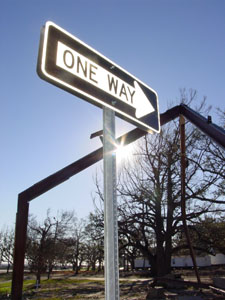
One Way?

Ruins of Redeemer Church in Biloxi after Hurricane KatrinaThe Pew Research Center's Forum on Religion & Public Life has just released the results of a survey of 35,000 Americans on their religious beliefs and practices. They found that Americans are quite flexible in their faith. On the one hand 71% believe that God is a certainty, 56% of those surveyed say religion is very important to their lives, and 58% pray daily. On the otherhand, we as a group also hold that whatever our faith is, it is not the only way to salvation and that there is more than one true way to interpret the teachings of our religion.

A large percentage of those of us who consider ourselves followers of Christ think that others who have not professed faith in Jesus will still end up in heaven. The Pew survey found that only Mormons (57%) and Jehovah’s Witnesses (80%) have majorities who claim that their religion is the one true faith.

Are other faiths right?
I have dealt before with this problem of declaring Jesus to the The Way, The Truth and The Life while trying to acknowledge the good within other faiths. The religion column Can Other Religions Be True is my attempt to deal with this in 1,000 words.

What I Believe
I am not a Christian for no particular reason, with Christianity being just one path among many other equally valid ones. I feel that God is working beyond all denominations and even through many religions to reach as many as can be reached with the love that is God's. After all Jesus told Nicodemus that the wind blows where it will. I believe that wind is God's Holy Spirit present through all creation, and so present beyond any church, reaching out to all.

I also believe that Jesus is the Son of God and the best guide to God. I am a Christian because Jesus was and is who he said he was and in following him I have the clearest picture of who God is and what God wants. It is that spirit bearing witness to my spirit that causes me to affirm the Christian faith within me. So I am solidly and unapologetically Christian.

I preach Christianity because I know it to be true. I know that what Jesus taught works. I can not say that about other faiths, except in the ways in which their beliefs coincide with Christian teaching.

The Big BUT
Here comes the however that may be just my version of why so many persons of faith felt that their way might not be the only one: I don't have the arrogance to suggest that faithful adherants of other faiths who seem to be good and Godly (if not Christian) are not connected to God. I do know Jesus to be The Way, I just can't answer as to whether, for example, the faithful Rabbi that he has not found that way through Judaism. In my experience, there are others who do not hold to Christianity who seem to be connected to God in a significant way.

So I am left in that middle ground that seems to be American. I hold to my faith and think it is not just right for me, but truly right. I want others to follow that path and am concerned that they might never get to God without doing so. Then I see in the lives of some others of differing faiths that it seems that God has found them already. Can I deny that? I don't think so as I think to say someone else is not connected to God, I run the high risk of denying God's presence working in and through that person?

The edge of the herd
So, my strategy for mission is to leave alone those whose faith works for them in a real and meaningful way and say that when it comes to folks of other faiths, we should just pick the sickly ones off the edge of the herd who have yet to find God on the spiritual path they are on.

What do you think?
Yes, I know what I have written can come across as wishy-washy. I'm just trying to be honest about what I believe and where that leaves me. Where do you stand?

peace,
Frank+
The Rev. Frank Logue, Pastor

Labels: ,

2 Comments:

  • At 6/24/2008 9:54 AM, Anonymous Anonymous said…

    I tend to agree with you strongly. However, when I think about how Jesus worked, He didn't merely pick from the edge of the herd.
    On the other hand, we're not Jesus, but, we have to consider what He asked of us and expects from us to this day.

     
  • At 6/27/2008 4:55 PM, Blogger Robin D. said…

    I have taken the leap of faith to believe that Jesus was who he said he was; God Incarnate.

    Despite the good and rightness of other religions' teachings, only Jesus claimed to be God with validity.

    God came down because we needed to be reunited with our creator and coming here as one of us was the way to do that.

    Jesus didn't come to create "Christianity" but to reunite us to the Father.

    Christianity as a religion grew up around our need to be united with each other in communion with him.

    When we spend our time fussing about comparisons then we go astray from Jesus' teaching.


Post a Comment

<< Home

6/09/2008

Religion vs. Faith

It is somewhat easy to be a religious person.
It is much harder to be a person of faith.
—anonymous

There is a joke about the man that went up to Abraham and asked as he was leaving in reponse to God's call:

Where you going?
I don't know.

Who you going to meet there?
I don't know.

How long you going to be there?
I don't know.

What you going to do there?
I don't know.

(That's faith!)

Labels:

0 Comments:

Post a Comment

<< Home

6/08/2008

Like a rope bridge over a scenic gorge

Cub Scout to Boy Scout bridging ceremony at King of Peace
[Faith] is not a well-fluffed nest, or a well-defended castle high on a hill. It is more like a rope bridge over a scenic gorge, sturdy but swinging back and forth, with plenty of light and plenty of air but precious little to hang on to except the stories you have heard…All you have to do is believe in the bridge more than you believe in the gorge…
—Barbara Brown Taylor

Labels:

0 Comments:

Post a Comment

<< Home

9/11/2007

Faith, doubt, certainty and the leap of faith

If a man will begin with certainties,
he shall end in doubts;
but if he will be content to begin with doubts
he shall end in certainties.
Sir Francis Bacon (1561-1626)

John Humphrys writes in a Times Online article In God We Doubt what sounds like a thinking man's agnostic position. In the lengthy article he tells of the atheist philospher AC Grayling who co-wrote the play On Religion in which
The night before I got married my brother sat me down in an Indian restaurant and (too many beers) got me to make a list on a napkin of why this girl was the right person for me to marry. One side of the napkin had all the pros and the other side the cons.

What was fascinating about the list was that nothing I could write down – kind, pretty, warm, sexy, etc – could ever add up to “I love her”. To marry and make the love commitment is the nearest thing to faith I know because it is something done with the same degree of risk.

a leap of faithWould a person who needed everything fully evidenced and rationally demonstrated ever be in a position to say, ‘I love you’? Couldn’t [an atheist] make a case for love being a fiction, a function of human need, a function of biology and selfish genes? He may have many useful and persuasive things to say but there is something deeply mistaken about thinking love is simply reducible to the chemistry of the brain.

Love, like faith, is to make more of a commitment than one can prove. But there is a truth to it that I won’t—indeed can’t—back away from. Of course, there is much to say about all of this and I can think of a dozen reasons why faith and love might look different. But the truth of both is, for me, found in the poetry, not in the science.
I certainly find comparing faith to love to be not a stretch at all and quite helpful as the essence of the Christian faith is love. So quoting an atheist philosopher or not, this agnostic had me intrigued. Humphrys goes on to write in the the Times article,
This is not an intellectual game. Even if we know what is true – and we don’t – you cannot reduce life to a set of provable realities. Humanity is too complex for that. In the end, it comes down to whether the world would be a better place without religion; and that is a matter of judgment, not certainty.

Yes, we loathe and fear the fanaticism that leads to a man strapping a bomb to his body and blowing up other human beings. But we should also fear a world in which the predominant values are materialism and consumerism, and the greatest aspiration of too many children is to become a “celebrity”. The existence of religion can offer some balance in a society obsessed with image, which turns vacuity into virtue....

As for the fanatics – religious or secular – history suggests they succeed only to the extent that we allow ourselves to be defeated by our own irrational fear. For every fanatic there are countless ordinary, decent people who believe in their own version of a benevolent God and wish no harm to anyone. Many of them regard it as their duty to try to make the world a better place.
Here is a man unable to prove God's existence to himself, but quite comfortable in seeing how that belief in God has helped millions of people lived more noble lives, rather than deluded ones.

He is looking from outside the faith in and while I can't share that viewpoint completely as I know there is a God, I can get close to his viewpoint. I do this by not looking at my own faith in God as revealed through Jesus Christ. Instead I look to the faith of a devout Buddhist. Strictly speaking, Buddhism is nontheistic, but it still works as an analogy. I do not believe in the tenants of Buddhism. I just don't. Yet, I do see that Buddhist practice has been very valuable to millions, helping them to live more enriched lives. I suspect this is something like how Humphrys views all faiths.

Where I part company with with him is that I am certain that there are different ways of knowing and some ways of knowing slip throw the net of science and reason. This is why the love analogy above works so well.

I can remove the logical obstacles to faith, but I can't reason someone all the way to heaven. There is a gap that demands a leap of faith. But what I have found, and I hope that you, gentle reader, have as well is that once you make that leap, there is another way of knowing in which one gets the blessed assurance that God is real. The problem is that I can not graft that experience on to a rational explanation and I can not give that experience to others. It takes the leap of faith first, and then comes the assurance.

That's my experience. Does it fit with yours?

peace,
Frank+
The Rev. Frank Logue, Pastor

Now faith is the substance of things hoped for,
the evidence of things not seen.
—Hebrews 11:1

Labels: ,

7 Comments:

  • At 9/11/2007 1:36 PM, Anonymous Anonymous said…

    It looks scary? Very hard to reach.

     
  • At 9/11/2007 2:32 PM, Anonymous Anonymous said…

    I'm not sure if my experience is a leap of faith, but I did receive a gift from God that sealed my faith.

    Up until a couple of years ago, I believed in God simply because I was afraid not to. I attended church regularly and prayed, but I never really felt anything or knew if God was actually with me, listening.

    One particular evening, I attended a rosary for a dying friend. The church was packed with his loving friends and family. After the rosary, he got up to speak. Even though he was dying, his faith was incredible, strong and unshaken. At that moment, something came over me and I felt the Holy Spirit as if I could reach out and touch Him. I was completely speechless for three days after. My priest at that time said that it was holiness recognizing itself, and that's why I was rendered quiet.

    Since that moment, I am able to recognize the hand of God working in my life and the lives of others every single day. I don't think I lept into faith, but was drawn into it by His loving touch.

     
  • At 9/11/2007 3:47 PM, Anonymous Anonymous said…

    That, is what I am searching for!

    That unwavering feeling that I know he is with me always.

     
  • At 9/11/2007 4:53 PM, Anonymous Anonymous said…

    I wasn't searching...I was on my knees begging! I even wrote letters to Him and left them on the altar--everyday!!! I couldn't even be sure that He was there.

    I think when I stopped demanding what I wanted and sat quietly and opened my heart, I was able to feel Him. I knew that He had been there all along. I was simply blinded by me and my demands and too much other stuff!

    I don't believe you have to search, just sincerely make yourself available to Him and He'll let you know He's there.

    That same priest told me that he no longer felt the Holy Spirit like he once had, and the same thing happened to Mother Teresa. Maybe that's the leap of faith--knowing that you are not abandoned and continuing in His name when you no longer feel Him around.

     
  • At 9/11/2007 8:49 PM, Anonymous Anonymous said…

    I feel like I'm on my knees more than I am standing. I just don't know how to open up. I want the faith that will carry me through to where I know I need to be. I just don't know how to get to that place.

     
  • At 9/11/2007 9:14 PM, Anonymous Anonymous said…

    Stay consistent. Say all that you need to say but allow equal and quiet time for Him. Sometimes, when I am not seeing or understanding, I ask God to send angels for clarity. Don't give up! He's there! Your faith must be strong if you spend so much time on your knees in prayer! :)

     
  • At 9/11/2007 9:25 PM, Anonymous Anonymous said…

    Thank You!


Post a Comment

<< Home