Irenic Thoughts

Irenic. The word means peaceful. This web log (or blog) exists to create an ongoing, and hopefully peaceful, series of comments on the life of King of Peace Episcopal Church. This is not a closed community. You are highly encouraged to comment on any post or to send your own posts.

10/15/2009

The Case for God

If I am capable of grasping God objectively,
I do not believe, but precisely because I cannot do this
I must believe.
—Soren Kierkegaard

At the online On Faith forum run by Newsweek and The Washington Post, Karen Armostrong asked the panelists: What makes the best 'case for God' to a skeptic or non-believer, an open-minded seeker, and to a person of faith and Why?

1) The message of scripture?
2) The scientific evidence for an Intelligent Designer?
3) The 'words' that God has 'spoken' - Torah, Jesus, the Qur'an?
4) A compassionate lifestyle?
5) Personal, subjective experience?

Anglican Bishop N.T. Wright answers very succinctly, "Beauty, Justice and above all Jesus" referring to a case he makes more broadly in his book Simply Christian (and elsewhere).

Emerging Church guru and pastor Brian McLaren ranks a compassionate lifestyle highest saying in part,
Many good-hearted people are seeking God but don't want to add to the ranks of the religious and bigoted, the religious and violent, the religious and elitist, and so on. So affiliating with faith in God means they need to find people who embody a compassionate lifestyle.
He ends by noting how science plays into faith for many in writing,
I've often found this is helpful for people who have already taken a step of faith, more as confirmation than as persuasion, but I know that for many, until they can remove intellectual or evidential obstacles to faith, they don't want to make a commitment to believe.
His full response is here: Wisdom and Compassion. All the panelists responses are here: The Case for God.

I think that one can not be reasoned all the way into the Good News of Jesus Christ. But that is no excuse for leaving our God given reason out of it, or checking our brains at the door to the church. Faith is rational, as it must be. And the rational answers to objections to the faith, help us set aside the potential or apparent problems and so be open to the experience of the divine. These objections include the actions of Christians who don't act Christ like. They also include the apparent disconnect between our experience of suffering and our teaching that God is all powerful and all good. These objections have good cases to be made as to why they are apparent problems and not real proof that God cann not exist.

Every atheist and agnostic I have questioned on this has times when they have experienced something "other" that fits with what believers refer to as the Spirit of God. That feeling may come in a cathedral or a grove of trees or in many places one would not usually consider holy. But this experience of the supernatural is something common to all people around the world.

Once our rational objections have been set aside by a solid case made against those obstacles to faith, God makes a case for God's own self within the human heart. That's my take (in this brief setting anyway). What's yours?

peace,
Frank+
The Rev. Frank Logue, Pastor

If we did not have rational souls,
we would not be able to believe.
—Saint Augustine

Labels: ,

0 Comments:

Post a Comment

<< Home

5/25/2009

This Is Your Brain on God

NPR reports on the work of folks doing Neurotheology, the work of studying neural pathways used in religious experience. Researchers talk about the predictable ways in which the neural pathways are different for people experienced in prayer. The article says,
It was the same when he imaged the brains of Franciscan nuns praying and Sikhs chanting. They all felt the same oneness with the universe. When it comes to the brain, Newberg says, spiritual experience is spiritual experience.

"There is no Christian, there is no Jewish, there is no Muslim, it's just all one," Newberg says.

A little theological dynamite there — but, remember, the research is just beginning.
Preliminary studies reveal that routine prayer and meditation is good for both brain and immune system. The article also notes,
"Just two months' practice among rank amateurs led to a systematic change in both the brain as well as the immune system in more positive directions," he said.

For example, they developed more antibodies to a flu virus than did their colleagues who did not meditate.
The full text of this article within a larger report is online here: Prayer May Reshape Your Brain … And Your Reality. The work does not give a scientific way of verifying God so much as verifying that prayer and meditation do work wonders for the one praying and meditating. Yet, for those of us who pray, it's an unecessary affirmation, but a welcome one nonetheless. That's my take. What's your thoughts on this?

peace,

Frank+
The Rev. Frank Logue, Pastor

Labels:

0 Comments:

Post a Comment

<< Home

5/13/2009

Things Science Is too Young to Understand


Dan Brown made a huge stir with his book and the subsequent movie, The DaVinci Code. A previous book surfaces in theaters this week to bring up the contention between science and religion. Angels & Demons opens in theaters around the country Friay trying to generate drama from the conflict of science and religion. It is true that there have been times when religious leaders suppressed science. It is also true that Christianity has been a supporter of scientific research. But the movie and the book on which it is based makes much of the myth which goes something like this: Science is about facts. Science tells us of things that are proven, that we can know with certainty. Religion is about beliefs and faith. Religion concerns things that we cannot prove, but that one must simply believe. Science is progressive while religion seeks to oppress science.

The new movie notwithstanding, there is a problem when this myth is pushed to the extreme, science is seen as being rational, enlightened, and standing on the side of knowledge. Christianity and other religions are viewed as backwards, superstitious, and authoritarian. It can come across as if one must decide whether to live a life according to science or Christianity.

We should get neither too excited when science seems to confirm our faith nor too bothered when science seems to contradict our faith. Science and religion are separate lines of inquiry into the same reality and as one character will say in the film, "There are simply some things science is too young to understand." The truth is that faith has not always shown the maturity that comes with age. Both our science and our faith are on a journey to a goal not yet reached, and we should let each run its course with the occasional check and balance from each other.

Albert Einstein is oft quoted weighing in on this issue saying, ”Science without religion is lame; religion without science is blind.” Discoveries from science can help illumine our faith. Likewise, a breakthrough in spirituality can help a scientist find new meaning in her or his work. These checks and balances become even more important as we move ahead as genetic research pushes ahead to new frontiers in what is possible. Some on the faith side currently choose to ignore any scientific discovery that seems to contradict their current understanding. I suggest that we neither ignore science nor place our faith in it.

I personally would not choose to give up all the advancements in medicine to return to a pre-enlightenment health care system. However, I would also hate to see science pushed ahead toward doing whatever is possible, with regard only to what can be done and never to what should be done. Therefore, while I suggest that the worlds of science and religion are largely separate, they need each other.

After all, humans seem hard-wired to ask the big questions like, “Why am I here?” and, “How did everything we see get here?” Science has shown that the more we understand, the muddier the water gets for the bigger questions. Scientific method alone can never answer these questions adequately.

That's my take. What do you think?

peace,
Frank+
The Rev. Frank Logue, Pastor

Labels:

3 Comments:

  • At 5/13/2009 6:29 AM, Anonymous Kelly said…

    I pondered this as a very young child making the nuns at school extremely angry when I would question them with scientific facts. I had a hard time with the Creation Story of Adam and Eve; and really got in trouble when I questioned the story of Jonah being swallowed by whale after learning about digestion. :)

     
  • At 5/13/2009 10:41 AM, Anonymous V W said…

    The more I learn of science in today's world the more I have 'Aha" moments in faith. Without the scientific break throughs we wouldnt be able to harness the gifts that God created. Electricity, from lightening, antibiotics from fungus, matter of fact our very structures wouldnt be very efficent if they were built without the understanding of gravity. But as humans we turn these gifts into nightmares through our science. Bio weapons from simple bacteria cultures, "smarter" bombs from advanced electronic components. Science is a method and is a tool but what guides the hand that uses the tool?

     
  • At 5/13/2009 12:07 PM, Blogger The Bosom Serpent said…

    Science is the team pulling the plow. Faith is the hand guiding the plow.

    Without the plow our world would be barren. Without the Hand on the reins the field would remain fallow.


Post a Comment

<< Home

2/19/2009

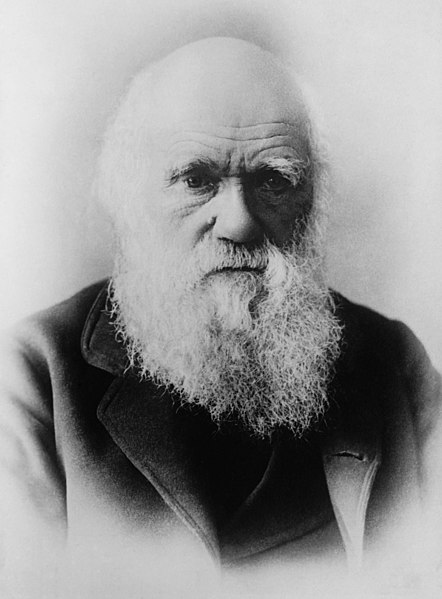
Darwin at Downe

The naturalist Charles Darwin would have turned 200 last week. That occasion is being marked in various ways. A recent article in Episcopal Life Evolution and Faith in Dialogue presents ways in which people of faith struggle with the results of Darwin's life work. That article considers how "an acceptance of evolution is entirely compatible with an authentic and living Christian faith."

St. Marys Church in DowneAnother angle on the naturalist is found here Darwin at Downe, a web page covering Darwin's ongoing involvement in his parish church of St. Marys in the village of Downe in Kent, where he lived for the last 40 years of his life. Darwin was heavily involved with local community organisations, such as the Coal and Clothing Fund, and was the co-founder of a Friendly Club to which local people subscribed for assurance of assistance in times of financial hardship. He served as its treasurer for over 30 years.

His parish priest described him saying,
He is a man of the most perfect moral character, and his scrupulous regard for the strictest truth is above that of almost all men I know. I am quite persuaded that if on any morning he met with a fact which would clearly contradict one of his cherished theories he would not let the sun set before he made it known. I never saw a word in his writings which was an attack on Religion.
There is no doubt that Darwin's observation have presented challenges to the faith of many. And we know from Darwin himself that his work moved him toward disbelief. As Darwin wrote himself,
In my Journal I wrote that whilst standing in the midst of the grandeur of a Brazilian forest: ‘It is not possible to give an adequate idea of the higher feelings of wonder, admiration, and devotion, which fill and elevate the mind.’ I well remember my conviction that there is more in man than the mere breath of his body. But now the grandest scenes would not cause any such convictions and feelings to rise in my mind.”
Charles darwinHe seems like a man who wanted to continue to believe in the Christianity of his youth, but his scientific work barred the way. And yet he continued to be actively involved in his parish church and the good he saw it could do. Too bad, that Darwin, could not, as so many other scientists have done, found a way to reconcile his faith and his scientific worldview. The two need not have been incompatible. This is covered in an article by the Rev, Malcolm Brown, Good religion needs good science at the same Church of England website as the one making the Darwin at Downe connection.

Labels:

0 Comments:

Post a Comment

<< Home

8/06/2008

The death of God Is Dead

Christianity Today carried a story in a recent issue that tells of how the God Is Dead movement in theology was sidestepped by a movement within philosophy that found other proofs of God's existence to still be intellectually viable. The article is here: God is not dead yet: How current philospher's argue for his existence.

The arguments are fairly basic and things that have occured to many people of faith like the cosmological argument which says,
  1. Everything that exists has an explanation of its existence, either in the necessity of its own nature or in an external cause.
  2. If the universe has an explanation of its existence, that explanation is God.
  3. The universe exists.
  4. Therefore, the explanation of the universe's existence is God.
There is also the moral argument:
  1. If God does not exist, objective moral values and duties do not exist.
  2. Objective moral values and duties do exist.
  3. Therefore, God exists.
This view would go on to say, "God wills something because he is good. That is to say, what Plato called "the Good" is the moral nature of God himself. God is by nature loving, kind, impartial, and so on. He is the paradigm of goodness. Therefore, the good is not independent of God. Moreover, God's commandments are a necessary expression of his nature. His commands to us are therefore not arbitrary but are necessary reflections of his character."

1966 Time cover storyThe author of the article, William Lane Craig is a research professor of philosophy at the Talbot School of Theology. He contends that putting together these and other logical arguments for God's existence is vitally important as while aetheists are working to show that belief in God is not intellectually possible, Christians should be prepared to demonstrate that it is. He still sees conversion as a work of the Holy Spirit and concludes writing,
Christians who depreciate natural theology because "no one comes to faith through intellectual arguments" are therefore tragically shortsighted. For the value of natural theology extends far beyond one's immediate evangelistic contacts. It is the broader task of Christian apologetics, including natural theology, to help create and sustain a cultural milieu in which the gospel can be heard as an intellectually viable option for thinking men and women. It thereby gives people the intellectual permission to believe when their hearts are moved.
I agree that we need to be able to make an account of the faith that is in us in such a way that those who do not believe feel challenged to open their hearts up to first the possibility of and then the reality of their loving creator.

A related sermon from the archives is Thoroughly Postmodern Paul.

peace,
Frank+
The Rev. Frank Logue, Pastor

Labels: , ,

0 Comments:

Post a Comment

<< Home

4/18/2008

What I know and what I believe

Some matters I believe and some matters I have to take on faith. Yet the categories of belief and faith are not as clearly defined as one might think. Sometimes we speak as if science deals with facts, while religion deals with blind trust. It’s not that simple.

Frank's photo of a first grade classroom in NepalI might say, “I know there is a Key West, Florida” and “I know there is a Kathmandu, Nepal.” But these statements are not equal. I know there is a Kathmandu as my wife and I spent two months there on our honeymoon. It’s not too much of a statement of faith to say that the city continues to exist even though we haven’t been there for 22 years. The same sources of information that told me the place existed before I visited, tell me of its continued existence.

On the other hand, I have never been to Key West. But I do know people who have and I believe the things I have both heard and read about the place and feel like I know something of that place as well.

These matters were considered more thoroughly by an intellect I can’t pretend to match in the fourth century by Augustine of Hippo. Augustine was a promising student in the Roman Empire. Though he was from North Africa, he was sent to Rome and trained in rhetoric at a time when the best and the brightest studied rhetoric. He knew logic and philosophy. And when talented rhetoritician came to faith in Jesus Christ, he brought his God-given gifts of reason with him into the church.

This post, which is my religion column for today's issue of the Tribune & Georgian continues here: What I know and what I believe

Labels: ,

1 Comments:

  • At 4/18/2008 11:35 AM, Anonymous Anonymous said…

    I believe that I think I know there is a restaurant in Key West that serves rattle snake. But, I have no faith in that statement as I have never been to Key West and would probably not go to a restaurant that serves rattle snake.

    Also, I don't believe that rattle snake tastes like chicken. I was told that frog legs and gator tail taste like chicken and I believed, therefore, I tasted. They didn't taste like chicken. I know that I believe that chicken tastes like chicken, so I'll put my faith in tasting like chicken in chicken.

    I know for a fact that I believe that Jesus is the Son of God. I place my faith in this too! :)

    BTW Good Article!


Post a Comment

<< Home

1/04/2008

Eating meat of the same cow over and over

The Wall Street Journal reports that cloned animals may be cleared to move into the food production chain. In the article Cloned Livestock Poised To Receive FDA Clearance reports that
After more than six years of wrestling with the question of whether meat and milk from them [cloned animals] are safe to eat, the Food and Drug Administration is expected to declare as early as next week that they are.
I think that asking whether the cloned meat is safe to eat may be asking the wrong question. My concerns are more for the breeding practices and its unintended consequences. I stand by what I wrote in a religion column on genetically engineered plant crops a few years ago:
The central problem is that humans are trying to adapt the natural world to fit the market-driven economy rather than having the farming methods fit the world around it. Some of the very problems now being countered with transgenic plants were not a problem in smaller-scale farming that relied on planting various crops alongside each other to naturally discourage pests. You see this in household gardens where tomatoes and marigolds are planted together as a natural form of pest control not seen as practical for large-scale farming.

While a life-saving crop of rice is tempting, we should not gamble our food supply on unproven methods. We do not yet know the long-term implications of genetically modifying the plants we eat. We humans may be making an end-run around biological barriers intended to protect us without first considering the consequences.

A little more humility is called for in both the science and the regulation. Corporations seeking to enlarge their profit margins will not introduce this humility. We need regulations to slow the move from greenhouse to broad-scale use with better science. After all, once the transgenic varieties are introduced, we have already found that they create their own hybrids with native species. We may find a new plant safe in the lab only to find that they have disastrous results when they move from greenhouse to field. We also need labeling which will allow you the consumer to know if the food you buy was genetically modified.

a cloned calfWhere is God in all this? God created a world with a dizzying array of plant and animal species held in a delicate balance. We know that greater diversity of plant and animal life allows greater chance of survival for the all species if one variety falls prey. This diversity of life is the way the world was created. Part of the role of stewardship of the earth found in both the Jewish and Christian faiths is that we are to protect the diversity of life, which in turn protects our food supply.
The full text of that column is online here: Where Is God in the Genetic Food Fight? I see this as a moral issue in which we believers have an obligation to try to make our feelings known. What do you think? Is cloning cows and other animals for market a problem?

Labels:

0 Comments:

Post a Comment

<< Home

12/19/2007

The Atheist Delusion

Georgetown University theology professor John Haught has written a book, God and the New Atheism, to counter the claims of the recent atheist writings like those of Richard Dawkins and Christopher Hitchens. Over at Salon.com, they have a current article, The Atheist Delusion presenting Haught's views in brief. In the article, he argues that those arguing for Intelligent Design share with their evolutionary materialists foes in debate the feeling that science can solve questions of faith, while he feels this may not be the only way of discovering truth. Haught says in part,
My chief objection to the new atheists is that they are almost completely ignorant of what's going on in the world of theology. They talk about the most fundamentalist and extremist versions of faith, and they hold these up as though they're the normative, central core of faith. And they miss so many things. They miss the moral core of Judaism and Christianity—the theme of social justice, which takes those who are marginalized and brings them to the center of society. They give us an extreme caricature of faith and religion....

I don't have any objection to the idea that atheists can be good and morally upright people. But we need a worldview that is capable of justifying the confidence that we place in our minds, in truth, in goodness, in beauty. I argue that an atheistic worldview is not capable of justifying that confidence. Some sort of theological framework can justify our trust in meaning, in goodness, in reason....

The new atheists have made science the only road to truth. They have a belief, which I call "scientific naturalism," that there's nothing beyond nature—no transcendent dimension—that every cause has to be a natural cause, that there's no purpose in the universe, and that scientific explanations, especially in their Darwinian forms, can account for everything living. But the idea that science alone can lead us to truth is questionable. There's no scientific proof for that. Those are commitments that I would place in the category of faith. So the proposal by the new atheists that we should eliminate faith in all its forms would also apply to scientific naturalism. But they don't want to go that far. So there's a self-contradiction there.
I don't agree with all that Haught says, but I do enjoy his trying to set some things straight with regard to Atheism, which is itself a theological conviction that take some faith. Haught's book is forthcoming. The full text of the interview is here: The Atheist Delusion.

I have written about some of the underlying assumptions here in the religion column, It Doesn't Have to Be Science Vs. Religion and in the blog post Faith, Doubt, Certainity and the Leap of Faith.

peace,.
Frank+
The Rev. Frank Logue, Pastor

Labels:

1 Comments:

  • At 12/19/2007 8:48 AM, Anonymous Anonymous said…

    I feel sad that most Atheists will never know what I know to be true. What He has shown to me can not be explained away by logic and science(I've tried). And the joy that I feel from Him just can't compare to anything else.


Post a Comment

<< Home

10/29/2007

Letter to a Southern Baptist Pastor


Biosociologist E.O. Wilson has written a "Letter to a Southern Baptist Pastor" as a means of seeking common ground between science and religion for the good of all for as he writes,
EO WilsonBecause religion and science are the two most powerful forces in the world today, including especially the United States. If religion and science could be united on the common ground of biological conservation, the problem would soon be solved. If there is any moral precept shared by people of all beliefs, it is that we owe ourselves and future generations a beautiful, rich, and healthful environment.
The full text is here Letter to a Southern Baptist Minister. In the letter, he lays on the line his own secular humanist beliefs, while making room for joining with those Christians who want to find common cause, particularly the most literal interpretors of scripture.

For the record here at Irenic Thoughts, I don't think I take scripture literally in the sense that is usually meant. But I take scripture so life-changingly seriously that I am always uncomfortable saying that I don't take scripture literally for that makes it sound like I don't think the Bible is true. On the contrary, I know it to be true. People ask, "Did it happen?" about this or that biblical event. I can say in reply, "It happens all the time." For the events in scripture such as the Exodus from Egypt are ones that repeat generation after generation as God calls people from slavery into freedom and from death into life.

With that said, I lament that many Christians have found reason not to follow God's command to be stewards of the earth and to serve and preserve the creation. As Wilson clearly states in his letter, some use Jesus' return as an excuse to not worry about the state of the planet. This is curious logic as we should want our Lord to find that we've been taking care of the place as requested. Martin Luther said that if someone said Jesus was returning tomorrow, he would plant a tree. If they were wrong, he would have prepared for the future. If they were right, he would be found by God to be taking care of the earth.

Wilson's impassioned plea is this:
Pastor, we need your help. The Creation—living Nature—is in deep trouble. Scientists estimate that if habitat conversion and other destructive human activities continue at their present rates, half the species of plants and animals on Earth could be either gone or at least fated for early extinction by the end of the century. A full quarter will drop to this level during the next half century as a result of climate change alone. The ongoing extinction rate is calculated in the most conservative estimates to be about a hundred times above that prevailing before humans appeared on Earth, and it is expected to rise to at least a thousand times greater or more in the next few decades. If this rise continues unabated, the cost to humanity, in wealth, environmental security, and quality of life, will be catastrophic.
Separate from issues of whether global warming is good science or bad, anyone can see that we are raping portions of the earth rather than caring for them. The earth is resilient and may well recover, but it could do so with a billion or so less humans on board. If this happens, it may not be God's judgment so much as God's built-in corrective for us not following the command to care for the gift of creation we have been given.

The professor who taught me Hebrew, Ellen Davis, said in a recent NPR interview,
The biblical writers have always maintained that the world is not a permanent entity as we know it; it can change; is likely to change; for better, or for much worse.
If our own free will leads us to saw off the limb on which we stand, we will not have God to blame. Perhaps this is yet another implication of this past Sunday's sermon When Fires Rage.

You will find some responses to E.O. Wilson at Washington Post and Newsweek's On Faith in Science and Religion. In the archives is the religion column Toward a Christian Ecology.

I think that Christians owe our creator the debt of caring for creation. For that reason, I do believe that I could easily find a good deal of common ground with E.O. Wilson. But then, he wasn't writing the letter to me. What do you think of Christianity and ecological crisis?

peace,
Frank+
The Rev. Frank Logue, Pastor

PS: There is also the reasoning of the Rev. Linda McCloud who said, "Preserve the earth; as far as we know, it's our only source of chocolate."

Labels:

1 Comments:

  • At 10/30/2007 7:27 AM, Anonymous Anonymous said…

    My family lives out in Mush Bluff and we are extrememly privileged to have a recycling truck along with our regular garbage collection. I can't believe the amount of plastic one family of four can accumulate in a week! For my family, it far outweighs the amount of paper, glass and cans.

    We started recycling 8 years ago and I wish we had done so a long time ago. To think of all we have acumulated that could be going to a landfill makes me sick. And with that said, even though we are lucky to have the recycling truck in our neighborhood, sadly, very few neighbors take advantage of it.

    Yes, there are enough Christians in this world who can set a great example and take care of our precious gifts from God. And regardless of our religious convictions, the one thing that all humanity has in common is our earth. It's our home. It's a legacy that we all need to protect for future generations.

    If each of us could donate just a little extra time, we could accomplish so much.


Post a Comment

<< Home

9/06/2007

That ain't right


Before this post is over I will sound like an unenlightened romantic at best a luddite or heartless troglodite at worst. But this NPR news report got my attention Scientists Hope to Create Human-Animal Embryo and not in a positive way. The short version is that
Two teams of British scientists had applied to Britain's Human Fertilisation and Embryology Authority (HFEA) for permission to create what are known in Britain as cytoplastic hybrids, or cybrids, in order to overcome a shortage of donated human eggs.

The process involves injecting human DNA into an animal egg cell from which the nucleus has been removed.

Researchers hope to use the hybrid embryos, which must be destroyed after 14 days, which would create stem cells. The stem cells could be used to help find new medical treatments for diseases such as Alzheimer's, Lou Gehrig's, and Parkinson's.
That's where I feel unenlightened. I certainly want relief for persons suffering from Alzheimer's, Lou Gehrig's and Parkinsons's. Who wouldn't? But I wonder about the cost of help and what the unintended consequences might be. The article goes on to say:
Scientists have said they understand that the idea of the process — which would create a hybrid embryo that is 99.9 percent human and 0.1 percent animal — might be shocking to some people. But Dr. Stephen Minger of Kings College London says the public should not be alarmed.

"What we do when we take an animal egg, is we remove the nucleus from the egg. We remove not only the genetic identity but we remove the species identity. What makes a cow egg a cow is its nuclear DNA. And we take that out — it's no longer a cow," Minger says.
Britain's Times online also features a Question and Answer on the issue.

Maybe I have watched I Robot one too many times (including last night), or took Jurassic Park or The Lost World too seriously, but I do wonder about the slippery slope and what it means to begin creating hybrid tissue for research purposes. My gut instinct is that we humans are not smart enough to pull this off without running into profound problems we can not yet forsee.

an urban legend playing on fears about this sort of reserach, click to find out moreI could and probably should throw in some biblical rationale for my opinion. Certainly the distinctions among species found in Genesis 1:4,6,7 with each animal reproducing after their kind shows a concern for keeping distinctions in a way that would see no problem with dog breeding and real cataclismic problems coming from recombining very different species. I'm not actually fearful of the urban legend pictured here coming true, but I do think it is dangerous precedent. Yes, I have read a few articles on this and understand that the intent is to remove almost all that is cow from the egg and make it human. But what is created will be a new sort of hybrid and we won't know the problems down the line until it is too late to reverse the course. I wish I didn't see it as market-driven research interested in boosting medical company profits as being the main factor in this continual push ahead trying to find ways to bend the ethics to make the new research acceptable to the broad public's sensibilities.

But I also need to admit that at this point, this is just a gut-level reaction on my part. I do think we should do all we ethically can to help prevent needless suffering from disease. I just think this solution crosses that line.

What do y'all think?

peace,
Frank+
The Frank Logue, Pastor

Labels: ,

4 Comments:

  • At 9/06/2007 7:12 AM, Anonymous Anonymous said…

    It's too FREAKY!!!! There's got to be another way! Suffering from these diseases is horrible, but I don't think I could expose myself to such a cure.

     
  • At 9/06/2007 8:10 AM, Anonymous Anonymous said…

    I totally agree. There are some awful things that can happen to people but sometimes the cost of the "cure" is way too high.

     
  • At 9/06/2007 10:43 AM, Anonymous Anonymous said…

    I think you hit the nail on the head with the word "ethically". Doctors are supposed to do no harm. If you believe that life is created by God, then you know that only God can play God and this isn't a thing we have any place meddling in. Disease has a way of working it's way out. Maybe we should put our focus into making medicines and treatment affordable to all, or even budget for medicines like we do our cell phones. I can think of at least 5 people I know who complain about a $60 prescription, yet willingly hand over $100/month for their phone service. How come a church isn't supposed to turn a profit, but life sustaining care can? Is it capitilism or greed? So many questions only raise more questions!

     
  • At 9/06/2007 1:24 PM, Anonymous Anonymous said…

    Mooooooooo...I mean...GROSS!!!!!!!


Post a Comment

<< Home

3/06/2007

God in a box

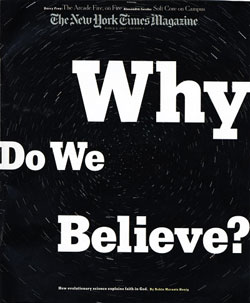
A recent article in The New York Times, Darwin's God, tells in part of "the magic-box demonstration" Scott Atran first conducted in the 1980s, when he was at Cambridge University studying the nature of religious belief. In the demonstration the article says,
He presents students with a wooden box that he pretends is an African relic. “If you have negative sentiments toward religion,” he tells them, “the box will destroy whatever you put inside it.” Many of his students say they doubt the existence of God, but in this demonstration they act as if they believe in something. Put your pencil into the magic box, he tells them, and the nonbelievers do so blithely. Put in your driver’s license, he says, and most do, but only after significant hesitation. And when he tells them to put in their hands, few will.

If they don’t believe in God, what exactly are they afraid of?
What indeed? This is the question being considered by scientists considering whether humans are "hard wired" to believe in God. I think so and think we were wired that way by a creator. But the scientists are working on the puzzle. The full text of the rather long article is here: Darwin's God.

But I wonder...would you have put your hand in the box?

peace,
Frank+
The Rev. Frank Logue, Pastor

Labels:

3 Comments:

  • At 3/06/2007 8:11 AM, Anonymous Anonymous said…

    Back in the 80's, I am 99.9% sure that I would have put my hand in the box. Sadly, though, I don't know if it would have been because of my faith in God, or because I was young and "invincible." I thrived on the excitement that a dare could bring to me back then.

    In my defense, however, even though I had developed major resentments toward my religion, I never had any doubt in the existence of God. I know that because of faith, I would not have believed in any mystical powers of an ancient relic and would have put my hand in, or not. Because of this faith, I may have seen the whole experiment as a waste of time for me.

    It's sad that these scientists continue trying to prove or disprove the existence of God and unfold the mysteries of faith. They're missing out on the joy we receive from faith alone.

     
  • At 3/06/2007 12:07 PM, Anonymous Anonymous said…

    "Faith alone" was not intended to mean "blind faith." It merely means that I know that there is God. It is not blind faith because God makes his presence known to me in ways that I can understand and accept. I find joy in getting to know God rather than exploring the universe to find out "if" God...

    Yes, I too have tested God. But, why would I waste my time with that if I didn't know He was there in the first place?

     
  • At 3/08/2007 6:32 AM, Anonymous Anonymous said…

    The end of the Newsweek article puts it well:

    "This internal push and pull between the spiritual and the rational reflects what used to be called the “God of the gaps” view of religion. The presumption was that as science was able to answer more questions about the natural world, God would be invoked to answer fewer, and religion would eventually recede. Research about the evolution of religion suggests otherwise. No matter how much science can explain, it seems, the real gap that God fills is an emptiness that our big-brained mental architecture interprets as a yearning for the supernatural. The drive to satisfy that yearning, according to both adaptationists and byproduct theorists, might be an inevitable and eternal part of what Atran calls the tragedy of human cognition."


Post a Comment

<< Home