Irenic Thoughts

Irenic. The word means peaceful. This web log (or blog) exists to create an ongoing, and hopefully peaceful, series of comments on the life of King of Peace Episcopal Church. This is not a closed community. You are highly encouraged to comment on any post or to send your own posts.

4/16/2010

A Piece of Mud

Lillian TrasherJacksonville native Lillian Trasher (1887-1961) began working in a North Carolina orphanage after one term in a Bible college. At the orphanage, she heard a missionary from India speak of her work there. Lilly knew that God was calling her to help people. Ten days before her wedding in May 1910, she broke off her wedding engagement to serve as a missionary to Africa.

In 1911, she arrived in Assyut, Egypt, and took in an infant whose mother had died. She rented a small house to care for the baby and the first donation she received was 35 cents given by a local telegraph boy. Within five years she was caring for 50 children. The locals called her "The Child Saver."

Lillian TrasherBy the time of her death in 1961, the Lillian Trasher Orphanage had grown to some 1200 children. During her lifetime, Lillian Trasher cared for 25,000 Egyptian children. A primary school, dormitories, a chapel, and sports facilities were built on the orphanage grounds. She loved the children who came into her care, but she never forgot that it was Christ in her giving her the capacity to love them. She said, "When Jesus healed the blind man in John chapter 9 by putting clay on his eyes, it wasn't the mud that healed, but the power behind the mud. God can use me or any other piece of mud."
God, whose everlasting arms support the universe: We thank you for moving the heart of Lillian Trasher to heroic hospitality on behalf of orphaned children in great need, and we pray that we also may find our hearts awakened and our compassion stirred to care for your little ones, through the example of our Savior Jesus Christ and by the energy of your Holy Spirit, who broods over the world like a mother over her children; for they live and reign with you, one God, for ever and ever. Amen.

Labels:

0 Comments:

Post a Comment

<< Home

11/12/2009

Required Communion?

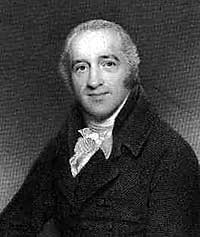
In 1779, students at Cambridge University in England were required to receive Holy Communion at least three times a year. That year, 20 year old Charles Simeon (1759-1836) entered the university in January interested in horses, games, and fashion. Baptized as an infant, his family was not religious. Simeon said that at that point in his life, Satan was as prepared to receive communion as was he. But Simeon decided that he must prepare for Easter communion. He began reading scripture and religious books.

He read of the sacrifices in the Old Testament, and later wrote that he thought, "What, may I transfer all my guilt to another? Has God provided an offering for me, that I may lie my sins on his head?" He said that on realizing that he had sinned and needed the forgiveness offered through Jesus, he immediately laid his sins "upon the sacred head of Jesus."

On the Wednesday of Holy Week, he wrote, he "began a hope of mercy. On the Thursday, that hope increased. On the Friday and Saturday, it became more strong. And on the Sunday morning, Easter Day, April 4, I woke early with these words upon my heart and lips: Jesus Christ is Risen Today, Halleluja, Halleluja!"

Simeon was ordained to the priesthood and served Trinity Church, Cambridge for nearly 50 years. His church tried to literally lock him out at first as he preached scripture to a university congregation not accustomed to such evangelical preaching. Over time, the congregation came around and supported Simeon's preaching and teaching ministry which would come to have worldwide effect as a third of all ordained ministers in the Church of England had sat at one point in his Cambridge pews.

It was the seriousness with which he took the requirement, which changed Charles Simeon's life. Who could imagine that a university requirement to receive communion would be to such effect? We celebrate him on this day each year as a saint of The Episcopal Church.

peace,
Frank+
The Rev. Frank Logue, Pastor

O loving God, we know that all things are ordered by your unerring wisdom and unbounded love: Grant us in all things to see your hand; that, following the example and teaching of your servant Charles Simeon, we may walk with Christ in all simplicity, and serve you with a quiet and contented mind; through Jesus Christ our Lord, who lives and reigns with you and the Holy Spirit, one God, for ever and ever. Amen

Labels:

1 Comments:

  • At 11/12/2009 11:00 PM, Blogger Tom Sramek, Jr. said…

    The irony, of course, is that actually requiring something like regular communion, especially from someone as unprepared as he was, is so un-Episcopalian nowadays.


Post a Comment

<< Home

5/22/2009

Controversial Common Law Saints


Miriam, Sister of MosesTo be named a saint officially is a lengthy church process. To become a "Common Law Saint" is much simpler, people just have to think of the person as saintly. Examples from recent history are the Rev. Dr. Martin Luther King Jr. and Mother Theresa.

St. Gregory of Nyssa Episcopal Church in San Francisco has just completed a decade long mural project with 89 saints dancing in the rotunda over their altar. This impressive project is pictured above from a page in Tikkun Magazine. The saints pictured are listed and described briefly at the church's website - Dancing Saints.

The controversy comes from the fact that not all of the common law saints are Christians. The Rev. Donald Schell, one of the co-Rectors at the time the project was undertaken, writes of this in an essay for Episcopal Cafe telling how he would describe the group to visitors,
Yes, I’d say, pointing up to her icon, that’s Elizabeth I dancing with Malcolm X to her right and Iqbal Masih to her left. We commemorate Elizabeth for her peace-making principle that people praying together would be the ground of our unity, not doctrinal uniformity. I usually began by talking about Elizabeth, because her vision helped shape the whole icon.

We remember Malcolm X, because on his trip to Mecca, God changed his heart and he renounced teaching hate of white people and became an orthodox Muslim, proclaiming and worshipping one God who embraced all humanity. Teaching God’s embrace of all humanity was what got him killed when he came back home.

And Iqbal Masih? He was a Pakistani Christian child sold into indentured servitude at age four. At ten he escaped from crippling work as a rug-knotter, and fearlessly told his story to the world, offering his voice and experience to support the Bonded Labor Liberation Front that was freeing thousands of child-slaves like him and teaching rug buyers around the world to ask who was making their hand-tied rugs, how the workers were being treated and whether they were being paid fairly. In 1995, when Iqbal Masih was twelve, he testified before the U.N. Commission on Human Rights. That Easter he went home to his village to go to church, and that afternoon was shot dead, martyred in the street for helping other children find freedom.
Sojourner TruthAs for myself, I absolutely that God touches the lives of those who are not Christian, reaching out to them and drawing them to himself. This is a very Christian idea. I also agree with Schell's contention that God makes saints, we do not and God makes many more than we acknowledge,
Actually, we believe God made them saints, and that God made and is making innumerably more saints, people named and unnamed, so many there’s no wall in the world big enough to hold their icon.
But I would not have even thought of adding "saints" from other faiths to the mural. It just would not have occurred to me. It would call on me to name an action of God's in a way in which I could have no confidence. Yes, I feel I can say I know Saint Francis to have been a saint. Can I name that with the same conviction about Malcolm X whose late in life conversion to a truer form of Islam that caused him to see even white men as his brothers? I value his witness, but I wouldn't be adding his likeness to the walls of King of Peace.

Interested in more on this idea of how God is present to those of other faiths? I have preached before on my own beliefs in this regard God Shows No Partiality.

What do you think?

peace,
Frank+
The Rev. Frank Logue, Pastor

PS I have past blogs on The Path to Sainthood I, The Path to Sainthood II, and The Path to Sainthood III.

Labels:

1 Comments:

Post a Comment

<< Home

3/17/2009

A "countryfied" exile

Saint Patrick is much known, loved, revered, but like many from his time period (389-460 a.d.) he left behind few writings. The quote below is from one of two writings widely agreed to come from his pen and not just something attributed to him:
I am, then, first of all, countryfied, an exile, evidently unlearned, one who is not able to see into the future, but I know for certain, that before I was humbled I was like a stone lying in deep mire, and he that is mighty came and in his mercy raised me up and, indeed, lifted me high up and placed me on top of the wall. And from there I ought to shout out in gratitude to the Lord for his great favours in this world and for ever, that the mind of man cannot measure.

Therefore be amazed, you great and small who fear God, and you men of God, eloquent speakers, listen and contemplate. Who was it summoned me, a fool, from the midst of those who appear wise and learned in the law and powerful in rhetoric and in all things? Me, truly wretched in this world, he inspired before others that I could be—if I would—such a one who, with fear and reverence, and faithfully, without complaint, would come to the people to whom the love of Christ brought me and gave me in my lifetime, if I should be worthy, to serve them truly and with humility.

According, therefore, to the measure of one’s faith in the Trinity, one should proceed without holding back from danger to make known the gift of God and everlasting consolation, to spread God’s name everywhere with confidence and without fear, in order to leave behind, after my death, foundations for my brethren and sons whom I baptized in the Lord in so many thousands.
The full text is online here: The Confession of St. Patrick (450 a.d.).

Labels:

0 Comments:

Post a Comment

<< Home

11/02/2008

Remembering All the Saints

At our 10 a.m. worship service this morning, Josh and Abi Gutleben will become the 80th and 81st people baptized at King of Peace. They join not merely King of Peace, but the church universal, the communion of the saints. While the Greek we translate as “saints” in the New Testament means “Holy Ones” it is clear in the Bible that the term saints refers to all Christians. Today is All Saints Day and on this day we remember all the saints of Christianity, the greats of the faith, those known only to God, and those we love who have died.

While those we know and love who die are no longer present to us, we trust that they are still present to God as Jesus told the thief on the cross, “Today you will be with me in paradise.” So while we can no longer be with those we love, we can not only remember them, we can also remember them to God in prayer.

“Remember” is strong word, even if we attach weak meaning to it these days. When something has been dismembered, to re-member is to put the members back together. To put this crudely, to reattach a severed arm is also to remember and it is from this that we get our current word connected with memory. The severed arm analongy is probably not overstating the case as the grief in the death of someone close to you is initially, just as wrenching. Losing a child a spouse or someone similarly close is as difficult as losing part of your own body.

It is in remembering someone we love to God that this very real pain of grief can begin to lessen. In re-membering, we are brought back together in some way. This is no where more true than in the worship of Holy Communion. In communion, we commune with God and through God with all those with whom God is in communion. So it is natural that through our common worship of God we are closest to the faithful departed. This is part of what we remember this day as Josh and Abi join that communion of the saints.

peace,
Frank+
The Rev. Frank Logue, Pastor

Labels:

0 Comments:

Post a Comment

<< Home

6/06/2008

The Path to Sainthood III

The inclusion of persons on the national calendar takes place at the General Convention of The Episcopal Church, the once every three years meeting of the national church. As a deputy to that meeting, I have voted on the inclusion of saints in the calendar and did carefully and prayerfully consider their cause.

Florence Li Tim-OiI admit that I was very skeptical about the inclusion of Florence Li Tim-Oi. She was the first woman ordained as a priest in the Anglican Communion. I found that mere fact to be the oddest reason to recognize someone as a saint, as it would rely on chance of history alone. Then I read more and discovered that there was much more to her story than being the first woman ordained as a priest in our communion. She had courageously led a group of Christians on Macau during the time of the Japanese invasion. She was serving as a deacon and no male remained to serve the Chinese Christians. She was willing to face possible persecution and death to continue the sacramental ministry among her congregation and was ordained as a priest.

After World War II, she ceased serving as a priest as that service was controversial in the communion, though she remained a faithful deacon in the very difficult circumstances of the communist take over and reeducation under Mao. Once again she lived a Christ-like life in a regime bent on suppressing her faith. She did not serve as a priest again until after moving to Canada in 1983. On the 40th anniversary of her ordination, women's ordination was approved there and she once again served as a priest. She was a woman of heroic faith who risked death to minister to the people in her care as requested by her Bishop and it so happens that she was the first woman ordained a priest in the Anglican Communion. Humbled by the example of a woman willing to serve as a Christian leader under Japanese rule in World War II and Chinese rule in Mao's revolution, and given the testimony of those who knew her, I was proud to vote for her inclusion in the calendar of saints.

Statue of Janini LawumI also voted to recognize Janini Lawum as a saint. I have only one degree of separation from this archbishop as I have known well someone who knew him well—a priest in seminary who had served as a deacon in Lawum's cathedral. Lawum was archbishop of the Anglican Church of Uganda during Idi Amin's cruel reign over that country. He stood up with other church leaders against Amin and was singled out to be put to death for his principled stand. This past February, the group from King of Peace sat at dinner during the diocesan convention with a retired Bishop from Uganda who also knew Lawum personally. He knew the archbishop to be a saintly man, martyred for his faith and he was grateful that his sacrifice was recognized by The Episcopal Church.
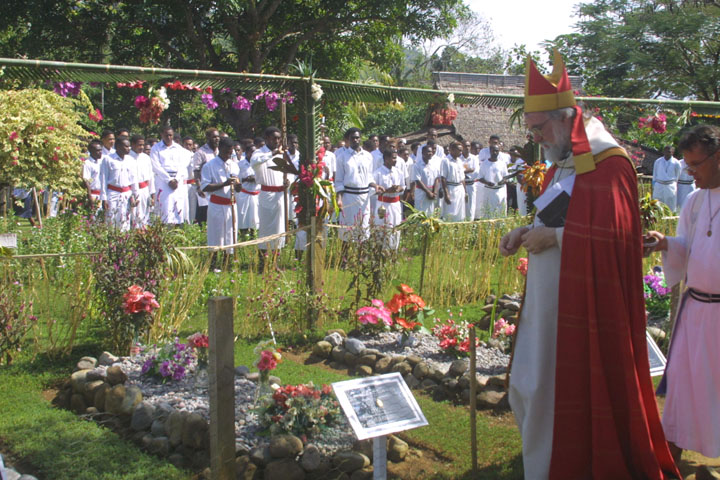
So while out process may not be the same as that found in the Roman Catholic Church (Pope John Paul II approved hundreds of saints during the time we admitted a few). I have found my involvement with it to be beneficial to my own faith. I am working on a long-term plan to help gain another group recognition in the calendar. They are the seven members of the Melanesian Brotherhood who were martyred in their successful attempt to bring peace to the then war torn Solomon Islands. The odd connection I feel with them through the experience of praying with them in their time of uncertainty I blogged about previously Widening the Human Family and I also preached about the martyrs of Melanesia here The Great Cloud of Witnesses. I trust that, in time, the witness of these seven Brothers will be added to our calendar of saints for The Episcopal Church as it has been in their own Anglican Church in the Solomon Islands and is in the process of being recognized in England.

peace,
Frank+
The Rev. Frank Logue, Pastor

Archbishop of Canterbury, Rowan Williams, at the graves of the martyrs of Melanesia.

Labels:

1 Comments:

  • At 6/06/2008 7:26 AM, Anonymous Anonymous said…

    Thanks for all of the information about saints! Now I know... :)


Post a Comment

<< Home

6/05/2008

The Path to Sainthood II

In The Episcopal Church, the process of being recognized as a saint is different from that of the Roman Catholic Church (see below). The full guidelines are online here. They say that those recognized as saints will typically exhibit the following traits: heroic faith, love, goodness of life, joyousness, service to others for Christ's sake, and devotion. They will further be already recognized by the faithful as saintly. And all of this should come with historic perspective that results from widspread recognition for two generations or fifty years or more.

Deaconess AlexanderThe main test however comes through long-term local recognition, which is allowed before national recognition. And so the commemoration of "local saints" is not only permissible, but encouraged. To that end, our Bishop, Henry I. Louttit, Jr., created a calendar of nine Saints of the Diocese of Georgia which includes the more internationally known John and Charles Wesley who both served here, as well as the lesser known Deaconess Alexander who served just north of Brunswick, Georgia and Anson Dodge who started what became Christ Church, St. Marys, among other churches. Three of those on our local list (John and Charles Wesley and Thomas Bray) are recognized by The Episcopal Church nationwide. The others may never be.

At King of Peace, our Wednesday evening worship service follows the Episcopal Church calendar's Lesser Feasts and Fasts, which gives our calendar of saints. We augment that with Bishop Louttit's list of Saints of Georgia. The readings selected point out some feature of the saints life. The sermons are designed to help us see the Gospel through the life of these people who followed Jesus faithfully in their own day. Over time, these church history lessons connected to scripture have a real power to show the interconnectedness of the Communion of Saints. We gather not to worship the saints. We gather to worship the same Lord they worshipped and to see through the life of another human, how we regular Christians can more fully follow Jesus.

Here are a few examples of those Wednesday sermons: mine on Dietrich Bonhoeffer All the Strength We Need, Jay Weldon's on Saint Benedict Taking Up the Cross and mine on Alphege Do Not Fear: Virginia Tech and Alphege of Canterbury, given the week of the shootings on the Virginia Tech campus.

Tomorrow, I'll give two examples of recently recognized saints, who I voted on in the General Convention.

peace,
Frank+
The Rev. Frank Logue, Pastor

Labels:

0 Comments:

Post a Comment

<< Home

6/04/2008

The Path to Sainthood


Becoming a saint was easy during the earliest days of Christianity when the New Testament was written. All one had to do was come to faith in God through his Son Jesus Christ by the power of the Holy Spirit. That's all it took. Become a Christian. Attend church and then you might get a letter from the Apostle Paul like the letter to the Ephesians which is written "to the saints who are in Ephesus and are faithful in Jesus Christ."

The word "Saint" means "Holy One" and all Christians were viewed as "Holy Ones," not through their own merits but because they were justified before God by their faith in Jesus. They were becoming holy (being "sanctified") over time as they came to live more Christ-like lives. But even before they were acting Christ-like, they were already called saints. This is proven by Paul's letters to "saints" with whom he then finds much to correct as he admonishes them.

The above is about recognizing God's action in making us imperfect people holy. The church's action in recognizing some people as saints is a different process, which has been in the news of late as the Roman Catholic Church considers two high profile prospects widely viewed by many as contemporary saints—Mother Theresa of Calcutta and Pope John Paul II. The Washington Post article Charting a Path to Sainthood and the New York Times articles Trials of the Saints and Miracles and the Fast Track to Sainthood detail more about this process in the Roman Catholic Church.

For Catholics, becoming recognized as a saint requires not only a saintly life free of unorthodox teaching, but also one post death miracle before beatification and another before full canonization. These miracles must be scientifically verifiable. Both John Paul II, who has a beatification website set up in his honor and Mother Theresa have detractors as well as strong supporters. Both are viewed as highly likely to be recognized by the Roman Catholic Church as saints.

Tomorrow we'll see what the process toward sainthood is like in The Episcopal Church. Tonight in our worship, we will remember The Martyrs of Uganda.

Labels:

1 Comments:

  • At 6/04/2008 8:26 AM, Anonymous Anonymous said…

    I think he's already a saint - but here's my pick: http://www.archbishopsheencause.org/


Post a Comment

<< Home