Irenic Thoughts

Irenic. The word means peaceful. This web log (or blog) exists to create an ongoing, and hopefully peaceful, series of comments on the life of King of Peace Episcopal Church. This is not a closed community. You are highly encouraged to comment on any post or to send your own posts.

6/12/2010

Go in Peace to Where?

In tomorrow's Gospel reading, Jesus is at the home of a Pharisee for a dinner when Luke's Gospel recounts,
a woman in the city, who was a sinner, having learned that he was eating in the Pharisee's house, brought an alabaster jar of ointment. She stood behind him at his feet, weeping, and began to bathe his feet with her tears and to dry them with her hair. Then she continued kissing his feet and anointing them with the ointment. Now when the Pharisee who had invited him saw it, he said to himself, "If this man were a prophet, he would have known who and what kind of woman this is who is touching him—that she is a sinner.
I preached a first-person sermon on this text found here: Go in Peace, to Where? The sermon is dramatized in the video below created by Brandon Watson with Craig Wells playing the role of the Pharisee. For those seeing this blog in Facebook, the video is found here: www.youtube.com/watch?v=5WaNXiW11uc.

Labels: ,

6/05/2010

Speak God's Word of Truth


In tomorrow's Gospelreading, Jesus raises the only son of widow of Nain. This is paired with an Old Testament reading in which the Prophet Elijah raised a boy to life. The Rev. Dr. Susanna Metz has preached on this passage concluding,
One of the many lessons we might learn from both these Scripture passages is that what Jesus and Elijah did, we must do also. We’ll probably not literally raise people from the dead, but we are called to be conduits of God’s grace, and we are called to be prophetic. Being prophetic doesn’t mean that we have to be dramatic. We are prophetic when we are aware of the needs in the world around us and we speak the truth about it. The power of prophesy is in the truth of the words and the challenge those words offer people to change for the better.

But we also know that prophets often get in trouble. The Old Testament is full of stories about prophets being reviled, ignored, harassed – and sometimes killed. John the Baptist lost his head. Jesus was crucified. Certainly we’re not supposed to be prophets like that are we?

The thing is – we are. Each one of us is called to speak God’s word of truth in a difficult world. Each one of us – not just the Dorothy Days or the Oscar Romeros, the prophets of our time – each one of us has our times to be prophetic. Different situations will affect us in different ways. Often, when we’re most prophetic, we so love what we’re doing that we don’t see ourselves as prophets.

There’s a man in Chattanooga, Tennessee, who left a very lucrative theater job in New York City to join the Brotherhood of St. Gregory. He gave everything away – absolutely everything he owned – to follow a call to serve the homeless poor as a monk in that southern city. Brother Ron lives in the shelter with the homeless. He helps them find medical assistance and food. He counsels them. He lets them know that God loves and cares for them even when they feel most alone and hopeless. Brother Ron also shares the stories of homeless people with congregations, seminarians, and city officials. The interesting thing about Ron is that even when people could be amazed and impressed by the work he does, that’s not what people see first. Ron is a prophet. He speaks the word of God to a hurting world, and he does it with power and truth. People see the graciousness of God through Ron, and they could use the same words the widow of Zarephath said about Elijah: “We know you are a man of God and that the word of the Lord in your mouth is truth.”

That sounds pretty extraordinary, but Ron isn’t all that different from you and me. Our vocations are unique. The ways we’re called to be prophetic are unique. Like any prophet, we only need to take our connection to God seriously. That connection might be through the Torah, through Baptismal promises, or through whatever our tradition holds as a means of being faithful to God. God will work wonders through each of us if we’re open. God’s word of truth can be in each of our mouths. What greater compliment could people say about us than that we are people of God?
The full text of her sermon is online here: Speak God's Word of Truth.

Labels:

1 Comments:

  • At 6/05/2010 3:14 PM, Blogger The Good Tale said…

    It is written Satan has deceived the whole world until the heel of time when a woman shall bruise him by exposing his lies Gen 3:15 check out the bruising of Satan and the true love of God for all at
    http://thegoodtale.blogspot.com
    Read all the posts to see the whole picture


Post a Comment

<< Home

5/29/2010

Both/And

click to see a larger version of the comic

105 years ago, Albert Einstein wrote a scientific paper that changed the world of physics. Among other things, Einstein proclaimed that light was both a particle and a wave. This notion was so radical that it took 20 years to really be acknowledged and even longer to be adequately validated by research to become part of a scholarly consensus.

Einstein's work was at the forefront of what we now call Quantum Physics. As physicists dove under the layers of the visible world to explore subatomic particles, they found in their mathematic equations an interconnectedness that surprised and sometimes frightened them.

The problem with light had been described in either-or terms. Light was either disconnected particles or an interconnected wave. But Einstein theorized and others proved that light is both particle and wave. Neither particle theory nor wave theory can describe light. This understanding of light has now become scientific dogma. In fact, this discovery has been part of the push in Quantum Physics to understand the interconnectedness of all things.

In the Quantum universe, relationships are more important to study than the particles themselves. We once saw the world as filled with more than 90% dark matter, or the absence of stuff. But now scientists can find and show connections between particles where no matter connects the two. There is an essential connectedness among all things.

I write this as tomorrow is Trinity Sunday, the only day of the church year devoted to a doctrone of the church. The readings for tomorrow from the New Testament are ones in which references to Father, Son and Holy Spirit are named in one passage. The word Trinity itself does not appear in scripture, but the idea of the one God being Father, Son and Holy Spirit does. And so I look to scientific understandings which show both/and as possible as I prepare to speak of God as both three and one.

These understandings from Quantum physics would not surprise St. Patrick, or early Christians for that matter, who understood God to be both three persons and one God. Neither the idea that God is three, nor the idea that God is one, could work alone to describe the attributes of God. God is three persons so completely interconnected as to be one. And we, who are made in the image of God, long to be part of that interconnectedness, that koinonia (the New Testament Greek word for communion). This is why St. Augustine wrote, that our hearts are restless until they find rest in God. We who are created in the image of God’s communion long for communion with God and with others.

We act out this Christian belief in koinonia each time we celebrate a communion service. Each of us comes as an individual (particle). We bring our own uniqueness. Through the words and actions of the service we are drawn together (wave). We say the same words, in order to commune with God. Through that communion with God, we realize that as children of God, we are brothers and sisters to all the other people on earth. Our connection to God allows for a deeper connection to other people. This is how we in our imperfect ways participate in the very life of the Trinity.

peace,
Frank+
The Rev. Frank Logue, Pastor

Labels: ,

0 Comments:

Post a Comment

<< Home

5/22/2010

Come Holy Spirit

PentecostSunday is Pentecost, the day in the church year when we celebrate the coming of the Holy Spirit to Jesus' disciples. At King of Peace, as with many other churches, it's a day for the congregation to all wear red, the color associated with the Holy Spirit because of the "tongues of fire" seen over the heads of the disciples on Pentecost (readings for this weekend are online here: Pentecost. The Rev. Rob Lord previously wrote about Pentecost at his blog, A New and Unending Kind of Life.
Alan Jones, Dean of Grace Episcopal Cathedral in San Francisco, once said, “only a fool would pray for the Holy Spirit” and then went on to say “only fools for Christ do”. To ask for the Holy Spirit may indeed be a dangerous thing. But to experience it we must ask for it. We must be willing to abandon ourselves to it. We must begin by an acceptance that the Spirit is not somewhere ‘out there’ or in some Never Never Land; but here, waiting to be invited in. The distance between us and the Kingdom of God is but a thin film that can easily be penetrated - if we intentionally seek to do so. Sadly, most of us intentionally seek other things...

In my own life, the Spirit comes not only in the "rushing mighty wind" of felt presence, but also in the still, soft dew, of waiting in silence and solitude, the lifeline of my relationship with the Lord.

Veni Sancti Spiritus - the ancient prayer and chant of the Church, is answered in so many suprising and generous ways, when we pay attention to our desire and thirst for the living God.

Are you willing to pray: Come Holy Spirit?

Labels: ,

0 Comments:

Post a Comment

<< Home

5/15/2010

Make Us One

In tomorrow's Gospel reading Jesus prays for those who will come to believe because of the testimony of his first disciples. He prays,
I ask not only on behalf of these, but also on behalf of those who will believe in me through their word, that they may all be one. As you, Father, are in me and I am in you, may they also be in us, so that the world may believe that you have sent me. The glory that you have given me I have given them, so that they may be one, as we are one, I in them and you in me, that they may become completely one, so that the world may know that you have sent me and have loved them even as you have loved me. Father, I desire that those also, whom you have given me, may be with me where I am, to see my glory, which you have given me because you loved me before the foundation of the world.
My friend Sarah Dylan Breuer has written on this passage saying in part,
Jesus asks that "those will believe in me through (the disciples') word" "may all be one." He asks that we may also "be in us" (Jesus and the Father) as the Father is in Jesus and Jesus in the Father, "so that the world may believe" that the Father sent Jesus.

That seems like a very tall order indeed, doesn't it? It may seem especially so in these days of headlines about schism and ecclesial invasions and traded accusations of heresy. Some use Jesus' words from this Sunday's gospel as a finger-wagging warning — "Jesus said we were to be 'completely one,' so who are you to step out of line?" I know that when this passage is read, some will sigh. How could Jesus' motley and feuding followers around the world not sigh when thinking about the distance between Jesus' words here and what we see around us?

We forget amidst those sighs that the words of this Sunday's gospel come not as marching orders delivered by Jesus to disciples, but as a prayer of Jesus to the Father. In other words, the unity — the communion — that we share is God's gift. Jesus asks God to grant it, not us to create it. If we doubt our own abilities to achieve unity with one another in Christ -- and well we should — we can be confident that God will answer Jesus' prayer. Unity in Christ is not a medal to be won, nor is it a negotiated settlement achieved by some at the expense of others. It is a gift flowing freely to and through us out of God's grace.

In other words, this is GOOD news, word at which our hearts can leap all the more with wonder when we recognize how deep the brokenness is that God is healing and reconciling in Christ. It's a word that is Good News not just for "my side" or my tribe, but for everyone.
The full text of her reflections is online here: Sarah Laughed.

Labels:

0 Comments:

Post a Comment

<< Home

5/08/2010

Finding Tomorrow Today

stained glass at King of Peace
In tomorrow's Gospel reading, Jesus says,
the Advocate, the Holy Spirit, whom the Father will send in my name, will teach you everything, and remind you of all that I have said to you. Peace I leave with you; my peace I give to you. I do not give to you as the world gives. Do not let your hearts be troubled, and do not let them be afraid. You heard me say to you, `I am going away, and I am coming to you.' If you loved me, you would rejoice that I am going to the Father, because the Father is greater than I. And now I have told you this before it occurs, so that when it does occur, you may believe.
The Rev. Dr. B. Wiley Stephens, senior minister of Dunwoody (GA) United Methodist Church wrote the following for Day 1 on this passage:
On this second Sunday of May it is our custom to honor our mothers. For those still blessed with their mother, we treasure the lessons we have learned or are learning in her love for us. For us who no longer have our mother, we treasure the memories that become more precious with each day.

For the disciples it was the same with Jesus. They would be pulled in many directions, but they would hold fast to what God had given through Jesus. To love him was to stay true to his word.

There is a contemporary hymn written in the l980s by Natalie Sleeth as she worked through her grief dealing with her own mother's death. The words speak of both the potential that is love and the truth that holds the future as well as our ability to trust beyond our understanding. It is called the Hymn of Promise. The words say this:

In a bulb there is a flower, in the seed an apple tree
In cocoons a hidden promise, butterflies will soon be free!
In the cold and snow of winter there's a spring that waits to be,
Unrevealed until its season, something God alone can see.

There's a song in every silence, seeking word and melody;
There's a dawn in every darkness, bringing hope to you and me.
From the past will come the future, what it holds a mystery,
Unrevealed until its season, something God alone can see.

In our end is our beginning, in our time, infinity
In our doubt there is believing; in our life, eternity
In our death, a resurrection; and at last, a victory,
Unrevealed until its season, something God alone can see.

We can live with this mystery of what the future holds because we trust the one who holds the future. We are finding tomorrow today as we find the one who will go with us into all our tomorrows. For Jesus then gives the key to this hope when he calls for us to be open to even greater things to come. "I have said these things to you while I am still with you. But the Advocate, the Holy Spirit, whom the Father will send in my name, will teach you everything, and remind you of all that I have said to you."

Mark Twain is quoted as having said, "Faith is believing what you know ain't so." We are not limited to the world we know but can with open hearts and minds seek a world that still will be revealed to us. The disciples had some great challenges ahead of them, and the gift they were being given was one that would go with them and lead them in ways they could not fully understand. They knew they were not ready. Perhaps this is one of the reasons they prayed and worshiped together for 40 days before Pentecost. Perhaps this is one of the reasons the church would struggle so as it reached out to the Gentiles. They had to believe in a world that was still coming.

But we don't start over every day. The future brings the joy of new experiences with God, but they are based on what Jesus has shown in his teachings, in his life, and in the days following our lesson in his death and resurrection. One of the great works of the Advocate, the Holy Spirit, is to reinforce what Jesus did and is doing.

For in the face of uncertainty and change, Jesus gives us the gift of peace. "Peace I leave with you; my peace I give to you. I do not give as the world gives." It may seem a strange gift to speak of in the middle of this talk of leaving, of death, and of persecution. But there it is. And it's far more than what we mean by peace being the absence of conflict, more than mere calmness or tranquility but rather the wholeness that is captured by the word Shalom. Unlike the world that would give a peace that is only a pause in the conflict. The gift that Jesus would give would keep on giving in the hard days ahead.

And with that promise of peace that would hold came the words of assurance that have spoken to countless souls through the ages, "Do not let your hearts be troubled, and do not let them be afraid." Like the kiss of a mother on a child's hurt, it may not solve all the problems, but it brings an assurance that all will be better.

Jesus was telling them of the future. Sure he would be taken, but he was coming to be with them. He wanted them to be assured of his presence, his peace, and his power before their world was torn apart. There was a center that would hold if they would believe.
The full text of his reflection is online here: Finding Tomorrow Today.

Labels:

0 Comments:

Post a Comment

<< Home

5/01/2010

As I Have Loved You


In tomorrow's Gospel reading, after Judas goes out to betray him, Jesus tells those remaining,
I give you a new commandment, that you love one another. Just as I have loved you, you also should love one another. By this everyone will know that you are my disciples, if you have love for one another.
In the early 400s, Cyril of Jerusalem (died 444 a.d.) wrote on this passage,
I give you a new commandment, said Jesus: love one another. But how, we might ask, could he call this commandment new?

Through Moses, he had said to the people of old: You shall love the Lord your God with all your heart and with all your mind, and your neighbor as yourself.

Notice what follows. He was not content simply to say, I give you a new commandment: love one another.

He showed the novelty of his command and how far the love he enjoined surpassed the old conception of mutual love by going on immediately to add: Love one another as I have loved you.

To understand the full force of these words, we have to consider how Christ loved us. Then it will be easy to see what is new and different in the commandment we are now given.

Paul tells us that although his nature was divine, he did not cling to his equality with God, but stripped himself of all privilege to assume the condition of a slave. He became as we are, and appearing in human form humbled himself by being obedient even to the extent of dying, dying on a cross. And elsewhere Paul writes: Though he was rich, he became poor.

Do you not see what is new in Christ's love for us? The law commanded people to love their brothers and sisters as they love themselves, but our Lord Jesus Christ loved us more than himself.

He who was one in nature with God the Father and his equal would not have descended to our lowly estate, nor endured in his flesh such a better death for us, not submitted to the blows given him by his enemies, to the shame, the derision, and all the other sufferings that could not possibly be enumerated; nor, being rich, would he have become poor, had he not loved us far more than himself.

It was indeed something new for love to go as far as that!

Christ commands us to love as he did, putting neither reputation, nor wealth, not anything whatever before love of our brothers and sisters. If need be we must even be prepared to face death for our neighbor's salvation as did our Savior's blessed disciples and those who followed in their footsteps.

To them the salvation of others mattered more than their own lives and they were ready to do anything or to suffer anything to save souls that were perishing. I die daily, said Paul. Who suffers weakness without my suffering too? Who is made to stumble without my heart blazing with indignation?

The Savior urged us to practice this love that transcends the law as the foundation of true devotion to God. He knew that only in this way could we become pleasing in God's eyes, and that it was by seeking the beauty of the love implanted in us by himself that we should attain to the highest blessings.

Labels:

1 Comments:

  • At 4/23/2016 9:59 AM, Anonymous Anonymous said…

    I am a Catholic priest and I am very grateful for the quote you shared-they have helped me in preparation for my Sunday homily. I was looking for additional commentaries on Jesus' new commandment and I had the inspiration to look up what Cyril of Jerusalem said about it. Totally random, but it brought me to this website. Thanks for your work and blessings to you.


Post a Comment

<< Home

4/24/2010

Our Shepherd Leads Us

A Roman mosaic in Ravena of Jesus as the Good Shepherd

The Psalm for tomorrow is that most familiar of Hebrew poetry, the 23rd Psalm, which in the King James Version says,
The Lord is my shepherd; I shall not want.
He maketh me to lie down in green pastures;
He leadeth me beside the still waters.
He restoreth my soul;
He leadeth me in the paths of righteousness for his Name’s sake.
Yea, though I walk through the valley of the shadow of death,
I will fear no evil; for thou art with me;
Thy rod and thy staff, they comfort me.
Thou preparest a table before me in the presence of mine enemies;
Thou anointest my head with oil; my cup runneth over.
Surely goodness and mercy shall follow me all the days of my life,
And I will dwell in the house of the Lord for ever.
The Gospel reading has Jesus in Jerusalem for the Festival of the Dedication of the Temple (which we call Hanukkah) saying,
My sheep hear my voice. I know them, and they follow me. I give them eternal life, and they will never perish. No one will snatch them out of my hand.
My friend and fellow church planter, the Rev. Susan Snook, has drawn these two passages together in a sermon written a few years ago in the aftermath of the Virginia Tech shooting that says in part,
At the Feast of the Dedication, the feast we now know as Hanukkah, the people remembered how the nation rededicated the temple after a great leader, Judas Maccabeus, defeated the Greek conquerors in 164 BC. The festival remembered the suffering of the Jewish people under the Greek Empire, and rejoiced at their great victory. Against this background, with Roman soldiers hovering and memories of thousands of crucified would-be rebels and other unjust suffering fresh in their minds, people asked Jesus, “Are you the Messiah?” Would Jesus be the new hero who would drive out the Roman invader? Would the nation be free and independent once more?

The people crowding around Jesus want a clear and decisive answer. Instead, he is cryptic and evasive. The people want him to speak with authority about weapons and strategies; instead, he talks about sheep. To their demand that he assume the leadership for which they have been hoping, he answers with a claim of leadership so astounding that many of them pick up stones to kill him on the spot: he claims to be one with God the Father.

This is no gentle, clear-eyed Jesus on a green, rolling hillside; this is a fierce, uncompromising Jesus, a Jesus who refuses to meet any earthly expectations, a Jesus whose frame of reference is so far removed from that of the people around him that it is a wonder he escapes with his life. And indeed, John tells us that the next time Jesus dares to show his face in Jerusalem, the chief priests cook up a scheme to have him crucified.

How do we reconcile the gentle, kind shepherd Jesus, the one who would go anywhere and risk anything to save even the smallest lamb, with the Jesus who provoked his enemies to violence? And how does this Jesus have anything at all to do with the worries and dangers of our lives? How can our faith in Jesus help us through a tragedy like the one at Virginia Tech? What can the gentle shepherd do to help?

The wonderful thing about Psalm 23 is just how realistic it is about the darkness of life. Perhaps the picture we get of the Good Shepherd from art and music and childhood memories is an image of pure light and pure sweetness. But the psalm itself knows darkness and fear. Like the writer of the psalm, many Christians have traveled through the Valley of the Shadow of Death. They too have known the threat of the unknown. And yet many have also known the comfort of God’s presence, walking alongside them through that dark valley. Many people have felt the exquisite sweetness of Jesus’ love surrounding and enfolding them in the most difficult moments of their lives. Many have experienced transcendent holiness and light in the darkest of times.

People who spend much time with those who are ill or bereaved begin to know what kind of help brings true comfort. Comfort does not come from assurances that everything will be all right or from platitudes that try to explain why everything that happens is God’s will. Comfort comes from the simple presence of companions who are willing to sit alongside us in our darkest hours, to walk through the darkness with us, to help us make the darkness holy, and to rejoice with us when small glimmers of light finally begin to shine.

And at the heart of it, that is what our Christian faith can tell us. It tells us that our Lord and Savior, the great hero who liberates us, is not the God of light alone. Jesus is sovereign over the darkness too, because he too has been enfolded by darkness. Like us, he has grieved over the senseless waste and tragedy of life. Like us, he has agonized over those who suffer. As all of us will eventually, he has entered into the darkness of death. And with all of us, he promises to walk that road so that we do not have to walk it alone. “Yea, though I walk through the valley of the shadow of death, I will fear no evil, for thou art with me.”

The ultimate truth of our Christian faith, the truth we remember this Easter season and every Sunday as we celebrate the Lord’s Resurrection, is that our Shepherd leads us out of death into life.
The full text of her sermon is online here: Our Shepherd Leads Us.

Labels:

0 Comments:

Post a Comment

<< Home

4/17/2010

Plenty of Room in the Net

click to find out more about this paintingIn tomorrow's Gospel reading, Jesus' post-resurrection appearance occurs on the shore of the Sea of Galilee. The disciples are back at the nets and have turned up no fish. He tells them to cast on the right side of the boat. They do as he says and catch more than they can haul in, landing 153 fish.

I have preached on this odd detail of knowing how many fish are in the net, saying in part,
With the impetuous Peter paddling to shore, the remaining disciples struggle in the hundred yards with bulging nets in tow. Once on shore we are told that they have caught large fish, 153 of them.

I want to pause here for a moment. 153 fish. Really. Who counted them. John, the future Gospel writer stops being the disciple whom Jesus loved long enough to turn into reporter. This will make a great scene in my book John thinks and starts stacking up the fish. “One, two, three, four. No Nathanael don’t move them, I’m counting. One, two, three, four.” And on he counts until “151, 152, 153.” So much for breakfast on the beach with Jesus.

The great commentator on scripture, Jerome, offered a different possibility. Jerome cites a source that Greeks taught of 153 species of fish. If Jerome is right, this number may be symbolic of what is actually happening on the beach that morning. When they followed Jesus’ instructions, the disciples did not just catch fish, they caught big ones. And they didn’t just catch a lot of fish, but all the kinds of fish there are to be caught. Now that’s the fishing story to end all fishing stories. They didn’t just have a good haul of fish, symbolically they caught them all. It is the fish story version of the line from Revelation that says, “You ransomed for God saints from every tribe and language and people and nation.”

What I think is going on here is that the spiritually-in-tune John is telling us what they really learned that morning they had the big catch, and it was not a fishing lesson. These men were apostles, which means someone who is sent out. Jesus was sending them out to start fishing for people in a big way and he provided an object lesson to bring the point home.

The Kingdom of God is not just for people who look like you, think like you, act like you. The Kingdom of God is for all the peoples of the earth. And the net is big enough to hold them all without tearing. John makes this point clear in writing, “Simon Peter went aboard and hauled the net ashore, full of large fish, a hundred fifty-three of them; and though they were so many, the net was not torn.”

click to find out more about this paintingThere is room in God’s kingdom for everybody, all kinds of people. In fact, the net won’t be full until it has every kind of person in it. Every tribe, language, people and nation. Don’t worry. It won’t tear. There is plenty of room in the net.

Then came breakfast. Jesus feeds his disciples again. Bread and fish, just like with the thousands on the hillside. This is making the message even clearer. See the net that catches all the kinds of fish and does not break. See the meal of bread and fish, just like before. Now remember that you are to go into all the world with this message of God’s love.

The hard part would have been leaving the beach...Yet, if those guys stay on the beach, then the Good News of Christianity never reaches you and me. Jesus longed for a relationship with all that he had made and the way to get it was for these guys around the campfire to get going....

It happens again and again. A church feels like a family. We all know and love each other. We may rub each other the wrong way now and again, but when it is family-sized, it feels like family. Every family has its little problems, folks who go on and on at family reunions and bore you with their stories. But, you just know that you took your turn with Uncle Joe at the last get together and so cousin Sally is taking her turn this time. It will be OK. Yet families grow. Folks marry, babies are born. Things change. But with churches, if we don’t watch it, we get that cozy breakfast on the beach feeling and forget that the net isn’t even close to full. We can look at a congregation and feel satisfied, everything is just about right. Jesus looks around and sees a lost and hurting world that needs someone to reach out to it in love and finds all the folks holding nets feel like their net is just about topped off. I’m sorry Jesus. This boat is full. No more room for smelly fish here....

Our loving God wants all creation to love like Jesus loves, and guess what? You are the one holding the net. Since the net is the Kingdom of God, you might not even be sure if there is a net, or if you are in the net yet. But God is still giving you the chance all the time to love as Jesus loves. You can sit back by the fire and decide to listen a bit more to the fish stories, or you can reach out in love with confidence that there is plenty of room in the net.
The full text of the sermon is online here: Plenty of Room in the Net.

peace,
Frank+
The Rev. Frank Logue, Fisher of Men (Women and Kids too)

click to find out more about this painting

Labels: ,

0 Comments:

Post a Comment

<< Home

4/10/2010

How do we know Jesus' resurrection was real?

In tomorrow's Gospel reading, we will read of the disciple Thomas doubting Jesus' resurrection after Jesus appears to the others while Thomas was away. I preached on this passage making a case for what we know about the resurrection and why I believe:

Last Sunday was Easter and we joyously celebrated the miracle of Jesus’ resurrection. A week has passed. The joy has subsided enough to look at things in the light of day. I want to dare to ask the question, “How do we know they didn’t just make it up?”

After all, we were all born centuries after that first Easter. On a morning when we have just read how Jesus’ own friend Thomas doubted whether the resurrection was true, we should feel emboldened to ask a couple of questions of our own. How do we know that the disciples did not just wish Jesus had been resurrected? How do we know they didn’t have something at stake in fooling everyone else into thinking that Jesus came back from the dead?

First, I want to give the standard answer and show the problems some folks have in accepting it. Then we will look a little harder to see if we might have something more to say on the matter to see if it holds up.

Here is the way the standard answer goes. The best proof of the resurrection is the change in Jesus’ own disciples. Before the resurrection, those same apostles were scared, hiding from persecution. After an encounter with their risen Lord, they were brave enough to take to the streets as Peter does in this morning’s reading from the Acts of the Apostles.

Yes, the disciples might have told a lie to keep the Jesus’ myth going, but not once it came at the price of their very lives. The disciples were in a position to know whether the resurrection stories were the truth or a lie. They were the very witnesses to Jesus’ resurrection. They might lie to keep the story going if it meant filling their purses with money, but when persecution came, they would back away from their claims of Jesus’ resurrection. When push came to shove they would not die for a lie?

That’s the standard answer and it works pretty well. The Bible does describe to us the beginnings of persecution against the early Christians. We hear of the first Deacon, Stephen, being stoned to death. But, we have no reason to believe he was a witness to the resurrection. We also read of the death Jesus’ brother James, who was himself converted by an encounter with the resurrected Christ. James was pushed off the top of the Temple for refusing to renounce his faith in Jesus. James would have been in a position to know the truth. Would he have died for a lie?

As for the other disciples, their fates are not described in the Bible. In fact, there is no good solid historical evidence for what happened to them, just traditions, that sometimes contradict one another. Yet, the traditions all have the apostles dying for their faith with the sole exception of John, who is said to have died of old age in Ephesus. Even if a skeptic were to grant that the traditions about these men having been put to death for their belief in Christ were true, would this prove that Jesus was really and truly raised from the dead? Not exactly.

Let’s be honest. It could have been a delusion—mass hysteria fed by a desire for the resurrection to be real. Maybe they felt that Jesus was somehow still present to them and they wished it into a historic fact. Or maybe they talked of Jesus’ teaching still being with them and later believers worked with the story until they told it that Jesus’ was resurrected. A symbolic event could have been confused as being an historic event by people living a few generations later.

The full sermon is online here: The Resurrection: An Apology and it continues by taking an honest look at the evidence for the resurrection.

peace,
Frank+
The Rev. Frank Logue, Pastor

Labels: , ,

0 Comments:

Post a Comment

<< Home

3/27/2010

What language does God speak?

Tomorrow's Gospel Reading is Luke's account of the Passion. We hear Jesus proclaim from the cross, "Father, forgive them; for they do not know what they are doing." In preaching on this passage previously, I wrote a story in which a Tanzanian man sets out on a pilgrimage to discover God's own language:

In the summer of 1998, I journeyed to Tanzania to take part in a cross-cultural internship sponsored by the Seminary. I worked in western Tanzania in an Anglican Church led by a Tanzanian priest. While there, I was asked several times, “What is your mother tongue?” You see in East Africa, everyone speaks Swahili, and many people speak English. But these are not the languages of home. Among their own tribe, their own family, most East Africans speak their tribal language. This language is their mother tongue. Whenever I explained that English was my mother tongue, people always felt sorry for me. They knew that I was a much poorer person for not having a mother tongue, a special language spoken only among my own people.

This concern about a mother tongue is reflected in a story told in East Africa of a man from the Dodomo district of Tanzania named Msafiri. Msafiri followed the traditional African religion of his people, the Wagogo. He believed in one God, the creator who is the source of all good things. Msafiri approached God by praying to his ancestors who he believed still watched over their people.

An Anglican evangelist came to his small village and began teaching the people about Christianity. Msafiri listened to the evangelist as he told about God sending his son Jesus to live among us. The stories of Jesus life, his death and resurrection touched Msafiri and he converted to Christianity. He studied with the evangelist and was baptized, taking the name Simon, for Simon of Cyrene, the African saint who had carried Jesus’ cross to Calvary.

Simon Msafiri went to church faithfully, always attending the Wednesday fellowship meetings and Sunday services. Gathered with the other Christians under the grass roof of the mud-walled church they had built together, he learned the stories from the Bible.

Simon Msafiri prayed to God in Kigogo, the language of his own people instead of the Swahili that he used in town with others. This was Simon’s mother tongue and was part of Simon’s ties to his extended family. Simon knew that God understood him when he spoke Kigogo, but he decided that God, too, must have a mother tongue—a language that was God’s own language from before time. Simon wanted to learn to pray to God in God’s own mother tongue. One day he asked the evangelist, “What is God’s mother tongue?” The evangelist thought for a moment and then said that God doesn’t have a mother tongue—all languages are the same to God.

Simon listened and thanked the evangelist. But as he went home, he began to wonder about the evangelist’s answer. Everyone Simon knew had a mother tongue they learned as a child and used among their own people. If the people Simon knew had a mother tongue, then God must as well. He decided to ask some of the elders of the village to get the answer to his question. One man said that God, as the great ancestor, must speak the language of their ancestors, Kigogo. Another said that surely God’s mother tongue is Swahili. These answers didn’t sound right to Simon and he decided to set out on a great safari, a journey to find his answer.

The full text of the sermon is online here: What language does God speak?

Labels: , ,

0 Comments:

Post a Comment

<< Home

3/20/2010

Extravagent Excessiveness

In tomorrow's Gospel reading, Mary of Bethany takes a pound of costly perfume made of pure nard, anoints Jesus' feet, and wipes them with her hair. Judas Iscariot, who keeps their common purse, is incensed that the money was not given to the poor.

Noted preacher Barbara Brown Taylor reflects on this passage for Day One, writing in part,
"Why wasn't this perfume sold for a whole lot of money and given to the poor?" That's what Judas wants to know, but Jesus brushes him aside.

"Leave her alone," he says. "She bought it so that she might keep it for the day of my burial. You always have the poor with you, but you do not always have me"--which is

about as odd a thing for him to say as what Mary did. Here is the champion of the poor, always putting their needs ahead of his, suddenly reversing course. Leave her alone. Leave me alone. Just this once, let her look after me, because my time is running out.

Whatever Mary thought about what she did, and whatever anyone else in the room thought about it, Jesus took it as a message from God--not the hysteric ministrations of an old maid gone sweetly mad but the carefully performed act of a prophet. Everything around Mary smacked of significance--Judas, the betrayer, challenging her act; the flask of nard--wasn't it left over from Lazarus' funeral?--and out in the yard, a freshly vacated tomb that still smelled of burial spices, waiting for a new occupant. The air was dense with death, and while there may at first have been some doubt about whose death it was, Mary's prophetic act revealed the truth.

She was anointing Jesus for his burial, and while her behavior may have seemed strange to those standing around, it was no more strange than that of the prophets who went before her--Ezekiel eating the scroll of the Lord as a sign that he carried the word of God around inside of him (Ezekiel 2), or Jeremiah smashing the clay jar to show God's judgment on Judah and Jerusalem (Jeremiah 19), or Isaiah walking around naked and barefoot as an oracle against the nations (Isaiah 20). Prophets do things like that. They act out. They act out the truth that no one else can see, and those standing around either write them off as nuts or fall silent before the disturbing news they bring from God.

When Mary stood before Jesus with that pound of pure nard in her hand, it could have gone either way. She could have anointed his head and everyone there could have proclaimed him a king. But she did not do that. When she moved toward him, she dropped to her knees instead and poured the perfume on his feet, which could only mean one thing. The only man who got his feet anointed was a dead man, and Jesus knew it. "Leave her alone," he said to those who would have prevented her. Let her finish delivering the message.

So Mary rubbed his feet with perfume so precious that its sale might have fed a poor family for a year, an act so lavish that it suggests another layer to her prophecy. There will be nothing economical about this man's death, just as there has been nothing economical about his life. In him, the extravagance of God's love is made flesh. In him, the excessiveness of God's mercy is made manifest.

This bottle will not be held back to be kept and admired. This precious substance will not be saved. It will be opened, offered and used, at great price. It will be raised up and poured out for the life of the world, emptied to the last drop. Before that happens, Jesus will gather his friends together one last time. At another banquet, around another supper table, with most of the same people present, Jesus will strip, tie a towel around his waist, and wash his disciples' feet. Then he will give them a new commandment: Love one another, as I have loved you.
The full text of her reflection is online here: The Prophet Mary.

Labels: ,

0 Comments:

Post a Comment

<< Home

3/13/2010

The Forgiving Father


In tomorrow's Gospel reading Jesus tells one of his best known parables, The Prodigal Son. Noted Episcopal preacher Barbara Brown Taylor once preached a sermon on this text called The Parable of the Disfunctional Family. I have seen some fellow preachers passing this sermon around this week with awe. My friend Kit writing that a sermon like this one makes her want to just stand in silence in the pulpit. Barbara Brown Taylor wrote in part,
The beauty of a really good parable—in the case of the prodigal son, perhaps the most beloved parable of all time—is that it meets generations of listeners wherever they are: in first century Palestine, in fourth century Rome, in sixteenth century Geneva, or in twenty-first century Chicago. Everyone has a weird family. Everyone has at least thought about running away from home. And whether or not you happen to have one yourself, almost everyone knows what a pain a sibling can be—especially when there are only two of you, so that the “good child/bad child” thing hovers over you no matter which one you happen to be at any given time. For these reasons and more, the parable of the prodigal son stays young no matter how old it is, giving all kinds of people all kinds of ways to make the story their own.

The problem with a really good parable—especially one as beloved as this one--is that it can become limp from too much handling. Like the velveteen rabbit, it can lose its eyes, its whiskers, and a lot of its stuffing, until it conforms to the arms of whoever picks it up. After a while, you hardly have to hold it anymore. You can just sling it over your wrist, with the head on one side and the body on the other, trusting it to stay put while you go about your business. That’s how you know you don’t have a live parable anymore, capable of leaping from your arms and leading you out to where you did not mean to go. You have a domestic pet instead, as captive to you as you are to your culture.

In twenty-first century Chicago, there is nothing remarkable about a young man deciding to leave his father’s home, where he will never be anything but the baby brother, to go seek his fortune in the world. This is so American that it’s hard to remember this boy is not from southern Illinois. From Daniel Boone to Lance Armstrong, the rugged individual is a national icon. The younger son did what young men are born to do. He may have hurt his father in the process, but his father understood, since he probably did the same thing himself. The difference was that the father made good and the son did not.

By failing at his individuation project, the son fell short of the American ideal, but all was not lost. In place of worldly success, he won wisdom, returning home to beg his father’s forgiveness—which his father gave him before he asked. The boy who was lost to his father was found. The son who was dead came back to life, and though he still had some things to work out with his elder brother, he was restored to his family and to his father’s love, sadder but wiser for all that he had brought upon himself.
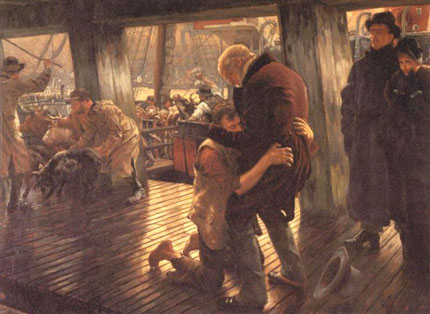
Told in this way, the parable is indeed the parable of the prodigal son—a story about the vastness of a father’s love, available to a wastrel son who returns home with true repentance in his heart. The way most Christians tell it, it is about our individual relationships with God. When we decide to go home and say we’re sorry, we too can be sure that a banquet awaits us—the improbable feast given in our honor by a father whose divine grace exceeds all human reason.

That’s a perfectly good story. It is also, I think, an American Protestant one, which is fine for those who want Jesus to be more like us. If we want to be more like him, however, then it is worth wondering what this story might have meant to a Middle Eastern audience hearing it from a Middle Eastern storyteller in the middle of the first century. What does Jesus know about the dynamics of this story that we do not know, because he told it in a different world?
She goes on to draw more from the story in a beautifully written sermon. The full text of her sermon is online here: The Parable of the Disfunctional Family.

Labels:

0 Comments:

Post a Comment

<< Home

2/20/2010

Settling for Less

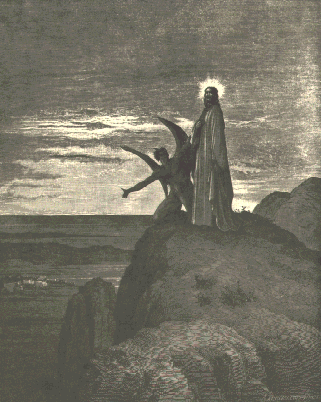
In tomorrow's Gospel reading, Jesus is tempted in the wilderness after his baptism.

Barbara Brown Taylor wrote in 1998 on this week's readings for the Christian Century,
Do not bother looking for Lent in your Bible dictionary. There was no such thing in biblical times. There is some evidence that early Christians fasted 40 hours between Good Friday and Easter, but the custom of spending 40 days in prayer and self-denial did not arise until later, when the initial rush of Christian adrenaline was over and believers had gotten very ho-hum about their faith.

When the world did not end as Jesus himself had said it would, his followers stopped expecting so much from God or from themselves. They hung a wooden cross on the wall and settled back into their more or less comfortable routines, remembering their once passionate devotion to God the way they remembered the other enthusiasms of their youth.

Little by little, Christians became devoted to their comforts instead: the soft couch, the flannel sheets, the leg of lamb roasted with rosemary. These things made them feel safe and cared for—if not by God, then by themselves. They decided there was no contradiction between being comfortable and being Christian, and before long it was very hard to pick them out from the population at large. They no longer distinguished themselves by their bold love for one another. They did not get arrested for championing the poor. They blended in. They avoided extremes. They decided to be nice instead of holy, and God moaned out loud.

Hearing that, someone suggested it was time to call Christians back to their senses, and the Bible offered some clues about how to do that. Israel spent 40 years in the wilderness learning to trust the Lord. Elijah spent 40 days there before hearing the still, small voice of God on the same mountain where Moses spent 40 days listening to God give the law. There was also Luke’s story about Jesus’ own 40 days in the wilderness during which he was sorely tested by the devil. It was hard. It was awful. It was necessary, if only for the story. Those of us who believe it have proof that it is humanly possible to remain loyal to God.

So the early church announced a season of Lent, from the old English word lenten, meaning "spring"—not only a reference to the season before Easter, but also an invitation to a springtime for the soul. Forty days to cleanse the system and open the eyes to what remains when all comfort is gone. Forty days to remember what it is like to live by the grace of God alone and not by what we can supply for ourselves.

I think of it as an Outward Bound for the soul. No one has to sign up for it, but if you do then you give up the illusion that you are in control of your life. You place yourself in the hands of strangers who ask you to do foolhardy things, like walk backwards over a precipice with nothing but a rope around your waist or climb a sheer rock face with your fingers and toes. But none of these is the real test, because while you are doing them you have plenty of people around and lunch in a cooler.

The real test comes when you go solo. The strangers put you out all by yourself in the middle of nowhere and wish you luck for the next 24 hours. That is when you find out who you are. That is when you find out what you really miss and what you are really afraid of. Some people dream about their favorite food. Some long for a safe room with a door to lock and others just wish they had a pillow, but they all find out what their pacifiers are—the habits, substances or surroundings they use to comfort themselves, to block out pain and fear.

Without those things they are suddenly exposed, like someone addicted to painkillers whose prescription has just run out. It is hard. It is awful. It is necessary, to encounter the world without anesthesia, to find out what life is like with no comfort but God. I am convinced that 99 percent of us are addicted to something, whether it is eating, shopping, blaming or taking care of other people. The simplest definition of an addiction is anything we use to fill the empty place inside of us that belongs to God alone.

That hollowness we sometimes feel is not a sign of something gone wrong. It is the holy of holies inside of us, the uncluttered throne room of the Lord our God. Nothing on earth can fill it, but that does not stop us from trying. Whenever we start feeling too empty inside, we stick our pacifiers into our mouths and suck for all we are worth. They do not nourish us, but at least they plug the hole.

To enter the wilderness is to leave them behind, and nothing is too small to give up. Even a chocolate bar will do. For 40 days, simply pay attention to how often your mind travels in that direction. Ask yourself why it happens when it happens. What is going on when you start craving a Mars bar? Are you hungry? Well, what is wrong with being hungry? Are you lonely? What is so bad about being alone? Try sitting with the feeling instead of fixing it and see what you find out.

Chances are you will hear a voice in your head that keeps warning you what will happen if you give up your pacifier. "You’ll starve. You’ll go nuts. You won’t be you anymore." If that does not work, the voice will move to level two: "That’s not a pacifier. That’s a power tool. Can’t you tell the difference?" If you do not fall for that one, there is always level three: "If God really loves you, you can do whatever you want. Why waste your time on this dumb exercise?"

If you do not know whom that voice belongs to, read Luke’s story again. Then tell the devil to get lost and decide what you will do for Lent. Better yet, decide whose you will be. Worship the Lord your God and serve no one else. Expect great things, from God and from yourself. Believe that everything is possible. Why should any of us settle for less?

Labels:

0 Comments:

Post a Comment

<< Home

2/13/2010

The Darkness of God

In tomorrow's Gospel reading, we read Luke's account of Jesus' Transfiguration (the Greek is "Metamorphosis") on a mountain prior to his crucifixion. In 2002, I preached on this picking up on God "overshadowing" the group on the mountain in a cloud. I preached in part,
God is light and that is good. Darkness is bad and God has nothing to do with darkness, because darkness is the absence of light. This is a good solid image from the Bible. This idea of God being light is a helpful metaphor, and we see in times like the Transfiguration that God as light may be more than a metaphor as Jesus’ face shines like the sun and his clothes take on a dazzling brightness.
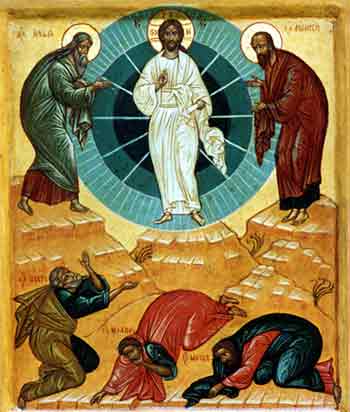
Then we get the paradoxical description of the group being overshadowed by a bright cloud. From the cloud, God the Father booms out “This is My Son, the Beloved, with him I am well pleased; listen to him!”

God speaking from this bright cloud should remind us of Jesus’ baptism when God spoke from a cloud saying, “This is my son, the beloved, with him I am well pleased.” The only difference this second time is that God adds, “Listen to him.” Not bad advice really. But this scene also calls to mind Moses own journey, which we read this morning in the book of Exodus.

Moses too went up a high mountain. God also called to Moses from a cloud. Moreover, later, beyond our reading for today, Moses too would come down the mountain with his face shining. In fact, Moses face shone so brightly that the people wanted him to cover his face with a veil.

The stories of Jesus on the mount of transfiguration and Moses on Sinai are similar, but not quite the same. Moses mountain is covered in cloud, which Moses enters to experience more of God. Moses’ story is connected to another strand within the Bible, a thread winding itself through scripture in which God seems to go with darkness.

It reminded me of creating the service for Christmas Eve. I wanted to change the Prayers of the People to use the form in the book Intercessions for the Christian People, which tailors the prayers to the scripture for the day. The prayer for Christmas Eve ended,

God of darkness and silence, you have pierced the quiet of this night by the utterance of your word made flesh. May our words of praise and petition be strong echoes of your Christmas word, so that all might come to the peace you promise in Jesus, who is Lord and God this night and forever. Amen.

When I first read, “God of darkness and silence,” I was tempted to edit it. I knew of this strand of scripture where God is described as darkness and silence, but it didn’t seem right for the season of celebrating the light of the world coming into the world. Yet, as I prayed about it, I knew that the people who wrote the prayers were on to something. At the Christmas season, many folks are in darkness or not hearing from God and they too should find themselves in the liturgy.

If you will indulge me one more time, I would like to share with you some of the many scriptures that speak positively of God and darkness:

Earlier in Exodus we are told “The people stood at a distance, while Moses drew near to the thick darkness where God was” (Exodus 20:21).

In the second book of Samuel God speaks to David who describes the event saying, “Thick darkness was under his feet” and “he made darkness around him a canopy” (2 Samuel 22:10-14).

In the first book of Kings story of the dedication of Solomon’s Temple records the glory of the Lord coming upon the place like this, “And when the priests came out of the holy place, a cloud filled the house of the Lord, so that the priests could not stand to minister because of the cloud; for the glory of the Lord filled the house of the Lord. Then Solomon said, ‘The Lord has said that he would dwell in thick darkness’” (1 Kings 8:10-12).

In Psalm 97, we hear, “The Lord is King! Let the earth rejoice; let the many coastlands be glad! Clouds and thick darkness are all around him; righteousness and justice are the foundation of his throne” (Psalm 97:1-2).

The prophet Isaiah told us a lot about light and darkness, particularly saying that the Messiah would be a light to the nations. But Isaiah also wrote, “I will give you treasures of darkness and riches hidden in secret places, so that you may know that it is I, the Lord, the God of Israel, who call you by name” (Isaiah 45:3).

I was helped with these lesser known scriptures describing God as dwelling in darkness by a sermon collection I read just before I started seminary. The book, called A Ray of Darkness, was written by the current Archbishop of Wales, Rowan Williams.[1] In it, Williams has several sermons which deal with this imagery of God as darkness.

The title of Williams book comes from the writings of a fifth-century Syrian monk who wrote using the pen-name Dionysius. For Dionysius, God sometimes cuts through our lesser light of understanding with a ray of darkness. This means that just when we think we get it, we understand who God is and how God acts, God shows us that we cannot contain God. This revelation cuts through our complacency like a ray of darkness.

William’s writes, “when God’s light breaks on my darkness, the first thing I know is that I don’t know, and never did.”

When God is described as enshrouded in a cloud or darkness, scripture is showing us God calling us to a deeper experience of God. God is calling us into his own glory, into the secret places of which we as of yet know nothing.

These two images of God being light and darkness are reconciled when we consider the brightness of the sun. If you stare into the brightness of the sun, you get blinded by the light. Look away from the sun and you won’t be able to see other things so clearly for a while. All is plunged into darkness compared to the bright light you have experienced.

Writers through the centuries have struggled to describe how the experience of God can plunge us into darkness. In fact struggling with the darkness of God was a popular spiritual and literary pursuit from the time of Moses through the seventeenth century. Just as this strand of scripture was falling out of favor in the 1600s, the Welsh poet Henry Vaughn wrote,

“There is in God (some say),
A deep but dazzling darkness.”

Dazzling darkness is just the sort of paradox writers often used, not unlike Dyonisius writing of a Ray of Darkness to describe what it is like to have the deep and hidden things of God break into our lesser understanding of God.

But what value is the story of Moses entering a cloud to experience God more deeply? What value is Solomon’s assertion that God has said he will live in deep darkness? How can a ray of darkness get me though the coming week?

We learn from this darkness imagery primarily that God is God and we are not. God’s thoughts are not our thoughts, God’s ways are not our ways.

In a sermon titled The Dark Night, Rowan Williams’ puts it like this,

“If you think devotional practices, theological insights, even charitable actions give you some sort of a purchase of God, you are still playing games. On the other hand, if you can accept and even rejoice in the experience of darkness, if you can accept that God is more than an idea that keeps your religion or philosophy or politics tidy—then you may find a way back to religion, philosophy, or politics, to an engagement with them that is more creative because you are more aware of the oddity, the uncontrollable quality of truth at the heart of all things.”

God cannot be controlled. Sometimes we will seek God and not find God, not because God is not there, for God is present in the silence, but because God avoids our every attempt at making God predictable, tame, safe.

Carry this with you as we journey through the season of Lent. When you reach out to God and experience darkness and silence, God is in that darkness and silence. Sometimes darkness and silence are the only ways the God of light and word can get our attention. Don’t give up on God but pray for a deeper experience of him even as you feel most deeply God’s absence.

God may be breaking into your lesser light, your lesser understanding, your lesser experience of God with a ray of darkness. Be open to God and God will bring to light the things now hidden in darkness.
The full text of the sermon is online here: The Darkness of God.

peace,
Frank+
The Rev. Frank Logue, Pastor

Labels:

0 Comments:

Post a Comment

<< Home

2/06/2010

Why Some People Don't Catch Fish


God alone put the sword in the swordfish,
the sail on the sail fish.
He put the big in the whale
and the play in the dolphin;
it was Him alone who put electric in the eel
and just because He's God.
And if He's God enough to do all of that,
what can He do with you,
when you're ready to catch fish?
—Robert C. Wright


In tomorrow's Gospel reading, Luke tells us that Jesus preached to a large crowd out of Simon's boat. As the sermon finished, he told Simon, "Put out into the deep water and let down your nets for a catch." Simon explained how they had been out all night and caught nothing, he added though, "Yet if you say so, I will let down the nets." They ended up catching an amazing load of fish, so that it took two boats to haul in the nets. My friend from seminary, the Very Rev. Robert C. Wright (who wrote the delightful quote above) reflected on this passage for Day One saying,
Some people don't catch fish because they refuse to go into deep water. Jesus told Simon, "Let's leave the shallows and go to the deep."

Everybody knows the schools of big fish are in the deeper water. And the first rule of fishing is you've got to go where the fish are. But we shouldn't limit this to fish only. Jesus was teaching a spiritual principal.

We could substitute fish for abundance or wisdom or love, healing or peace. All those things we want in abundance. Some people don't catch these things because they simply refuse to go deep.

Deep water is where the increase is. Deep water takes faith. Deep water is a risk. Focus of mind and heart are needed.

The visibility in deep black water is next to nothing. You've got to trust the words and directions of others who have passed through deep water to make it there. Jesus is always inviting people to the deeper end of things.

But shallow water is pleasant. It tickles our ankles when we walk in it. The minnows and the half-grown fish gather there. You can see all the way to the bottom in shallow water.

Christensen's painting of Brendan the NavigatorStaying in shallow water is such a temptation. Shallow water doesn't cost much; it doesn't take a whole lot of courage. But Simon knew the minnows couldn't feed him. They couldn't fill him. The minnows weren't the desire of his heart. The deep water of faith is where those things we say we want are swimming around. The shallow is where we begin the adventure, not where we finish.

There is a time for classes and listening and a time to live what we've learned, a time to receive and a time to give sacrificially, a time to worship the Lord in church, and a time to be church and lead the world in the worship of the Lord.

Deep water is where we have to go to get what God has for us.
The full text of his reflection is worth reading. It is online here: Why Some People Don't Catch Fish.

Labels:

1 Comments:

  • At 2/06/2010 9:14 AM, Blogger infidel said…

    The reason why I don't catch fish, is because I am using the wrong bait. Self denial is not a good bait. Passing your very own "T" bone steak to another is not a good bait. When we pursue righteousness this is our bait, but on the other side of the coin, eat, drink and be merry, is the bait that will get the most attention

    Clarence


Post a Comment

<< Home

1/30/2010

Do we want a gracious God?

Jesus in the synagogue in Nazareth Luke 4
In tomorrow's Gospel reading, we continue from last week when we read of Jesus going to the synagogue in Nazareth. Jesus tells those gathered for worshop that day,
Truly I tell you, no prophet is accepted in the prophet's hometown. But the truth is, there were many widows in Israel in the time of Elijah, when the heaven was shut up three years and six months, and there was a severe famine over all the land; yet Elijah was sent to none of them except to a widow at Zarephath in Sidon. There were also many lepers in Israel in the time of the prophet Elisha, and none of them was cleansed except Naaman the Syrian.
This mention of what God did and did not do during the time of Elijah and Elisha gets folks angry. Luke's Gospel tells us,
When they heard this, all in the synagogue were filled with rage. They got up, drove him out of the town, and led him to the brow of the hill on which their town was built, so that they might hurl him off the cliff. But he passed through the midst of them and went on his way.
Brian P. Stoffregen offers the following reflection on the text:
Jesus says the wrong things for this crowd. He recalls a story from Elijah's time. God miraculously provided food for a poor, pagan widow. There were many poor, starving widows in Israel during the famine who didn't receive any miraculous food. The crowd in the synagogue starts mumbling to each other: "Is he saying that God likes Gentiles better than Jews? Jesus' had better watch what he says."

Jesus recalls a story from the time of Elisha. God miraculously cured Naaman, a pagan leper. There were many sick lepers in Israel during that time who received no miraculous cure. The crowd's whispers are getting louder. "Is he saying that God prefers the pagans" That's not what we came to hear? We want to hear some harsh words of judgment. We want Jesus to urge the Jews onto living and acting right. We want him to drive out the Gentiles. Why did he use those examples? Why did he talk about God helping pagan Gentiles? He should be warning us to stay away from those Gentiles. If God likes the Gentiles so much, what's the use in being a Jew, keeping all those commandments? He's going to destroy what little faith there is left in Nazareth."

In essence, the people declared Jesus a false prophet. He was blaspheming the faithful, pious Jew. He was praising the sinful, pagan Gentiles. The punishment for false prophecy is death. They try to destroy Jesus. He just wasn't what they expected. He didn't do the miracles they expected. He didn't say the words that they expected. He had to be a false prophet, because he didn't act like they wanted him to act.

Isn't this story similar to the parables in Luke 15: the lost sheep, the lost coin, and the lost son? In each case, others are invited to rejoice over the lost being found. We don't know the response of the neighbors in the first two parables, but we know that the older brother in the third one can't rejoice with his father and participate in the extravagant feast.

The people in Nazareth recognize and marvel at Jesus' "gracious words" (v. 22); but when illustrations of God's grace to outsiders are given; their feelings turn to rage. They are also hearing that God does not act the way they want God to act. Do we really want a gracious God? Certainly we do -- for ourselves; but can we have a gracious God if we don't believe that the same grace is given to those sinners outside our church doors, outside our faith, outside our boundaries of acceptability?
The full text of his reflection on the readings for tomorrow is found here: CrossMarks Christian Resources.

The Very Rev. Robert Wright, a fellow Fighting Friars football team member with me in seminary, also offers a nice reflection on our epistle reading for Day One: Love Is For Grownups

Labels:

0 Comments:

Post a Comment

<< Home

1/16/2010

The ordinary but deep joy of living

In tomorrow's Gospel reading, John reports Jesus' first miracle of changing water to wine at a wedding in Cana. Kate Huey wrote a reflection on this passage for a UCC website saying:
While I grew up hearing about the miracle of Cana only in the context of "the institution of the sacrament of marriage," most scholars focus on the "sign" (that's what John calls miracles; think of them as signs pointing to something else, beyond themselves) of God's reign breaking through, and marriage itself is not of central importance for the larger meaning of the text. However, Renita Weems provides a lovely reflection that compares the spiritual journey to marriage: "It hits highs and lows, goes through seasons of ecstasy and ennui, and you find yourself wondering whether it's possible to regain the passion, the conviction, the spiritual momentum you once enjoyed. The message of this second Sunday after the Epiphany is yes. Take those empty stone jars, fill them to the brim with the water of hope, prayer, and persistence, and draw from them." We encounter Christ, she writes, not only in mountain-top experiences, for "he has been known to show up in miraculous ways on more than one occasion in the simple day-to-day activities of drawing water from wells, preparing food, tending sheep, and trying to figure out what to do when the wine runs out at a wedding celebration" (New Proclamation 2000).

Indeed, several commentators on this story about a celebration turn our attention to the ordinary but deep joy of living, and our habit of letting it slip by: "Sometimes, the church has forgotten that our Lord once attended a wedding feast and said yes to gladness and joy," Robert Brearley writes. "God does not want our religion to be too holy to be happy in" (Feasting on the Word). "Too holy to be happy in": there's a sermon in there! It seems that we in the church need to examine our role in suppressing the joy of a life lived in and by grace, a life lived fully, abundantly, vibrantly. "When John's Gospel speaks of salvation as life, the meaning is not mere life, but life in its maximal sense: life invigorated and intensified," Richard Bauckham writes; "Jesus gives life by connecting people with the divine springs of life from which the vitality of life is constantly sustained and replenished" (The Lectionary Commentary).

Labels:

0 Comments:

Post a Comment

<< Home

1/09/2010

Remember

In tomorrow's Gospel reading, we here the Gospel of Luke's account of Jesus' baptism in the Jordan River:
Now when all the people were baptized, and when Jesus also had been baptized and was praying, the heaven was opened, and the Holy Spirit descended upon him in bodily form like a dove. And a voice came from heaven, "You are my Son, the Beloved; with you I am well pleased.
The Rev. Dr. Joanna Adams, pastor of Morningside Presbyterian Church in Atlanta reflected on this passage for the radion program Day 1. She said in part,
An ancient Christian catechism describes baptism as a "visible sign of invisible grace." By the grace of God, we are surrounded and upheld every day. The great Protestant Martin Luther was plagued at times by a sense of unworthiness and despair. To drive back those demons, he kept an inscription over his desk that read, "Remember, you have been baptized." Often, he would touch his forehead and remind himself, "Martin, you have been baptized."

Before I prepared this message for you, I had told Luther's story any number of times, but I had never touched my own forehead. I had never reminded myself in a physical way that I too have been baptized—cleansed and forgiven, claimed and sanctified, sealed by God's own Spirit and given my new, everlasting identity in Christ. I recommend that you take a moment, touch your own forehead, and remind yourself that you are a child of God. Baptized or not yet baptized, you are a beloved child of God.

At present, I am a busily engaged pastor, but I am also only days away from being launched into that unknown sea called retirement. I do not know where the tides will take me, but I am sure that whatever the next chapter holds, I will sail with the winds of the Holy Spirit in my sails and with the guiding hand of God holding fast to the rudder of my future. I will be exactly the same person who at the age of six months was buried into the death of Christ and raised up into new life through him. In every season of life—in life and in death—we belong to God.

Let's go for a moment to the banks of the River Jordan where Jesus is being baptized. Here he makes his first public appearance on the stage of human history. John the Baptist, repentance-preaching, fire-breathing John, had prepared the people for a Messiah who would baptize with the Holy Spirit and fire. And here he is, Jesus, going under the water and coming up out of the water. While he prays his own post-baptism prayer, suddenly heaven itself opens, the Holy Spirit descends like a dove, a voice comes from heaven speaking to Jesus, but in a way that all who are gathered can hear: "You are my Son, the Beloved, with you I am well-pleased."

I remember a theater production in Atlanta of Clarence Jordan's Cotton Patch Gospel. In this production the excellent actor Tom Key played God. Not a bad role if you can get it. Tom stood on a ladder on the stage. The actor playing the recently immersed Jesus stood below him looking up with hope and perhaps a little bit of anxiety in his eyes. But he needn't have worried. God speaks in a voice loud enough to be heard all the way down Peachtree Street: "You are my boy, Jesus. I am so proud of you!"

I could feel in the marrow of my bones the exuberant love and approval in the actor's voice, and I believe that something similar happens between God and us in our own baptisms: "This one is mine!" the Lord exclaims. "I see my image in her! Don't you see my image in him? And here comes my Spirit, my Spirit to sustain and guide as you go about doing what I put you on earth to do."

At King of Peace Tomorrow
At our 10 a.m. worship service, Nolan Davenport will be the 98th person baptized at King of Peace. Following the worship, we will hold our annual meeting. Then at 2 p.m., we will hold a Memorial Service for Angela Gartner.

Labels:

3 Comments:

  • At 1/09/2010 1:43 PM, Blogger Tom Sramek, Jr. said…

    Frank: I'm wondering about your take on her comment: Baptized or not yet baptized, you are a beloved child of God. While I believe that God loves each of us as the one who created us, I'm uncomfortable saying "you're a child of God, whether you are baptized or not." Seems to me that undercuts the theology of baptism that sees it as adoption into God's family.

     
  • At 1/10/2010 6:56 AM, Blogger King of Peace said…

    Tom,

    We were created to be children of God. Adoption in baptism involves a conscious choice to live into that identity God intended.

     
  • At 1/15/2010 6:25 PM, Blogger Tom Sramek, Jr. said…

    Frank: I knew you'd have a good answer for me! Thanks. It's been on my mind for a while now.


Post a Comment

<< Home

1/02/2010

Whose kingdom do you prefer?


In The Episcopal Church, we use the Revised Common Lectionary (RCL), which is a pattern for reading through the Bible in worship which we share with hundreds of millions of Christians from a variety of denominations. Sometimes, the RCL offers options at it does this week with a choice of three Gospel texts. At King of Peace we will go for the first option as our Gospel reading for tomorrow, though I will add in the missing three verses found in the reading for Holy Innocents Day but skipped in this Sunday reading. These verses tell of the innocent babies in Bethlehem who died by order of King Herod in an attempt to kill the infant Messiah predicted by prophets and worship by the Magi.

Katerina Whitley's sermon on this passage says in part,
The gospel reading today reminds us that Jesus was born at a time that held little to no regard for human life. Emperors and kings reigned supreme, considering themselves equal to gods. They held the power to kill, and there was no one to hold them accountable....

Look at the history of the Herods and compare them to the stories of Jesus – the child born to a poor young mother who said yes to God; the child protected by a good man named Joseph who obeyed the words of the messengers of God. Who made a difference in subsequent history and in the hearts of human beings? Who is remembered with love and devotion? Who is worshiped and obeyed? And whose life and death changed the world? Think about Herod and then think about Jesus of Nazareth. Whose kingdom do you prefer?

One bribes the Romans with money taken from the taxes of the poor people of Judea in order to curry favor with the conquerors and hold on to his throne. The other urges his followers to give what they have to the poor while he himself lives as one who has nowhere to lay his head.

Herod uses violence that brings forth more violence; Jesus resists violence by offering peace and forgiveness.

Herod builds palaces and temples to his own glory while Jesus builds the kingdom of God by turning the values of power and wealth upside down.

One lives by injustice, the other by justice.

Herod orders death while Jesus offers life.

Who is the one we long to emulate?

Labels:

0 Comments:

Post a Comment

<< Home