Irenic Thoughts

Irenic. The word means peaceful. This web log (or blog) exists to create an ongoing, and hopefully peaceful, series of comments on the life of King of Peace Episcopal Church. This is not a closed community. You are highly encouraged to comment on any post or to send your own posts.

5/13/2010

Ascension Day

What follows is a sermon I wrote for today on behalf of The Episcopal Church's Sermons That Work series:

Now is the turning of the tide. In our readings for this Ascension Day, we encounter an important shift for those who follow Jesus from being turned inward, focusing on their common life and learning at Jesus’ feet, to that same group looking outward to the needs of the world. In this way, the Gospel of Luke completes the incoming tide of Jesus’ life and ministry and the Acts of the Apostles begins the outgoing tide which has the Gospel flowing forth to the ends of the earth.

The Evangelist Luke is the beloved physician who wrote both the Gospel of Luke and the Acts of the Apostles. This two-volume set is fully a quarter of the entire New Testament. Our readings for today are at the seam where these two texts overlap to recount the last moments of Jesus’ earthly ministry and the genesis of the Christian Church. Through these readings we encounter a dynamic that is important not simply to understanding that point in history, but is vital to our own journey as followers of Jesus.

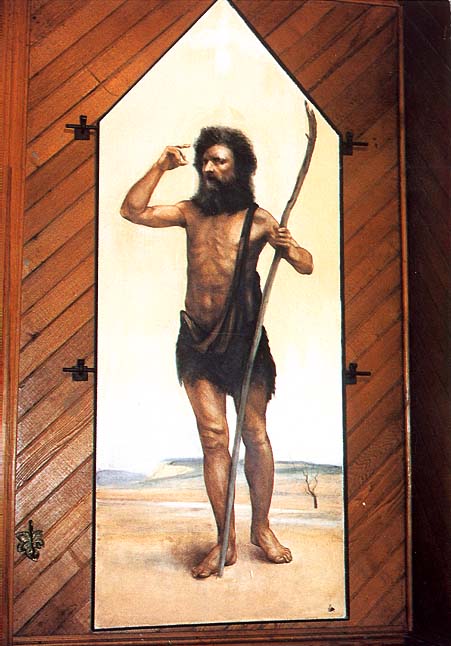
The Book of Luke begins in the temple in Jerusalem. The Gospel begins the Good News of Jesus with the priest, Zechariah, serving in the Holy of Holies. There the angel Gabriel appears with the news that Elizabeth, Zechariah’s aged wife who was thought to be barren, will give birth. The son born to Elizabeth and Zechariah is the forerunner, John the Baptist. The Gospel of Luke will then continually return to the temple, for Jesus’ naming, his teaching the elders when on a trip with his family at the age of twelve. Then through his ministry, Jesus will return to the temple. Finally the Gospel ends, with the final line verses, “They worshipped him and then went back to Jerusalem full of joy; and they were continually in the Temple praising God.”

The temple has a gravitational pull in Luke’s Gospel, everything is always pulled back to that center. Then in the Acts of the Apostles, Luke opens in Jerusalem, but then goes outward to Judea, Samaria, and while not to the ends of the earth, he will reach to Rome and beyond. Along with the journeys of Peter and the other apostles, we get Saul the persecutor becoming Paul the Apostle.

In Luke, everything was focused inwardly on building up the group. In Acts, that group is shot out from the center point. Pentecost will come like a bomb going off, which sends out a creative rather than destructive force. Ascension Day is the seam that holds those two narratives together. This is where the inward focused turned and after a ten-day wait for the tide to turn at Pentecost, the outward focus began.

It is worth pausing for a moment to acknowledge that Ascension Day is a stumbling block for some. They will remark rightly that we know better than to conceive of a three-storied universe with heaven above, hell beneath, and earth sandwiched in the middle. We have pierced the sky, traveled to the moon and are even now being watched over by astronauts working at the international space station. What sense does it make to talk of Jesus disappearing off into the sky, a vanishing point of distance from earth ending his earthly ministry?

This knowledge need not distract us as we know through our own faith journeys that God has a knack for giving us not just what we need, but what we are ready to receive. The disciples, or followers, were becoming apostles, or ones sent out, and they needed Jesus to leave in such a way that they would stop hanging around and get about the work of the Gospel. Ascension Day accomplished that essential purpose.

On all the days leading up to that one, the disciples looked for their Lord. Their lives were centered on Jesus. Knowing more about the heavens, doesn’t change the truth of Jesus’ leaving his earthly ministry to become once more the second person of the Trinity, no longer limited by the incarnation to being in one place at a time. After the ascension, the apostles began to pray and wait for the coming of the Holy Spirit. Then with Pentecost, they were empowered to go out in ministry.

The truth is that Ascension Day worked. With Jesus’ ascension into heaven, the disciples became apostles. They stopped looking for Jesus here and there, and began to pray for the Holy Spirit who would be with them always. On that day, Jesus’ followers were given what they needed to begin to change their focus.

What would it take for us to change our focus? After all, it is easy for a church to go from being about the mission of sharing the love of God found in Jesus with a lost and hurting world, to turn our mission stations into clubs. A church does not exist for its own sake, but as preparation for those who gather to take part in Christ’s work of reconciliation in the world. The word member should probably not even be used of aligning oneself with a given congregation. We are not to be members of a club, exclusive or otherwise, as if Jesus’ ministry, death and resurrection were for the purpose of starting a new institution. The institution of the church exists to further the mission which is God’s mission—reconciling the world to God. We are missionaries working on the front lines of the mission of the church, which is what we each encounter every where we go.

This need to turn outward is so crucial, that it is a good idea to have someone at the end of Eucharist to step up and take the role of the two men robed in white who said, “Men of Galilee, why do you stand looking up toward heaven?” These words were the push the apostles needed to stop focusing on the spot where they last saw Jesus. The words of the angels turned the disciples gaze outward to a lost and hurting world and so made them into apostles, ones sent forth on a mission. After that push, the apostles would be prepared when the Holy Spirit came ten days later on Pentecost to begin the work of taking the Good News of Jesus to the ends of the earth.

In the dismissal, we have such a moment. The deacon or priest says, “Alleluia. Go in peace to love and serve the Lord” or similar words that focus us outwardly. This is no idle moment. This is an active moment, a push to tell us to stop looking toward the altar—that point where we last saw the Lord. The dismissal is a reminder as our worship service is ending that while the worship is finished for now, the service is just beginning. We are sent out from every service to love and serve the Lord through loving and serving others in his name.

Most of us do not go out loving and serving the Lord right away. It is more likely that we go out to get something to eat rather than going to serve in a soup kitchen, or to console a grieving friend. That is fine. But we should not leave worshipped untransformed. We should look at our server differently, knowing that this is a person who we depend on not being in church, so that we can enjoy a meal after we worship. Treat that server as you would treat Christ if he were serving your table. For having seen Christ in worship, we should become better at seeing Christ in others. Then loving and serving the Lord will be much simpler as we will find Jesus everywhere we look.

This is the transformation of Ascension Day. The tide is turning. Before many minutes pass, we will have been spiritually fed and empowered to act. Flow forth from this place to begin to fulfill that mission anew. This is the day for turning our eyes outward. This is the day for changing our focus to see Christ in the world anew. And having seen, we can begin anew to love and serve.

Amen.

Labels:

0 Comments:

Post a Comment

<< Home

4/17/2010

Plenty of Room in the Net

click to find out more about this paintingIn tomorrow's Gospel reading, Jesus' post-resurrection appearance occurs on the shore of the Sea of Galilee. The disciples are back at the nets and have turned up no fish. He tells them to cast on the right side of the boat. They do as he says and catch more than they can haul in, landing 153 fish.

I have preached on this odd detail of knowing how many fish are in the net, saying in part,
With the impetuous Peter paddling to shore, the remaining disciples struggle in the hundred yards with bulging nets in tow. Once on shore we are told that they have caught large fish, 153 of them.

I want to pause here for a moment. 153 fish. Really. Who counted them. John, the future Gospel writer stops being the disciple whom Jesus loved long enough to turn into reporter. This will make a great scene in my book John thinks and starts stacking up the fish. “One, two, three, four. No Nathanael don’t move them, I’m counting. One, two, three, four.” And on he counts until “151, 152, 153.” So much for breakfast on the beach with Jesus.

The great commentator on scripture, Jerome, offered a different possibility. Jerome cites a source that Greeks taught of 153 species of fish. If Jerome is right, this number may be symbolic of what is actually happening on the beach that morning. When they followed Jesus’ instructions, the disciples did not just catch fish, they caught big ones. And they didn’t just catch a lot of fish, but all the kinds of fish there are to be caught. Now that’s the fishing story to end all fishing stories. They didn’t just have a good haul of fish, symbolically they caught them all. It is the fish story version of the line from Revelation that says, “You ransomed for God saints from every tribe and language and people and nation.”

What I think is going on here is that the spiritually-in-tune John is telling us what they really learned that morning they had the big catch, and it was not a fishing lesson. These men were apostles, which means someone who is sent out. Jesus was sending them out to start fishing for people in a big way and he provided an object lesson to bring the point home.

The Kingdom of God is not just for people who look like you, think like you, act like you. The Kingdom of God is for all the peoples of the earth. And the net is big enough to hold them all without tearing. John makes this point clear in writing, “Simon Peter went aboard and hauled the net ashore, full of large fish, a hundred fifty-three of them; and though they were so many, the net was not torn.”

click to find out more about this paintingThere is room in God’s kingdom for everybody, all kinds of people. In fact, the net won’t be full until it has every kind of person in it. Every tribe, language, people and nation. Don’t worry. It won’t tear. There is plenty of room in the net.

Then came breakfast. Jesus feeds his disciples again. Bread and fish, just like with the thousands on the hillside. This is making the message even clearer. See the net that catches all the kinds of fish and does not break. See the meal of bread and fish, just like before. Now remember that you are to go into all the world with this message of God’s love.

The hard part would have been leaving the beach...Yet, if those guys stay on the beach, then the Good News of Christianity never reaches you and me. Jesus longed for a relationship with all that he had made and the way to get it was for these guys around the campfire to get going....

It happens again and again. A church feels like a family. We all know and love each other. We may rub each other the wrong way now and again, but when it is family-sized, it feels like family. Every family has its little problems, folks who go on and on at family reunions and bore you with their stories. But, you just know that you took your turn with Uncle Joe at the last get together and so cousin Sally is taking her turn this time. It will be OK. Yet families grow. Folks marry, babies are born. Things change. But with churches, if we don’t watch it, we get that cozy breakfast on the beach feeling and forget that the net isn’t even close to full. We can look at a congregation and feel satisfied, everything is just about right. Jesus looks around and sees a lost and hurting world that needs someone to reach out to it in love and finds all the folks holding nets feel like their net is just about topped off. I’m sorry Jesus. This boat is full. No more room for smelly fish here....

Our loving God wants all creation to love like Jesus loves, and guess what? You are the one holding the net. Since the net is the Kingdom of God, you might not even be sure if there is a net, or if you are in the net yet. But God is still giving you the chance all the time to love as Jesus loves. You can sit back by the fire and decide to listen a bit more to the fish stories, or you can reach out in love with confidence that there is plenty of room in the net.
The full text of the sermon is online here: Plenty of Room in the Net.

peace,
Frank+
The Rev. Frank Logue, Fisher of Men (Women and Kids too)

click to find out more about this painting

Labels: ,

0 Comments:

Post a Comment

<< Home

4/10/2010

How do we know Jesus' resurrection was real?

In tomorrow's Gospel reading, we will read of the disciple Thomas doubting Jesus' resurrection after Jesus appears to the others while Thomas was away. I preached on this passage making a case for what we know about the resurrection and why I believe:

Last Sunday was Easter and we joyously celebrated the miracle of Jesus’ resurrection. A week has passed. The joy has subsided enough to look at things in the light of day. I want to dare to ask the question, “How do we know they didn’t just make it up?”

After all, we were all born centuries after that first Easter. On a morning when we have just read how Jesus’ own friend Thomas doubted whether the resurrection was true, we should feel emboldened to ask a couple of questions of our own. How do we know that the disciples did not just wish Jesus had been resurrected? How do we know they didn’t have something at stake in fooling everyone else into thinking that Jesus came back from the dead?

First, I want to give the standard answer and show the problems some folks have in accepting it. Then we will look a little harder to see if we might have something more to say on the matter to see if it holds up.

Here is the way the standard answer goes. The best proof of the resurrection is the change in Jesus’ own disciples. Before the resurrection, those same apostles were scared, hiding from persecution. After an encounter with their risen Lord, they were brave enough to take to the streets as Peter does in this morning’s reading from the Acts of the Apostles.

Yes, the disciples might have told a lie to keep the Jesus’ myth going, but not once it came at the price of their very lives. The disciples were in a position to know whether the resurrection stories were the truth or a lie. They were the very witnesses to Jesus’ resurrection. They might lie to keep the story going if it meant filling their purses with money, but when persecution came, they would back away from their claims of Jesus’ resurrection. When push came to shove they would not die for a lie?

That’s the standard answer and it works pretty well. The Bible does describe to us the beginnings of persecution against the early Christians. We hear of the first Deacon, Stephen, being stoned to death. But, we have no reason to believe he was a witness to the resurrection. We also read of the death Jesus’ brother James, who was himself converted by an encounter with the resurrected Christ. James was pushed off the top of the Temple for refusing to renounce his faith in Jesus. James would have been in a position to know the truth. Would he have died for a lie?

As for the other disciples, their fates are not described in the Bible. In fact, there is no good solid historical evidence for what happened to them, just traditions, that sometimes contradict one another. Yet, the traditions all have the apostles dying for their faith with the sole exception of John, who is said to have died of old age in Ephesus. Even if a skeptic were to grant that the traditions about these men having been put to death for their belief in Christ were true, would this prove that Jesus was really and truly raised from the dead? Not exactly.

Let’s be honest. It could have been a delusion—mass hysteria fed by a desire for the resurrection to be real. Maybe they felt that Jesus was somehow still present to them and they wished it into a historic fact. Or maybe they talked of Jesus’ teaching still being with them and later believers worked with the story until they told it that Jesus’ was resurrected. A symbolic event could have been confused as being an historic event by people living a few generations later.

The full sermon is online here: The Resurrection: An Apology and it continues by taking an honest look at the evidence for the resurrection.

peace,
Frank+
The Rev. Frank Logue, Pastor

Labels: , ,

0 Comments:

Post a Comment

<< Home

3/27/2010

What language does God speak?

Tomorrow's Gospel Reading is Luke's account of the Passion. We hear Jesus proclaim from the cross, "Father, forgive them; for they do not know what they are doing." In preaching on this passage previously, I wrote a story in which a Tanzanian man sets out on a pilgrimage to discover God's own language:

In the summer of 1998, I journeyed to Tanzania to take part in a cross-cultural internship sponsored by the Seminary. I worked in western Tanzania in an Anglican Church led by a Tanzanian priest. While there, I was asked several times, “What is your mother tongue?” You see in East Africa, everyone speaks Swahili, and many people speak English. But these are not the languages of home. Among their own tribe, their own family, most East Africans speak their tribal language. This language is their mother tongue. Whenever I explained that English was my mother tongue, people always felt sorry for me. They knew that I was a much poorer person for not having a mother tongue, a special language spoken only among my own people.

This concern about a mother tongue is reflected in a story told in East Africa of a man from the Dodomo district of Tanzania named Msafiri. Msafiri followed the traditional African religion of his people, the Wagogo. He believed in one God, the creator who is the source of all good things. Msafiri approached God by praying to his ancestors who he believed still watched over their people.

An Anglican evangelist came to his small village and began teaching the people about Christianity. Msafiri listened to the evangelist as he told about God sending his son Jesus to live among us. The stories of Jesus life, his death and resurrection touched Msafiri and he converted to Christianity. He studied with the evangelist and was baptized, taking the name Simon, for Simon of Cyrene, the African saint who had carried Jesus’ cross to Calvary.

Simon Msafiri went to church faithfully, always attending the Wednesday fellowship meetings and Sunday services. Gathered with the other Christians under the grass roof of the mud-walled church they had built together, he learned the stories from the Bible.

Simon Msafiri prayed to God in Kigogo, the language of his own people instead of the Swahili that he used in town with others. This was Simon’s mother tongue and was part of Simon’s ties to his extended family. Simon knew that God understood him when he spoke Kigogo, but he decided that God, too, must have a mother tongue—a language that was God’s own language from before time. Simon wanted to learn to pray to God in God’s own mother tongue. One day he asked the evangelist, “What is God’s mother tongue?” The evangelist thought for a moment and then said that God doesn’t have a mother tongue—all languages are the same to God.

Simon listened and thanked the evangelist. But as he went home, he began to wonder about the evangelist’s answer. Everyone Simon knew had a mother tongue they learned as a child and used among their own people. If the people Simon knew had a mother tongue, then God must as well. He decided to ask some of the elders of the village to get the answer to his question. One man said that God, as the great ancestor, must speak the language of their ancestors, Kigogo. Another said that surely God’s mother tongue is Swahili. These answers didn’t sound right to Simon and he decided to set out on a great safari, a journey to find his answer.

The full text of the sermon is online here: What language does God speak?

Labels: , ,

0 Comments:

Post a Comment

<< Home

12/05/2009

Prepare the Way

In tomorrow's Gospel Reading we begin with a list of the people in power at the time John the Baptist came onto the public scene in Judea:
In the fifteenth year of the reign of Emperor Tiberius, when Pontius Pilate was governor of Judea, and Herod was ruler of Galilee, and his brother Philip ruler of the region of Ituraea and Trachonitis, and Lysanias ruler of Abilene, during the high priesthood of Annas and Caiaphas, the word of God came to John son of Zechariah in the wilderness.
I preached on this nine years ago at King of Peace saying in part:
If you’ll look at the passage with me, I’ll show you what I mean. You could read it through in your mind like this:

In the fifteenth year of the reign of some guy, when, oh I know that one, Pontius Pilate was governor of Judea, I think that’s how you say it, and some other guy was ruler of some place and his brother was ruler of the region of two hard to pronounce names, and another guy was ruler of Abilene, I thought that was in Texas, during the high priesthood of two guys with names I don’t know, the word of God came to John son of some Z name in the wilderness.

Another way to do it is to just see what the words are and not even really read them. That would go like this:

In the fifteenth year, yada yada, yada during the high priesthood, yada, yada, yada, the word of the Lord came to John, son of some guy in the wilderness.

I don’t want to poke fun at this way of reading through a hard list of names and places. It makes sense really. I ran across a similar suggestion in a book recently. My daughter, Griffin, and I were reading through the introduction to her copy of Jules Verne’s classic book 20,000 Leagues Under the Sea where Bruce Colville, himself an author, gives advice on how to read the book. Listen to this introduction to see how it might relate to reading the Bible:
Now, before you begin reading, I have to give you a warning. This is not a book for lazy readers, not a walk-through. In fact, odds are you’re going to have to work to get it.

That’s okay. In fact, I’m going to give you permission to do something that normally bugs the daylights out of me: You can skip some of the stuff. One of the quirks of Verne’s style in this book is that he occasionally stops to make long lists of the undersea creatures that Professor Arronax (the character narrating the story) sees through the windows of the Nautilus.

Trust me: You don’t need to read them all.

Here’s another tip: You might enjoy having a globe or atlas nearby while you are reading.

It’s not necessary to have one to enjoy the book, of course. But because this is a trip around the world, you might find it fun to trace the route the Nautilus follows.

“Good grief,” you may be muttering to yourself. “If the book is so much work, why bother?”

Let me offer three reasons.

Reason Number One—Most stuff that’s worth doing takes some extra effort….
Reason Number Two—It’s a great adventure story, one of the grandest every written….
Reason Number Three—Two words: Captain Nemo.
Okay, so that reason won’t work at all—unless, you change the two words to Jesus Christ. Because it is in the pages of the Bible that we can meet Jesus Christ. However, the rest of the advice is reasonable enough. If a list of names and places is threatening to slow your Bible reading down to a halt, it might be best just to scan over the list and keep reading. That does not mean that those passages have nothing to teach, but it could be that they need to wait for another time.

Well, this is another time and place. Is there anything to gain from a list of people and places like the one Luke gives us this morning? What does the fifteenth year of the reign of the Emperor Tiberius have to do with us? You see, the challenge I always feel in studying a passage of scripture with a sermon is to discover what it has to say to us, right now, this week. Does this passage have anything to say to us that could or should change the week ahead? I think it does. This list of names reveals something about God to us that can have a profound effect on how we live our lives.
As I was concluding the sermon, I said in part:
God’s love is not for the lovely alone. God’s love is for all. No matter how unlovable a person seems to us, they are not beyond God’s love. This is good news for people living on the streets, or to people dealing with the final stages of disease. But God’s love extending to everyone is good for all of us gathered here this morning. When we feel our most unloved, when we feel our most unlovable, we can know that God loves us anyway. That’s the way God has always been. And God continues to scatter the proud and to lift up the lowly. God continues to show up in unlikely places. You don’t have to worship in a great cathedral surrounded by stained glass for God to be present. You can find God as John did in the wilderness. Or you can encounter God in a church that meets in the living room of a house.
The full text of the sermon is online here: A Particular Time and Place.

peace,
Frank+
The Rev. Frank Logue, Pastor

Labels: ,

0 Comments:

Post a Comment

<< Home

10/27/2009

World on Fire

This is a Youth Sunday sermon by high school senior Jeremy Douylliez given at First Presbyterian Church in Saint Marys, Georgia this past Sunday, October 25, 2009:


1 Kings 19: 11-13

The LORD said, “Go out and stand on the mountain in the presence of the LORD, for the LORD is about to pass by.”

Then a great and powerful wind tore the mountains apart and shattered the rocks before the LORD, but the LORD was not in the wind. After the wind there was an earthquake, but the LORD was not in the earthquake. After the earthquake came a fire, but the LORD was not in the fire. And after the fire came a gentle whisper.

Mark 5: 36

Ignoring what they said, Jesus told the synagogue ruler, “Don’t be afraid, just believe.”


Have you watched the news recently? It’s pretty scary. Everyday there are more murders, burglaries, kidnappings, acts of terror, and the list goes on and on and on. Children in Africa die of AIDS and starvation at unimaginable rates. Teachers in schools no longer worry about talking or passing notes because they have to worry about guns and violence. Everyday more people are tortured and more unnecessary lives are lost in war. Everyday more people are forced to live in fear. Everyday hope fades in the lives of so many. The world is on fire.

Tsunamis crash on Indonesian soil killing thousands. California forest fires leave countless homeless. The aftermath of Katrina is still very real, and it will still be many years before the Gulf has fully recovered. Earthquakes destroy entire cities. And Mother Nature’s fires unfortunately have a tendency of causing us to point fingers. We blame ourselves for global warming. We blame FEMA for poor disaster response. We blame God for letting it happen.

The last is the easiest…and perhaps the most common. God holds the universe in his hands. He can control anything and everything. He can stop bad things from happening…but he doesn’t. Blame God. Blame God. Blame God. If God loved us soooooo much, how could he allow what happens to us to happen to us?

Better yet, we reverse that viewpoint and say things like this. I wonder what those people in Indonesia were doing to deserve the tsunami. I wonder what was going on in the lives of the Katrina victims that God drowned. I wonder why God would kill those people, destroy those cities, and sentence them to hell.

Almost everyday at school I am challenged with the question, “If there’s a God, why does he let bad things happen?” I like to respond saying, “Well how would you feel if the next time you were about to do something wrong, God stopped you?” Isn’t it ironic that God loved us enough to give us free will, but the second something goes wrong we don’t want it anymore! The second a child is kidnapped, we want God to intervene! We want God to force the hand of the kidnapper! We forget about that gift called free will, when it stops being convenient, but no one better try and take it away from us.

At the Gathering Place last summer, a room filled with a little over a thousand teenagers was informed by a speaker that Michael Jackson is burning in the lowest level of hell. Really? The general theme of that message was that God will destroy you if you do the wrong things. God is sitting up in his big throne with a finger pointed ready to zap you. Better watch out.

The world is on fire.

And it’s not only burning because of the natural disasters, the crime, the starvation, or the unimaginable amounts of pain inflicting millions across the planet. It is also on fire with two types of people. The people who blame God set the world on fire and the people who accredit every disaster to God’s wrath set the world on fire.

Our passage from 1st Kings this morning refutes both of these viewpoints. There was a wind, but the Lord wasn’t in the wind. There was an earthquake, but the Lord wasn’t in the earthquake. There was a fire, but the Lord wasn’t in the fire. God isn’t in the fires of our world. He doesn’t start them, he doesn’t stop them. The kicker is in that final verse. After the fire, there was a still small voice.

God answers in a still small voice. Instead of posing the question, “Where is God in disaster?” I think the better question is, “Where are we, God’s people, in disaster?” Are we on the front lines aiding injured, rebuilding walls, instilling hope? Where are we? God isn’t in the fires, he’s in the response. We have to be the still small voice of God.

Not a sparrow can fall to the ground without God noticing. But the sparrow still falls. The fires still burn. The still small voice is what will pick the sparrow back up off of the ground. It is what will rebuild where the fires have burned.

So what if God isn’t in the fires, but in the response? That doesn’t make them any less frightening. The world still burns and I’m still afraid. On Jesus’ way to raise a young girl to life he preaches the shortest sermon in his career. “Do not be afraid, just believe.” When the Angel of the Lord appeared to the shepherds in the fields he said, “Do not be afraid.” When He appeared to Martha and Mary at the tomb he said, “Do not be afraid.” Christ says it numerous times throughout the gospels. “Do not be afraid.”

Just believe.

The world is on fire. Nations are raging against other nations, famine is striking down thousands a day, homeless rates continue to grow, the world is on fire. The world economy continues to fail, jobs are lost, wages are cut, employees are furloughed, the world is on fire. The polar ice caps are melting – it is not a political statement it is a scientific reality the world is on fire. Hope, faith, and love are becoming things of the past, the world is on fire. But the Angel of the Lord says, “Do not be afraid.”

For a time is coming: a time when God’s new city will descend on Earth and He will live with his people. Live for that day. Live for the day when God will wipe every tear from our eyes and death and sorrow will be no more. Live for the day when cries of hunger are replaced with songs of thanksgiving around a plentiful dinner table. Live for the day when swords are beaten into plow shares and spears into pruning hooks. Live for the day when love has conquered any and every obstacle. Live for that day. And do not be afraid.

Amen.

Labels:

2 Comments:

  • At 10/27/2009 3:14 PM, Anonymous Anonymous said…

    THIS IS FROM A HIGH SCHOOL SENIOR?
    THANKS, FRANK, FOR SHARING THIS WITH YOUR READERS.

     
  • At 10/27/2009 10:22 PM, Anonymous Anonymous said…

    Amen, little brother in the faith.


Post a Comment

<< Home

8/09/2009

A Vast Operation

Last night, I was honored to preach on the occassion of the ordination of Ira Jackson to the sacred order of priests. In so doing I wondered aloud about why it is that we speak of all baptized Christians as ministers. saying in part,
Why in the world would Jesus need such a vast operation—every single baptized Christian working in ministry while deacons serve as icons of service to others, taking the church to the world and bringing back the needs of the world to the church; while being built up, encouraged, equipped and so on by priests who are serving in the ministry of Word and Sacrament; and all of this taking place under the oversight of bishops, the chief pastors of a diocese—isn’t that a little much?

Well, it would be, if Jesus was concerned about the people who gather each week to worship at Grace Church in Sandersville. And this kingdom of priests who are made up of all Christians would even be far too much if Jesus only concern was those who are in all the Christian churches in the world each Sunday, or even each Christmas and Easter. But this would be a very narrow view of Jesus’ compassion for each and every person on this planet.

Jesus’ vision for the kingdom of God is bigger, grander, more all encompassing than something like the present state of affairs. Jesus’ vision is that all of the harassed and helpless find green pastures. Jesus teaches clearly that there are folks wandering around aimlessly like sheep without a shepherd. These poor people are trying to find peace in their lives through alcohol abuse, and abusing drugs both legal and illegal, as well as through unhealthy relationships, and lots of other things that will never bring rest to their weary souls. Jesus’ vision is that every one of these lost sheep is brought to still waters.
It was an honor and I am thankful to Ira for asking me to serve in this way at the ordination service. The full text of the sermon is online here: When the Spirit Rested on Them—An Ordination Sermon for Ira Jackson.

peace,
Frank+
The Rev. Frank Logue, Pastor

Labels: ,

0 Comments:

Post a Comment

<< Home

6/27/2009

Daughter of God

In tomorrow's Gospel reading Jesus has the hem of his cloak touched by a woman as he is en route to the home of a synagogue leader whose daughter is near death. I preached on this passage before in the first person, saying:
Mine was a story destined not to be told. I was the one to die unknown, unremembered, unremarked. Then I got it into my head that all I had to do was reach out and touch the hem of Jesus’ garment. Nothing more, nothing less.

Woman with HemorrageI had heard of Jesus. Everyone had by then. He was the healer from Nazareth that had set tongues wagging from the Decapolis to the Negev. I traveled more than most, and heard of Jesus everywhere I went.

I had begun seeking healing with sacrifices offered at the Temple. But as soon as the priests found out what my problem was, I was declared unclean. I was no longer fit to be in God’s presence. I was no longer welcome in the Court of the Women at the Temple in Jerusalem.

Feeling cast out by my God, I turned to everything anyone ever heard of doing. I sought out healers and magicians. I recited incantations in languages I couldn’t understand, to God’s of whom I had never heard. But mostly I sought out the care of physicians, any physician, all physicians. I ate every conceivable combination of herbs. I applied creams and ointments. I did anything they asked and paid everything I had.

As for me, the hemorrhage continued as did my spiraling descent away from others. They don’t tell you how sickness cuts you off from others. Oh get some quick fever that either kills you or leaves you spent but recovering and the family will rally around, but get some slow wasting disease and watch how others gently pull back all contact. No one wants to speak and certainly now one wants to touch you unless the illness should rub off on them. I don’t think it was conscious, but it was predictable. As soon as anyone found out I had been bleeding for five years, seven years, ten years—whatever it was by that point—he or she would pull back, withdraw.

I didn’t realize that being cut off from others was worse than the hemorrhage. But it didn’t matter anyway, because my health problems and I were one. I let my sickness define me and then so did everyone else.

Of course, I did hear of Jesus—everyone did in those days. There was talk of Jesus’ teaching with great authority. There was talk of how he could be the Messiah. Many hoped he would overthrow the Romans so that Jews could once more rule Israel on their own. But for people like me—the real sufferers—there was only one tidbit about Jesus that mattered. Wherever Jesus went, he healed people. Jesus touched the blind, the deaf, the lame and they could see, hear and walk.

I knew I had to get to him, but even that proved a disaster. First, it was hard to pin down where he was. Jesus was always crossing back and forth around the Sea of Galilee and then he traveled down to Jerusalem for the festivals too. It seemed that he was everywhere at once and never where I was. Then I did find him one day and even get close enough to speak, but I lost heart. I couldn’t dare to speak to him. If the stories were true, then I couldn’t risk speaking with him. After all God his Father’s own priests tossed me out of the Temple as unclean. I couldn’t bare for Jesus to reject me too. Where would I turn then?
The full sermon is online here: Daughter of God

peace,
Frank+
The Rev. Frank Logue, Pastor

Labels: ,

0 Comments:

Post a Comment

<< Home

4/08/2009

As Though I Were a Bandit

Below is the sermon I gave at noon today for St. Marys, Georgia's Ecumenical Holy Week services. I gave a storytelling sermon there three years ago and didn't want to again, but the text was the quote in the first line of the sermon and the only way I could see to enter into it fully was through a story, which I based on Matthew's account of the last week of Jesus life, the Book of Acts account of Saul's conversion, and Ignatius of Antioch's letters written while en route to his martyrdom in the coliseum:

“Have you come out with swords and clubs to arrest me as though I were a bandit?” That question on the lips of Jesus stopped me in my tracks. It got me thinking that night and I have been turning it round and round in my head ever since. It was a conversation with Jesus in which he asked one question and I have spent my life living into the answer.

They tell me that I will die tomorrow at noon. I am one of a small group destined to face the lions in this local coliseum. They have offered us a way out. Deny Jesus as Lord, offer sacrifices to the emperor as a God and live. But I am not capable of denying Jesus and so want to get this story out before I face my death.

You can trust that everything I say now is completely true. This is not a time for holding back. I want you to understand that we were not bad men. We were good men, who for all the right reasons, played our parts in the most evil act in human history.

I was there that night of Jesus’ arrest representing the scribes, the keepers of the law. I was one of the men sent by the chief priests and the elders of the people to make sure that Jesus of Nazareth was silenced. We had temple guards and others with swords and clubs ready to put down any resistance. We had Judas Iscariot ready to pick the rebel rabbi out of the dusty group from Galilee. We were ready for anything.

By torchlight, I could see Jesus face as Judas kissed his teacher, betraying him into our hands. Hurt, disappointed, but loving just the same. Then he asked the question: “Have you come out with swords and clubs to arrest me as though I were a bandit?”

Unbidden from within me came the response flashing across my mind, “A bandit, yes!” That’s it, I thought. You are stealing the affections of the people, taking the attention that belongs to the authorities and claiming it as your own. You are the boldest of bandits, taking what belongs to others while acting like it was yours by right all along.

“Jesus” was the name everyone was talking about that Passover week now thirty years ago. Jerusalem buzzed with stories of Jesus greeted as a king when he processed into Jerusalem on a donkey to a crowd of admirers waving palm branches, shouting “Hosanna to the Son of David!” Jesus turning over the tables of the money changers, disrupting the worship in the Temple on its busiest week of the year. Jesus teaching that confounded every verbal trap we set for him that week. Jesus who was undeterred by our best efforts could effortlessly turn an argument on its head, “Render unto Caesar what is Caesar’s and to God what is God’s.” Jesus. Jesus. Jesus.

It was blasphemous the way the crowds treated him as the Messiah, God’s own son. I knew that night that the chief priests and the elders were justified in protecting God by silencing this Jesus. So when he asked why we were treating him as though he were a bandit, my reply to myself was, we treat you like a bandit, because you take what rightly belongs to the temple and the priests as your own. They should come to us for healing, for forgiveness, to get connected to God. Instead they were going to Jesus in ever larger numbers. He would steal the whole flock out from under the rightful shepherds if no one took action. So when an arrest party was put together, I was honored to go out and make sure nothing went wrong. Once Jesus gave me the words for it, I was eager to name him as the worst of thieves.

I stayed up all night. I was there and heard with my own ears when Jesus told the high priest he was the Son of Man who would sit at the right hand of the Mighty One. Blasphemy! The high priest tore his cloak. Then we traveled from place to place making sure that every loophole was closed. It should have been easy to get Pilate to understand that Jesus had to die, but he seemed oddly reluctant. When Pilate tried to offer absolution to Jesus and set him free, I was there screaming with all my might for Pilate to give us Barabbas instead. When Pilate asked what he should do with Jesus, I wanted him treated like the most unrepentant of thieves. “Crucify him!” I shouted along with the mob. “Crucify him!”

I followed close at hand as a beaten and bloodied Jesus made his way to Golgotha. I was there when cold steal tore through warm flesh and the sound of those nails driven into his arms of love haunts me still. I watched as darkness fell over the land and I heard him cry out, “Eloi, Eloi, lama sabachthani.” I thought he was calling out for Elijah and joined in with others taunting him as he died. The words burn through my heart now, “My God, My God, why have you forsaken me?” In those words of the psalmist spoken by the dying Christ, I now see what length Jesus was willing to go from to save even me from the power of sin and death.

I heard the stories: The earthquake. People rising from their graves. The veil in the temple torn from top to bottom, as if the dividing wall between God and man had been rent from heaven. Monday, everyone was talking about the word that Jesus was risen from the grave. I knew that rumor was false. I had seen him breathe his last. I watched Jesus’ body come down off the cross. The one fact of which I was most certain was that Jesus was dead. I knew the movement he started would soon die out too. After all, I saw his disciples scatter and run when we came into the garden to arrest him. Jesus had come into Jerusalem to steal the hearts of the faithful and we had taken them back for ourselves.

Months passed. The movement gained new strength. Some of our group sought to put them down by force. I wasn’t there when that Greek, Stephen, was stoned to death, but I heard he was talking the same blasphemy as Jesus. It was Saul who got my attention. We both saw ourselves as up and coming spiritual leaders. I knew he was taking the lead in persecuting these fools who were following their dead teacher. That’s why I was so surprised when he told me about his trip to Damascus.

Saul was back in Jerusalem trying to join with Jesus’ disciples. He found me in the court of the temple teaching a group of boys to read the Torah. As the class ended he took me aside. With eyes aflame with a passion I knew nothing of he told me the truth. He recounted the blinding light, the voice of Jesus, and then the prophetic words that led Ananias to seek him out, teach him and baptize him. Saul told how he had been blinded and when the Holy Spirit came upon him it was like scales falling away from his eyes.

Saul’s words sounded crazy. Then Saul opened the scripture up to me in a way I never heard it before. I knew the prophets so well, but he showed me how they pointed to Jesus. It was all in our scriptures with such clarity, I was astounded that I had not seen it myself. When he began to quote from Isaiah words of the Suffering Servant passage, I took over reciting the words by heart,

“Surely he took our infirmities and carried our sorrows, yet we considered him stricken by God, smitten by him and afflicted. But he was pierced for our transgressions, he was crushed for our iniquities; the punishment that brought us peace was upon him, and by his wounds we are healed.”

I was crushed. I wailed, sobbing uncontrollably. I had looked God incarnate in the face and rejected him. I had helped kill Jesus just as surely as if I had driven the nails with my own hands. The words “Crucify him” now burned in my throat. Saul understood and he let me cry myself out. Then he showed me how Jesus could forgive even me. He led me in a prayer to God through Jesus in which I felt the Holy Spirit in a mighty way.

The prayer was a continuation of the conversation Jesus started with his question, “Have you come out with swords and clubs to arrest me as though I were a bandit?” I admitted to him that I had done just that, thought of him as a bandit, stealing the hearts of the people. But in prayer, I gave him my heart freely, openly, completely. I realized that Jesus had never taken anything from anyone. He gave of himself freely even to his dying breath. In answer to my prayer Jesus gave me such peace and a feeling of forgiveness that I was flooded with joy.

Now I sit in a prison, chained to Roman guards who will be with us right up to the last. All I want to do is help them understand that I am free. They are the ones who are bound. Rome wants to take my life, without realizing that I have already given it away. They are putting me to death as a bandit as well. Their leaders think that I have stolen the power and honor and glory that rightly go to Caesar and have given them to Jesus. They don’t understand that in giving Jesus my life, I only gave back what was rightfully his.

Now if I can just convince this soldier next to me to have his own conversation with Jesus, I will add a bit of joy to these last hours of life. Try it. Offer Jesus your heart. You’ll be surprised at the peace and love and joy and hope he will give you in return.

Labels:

0 Comments:

Post a Comment

<< Home

2/13/2009

Wonderful Words of Life

Among the live oak trees in Homeward Cemetary (west of Waverly, Georgia) we laid to rest this morning the mortal remains of Dorothy McCarthy Bundy. The sermon took as its theme the words of the hymn, Wonderful Words of Life. The Philip Bliss hymn is one that Dot first played at the age of three, 90 years ago.

We give thanks for her long, full life. The sermon is online here: Wonderful Words of Life - A Eulogy for Dorothy Bundy.

Labels:

0 Comments:

Post a Comment

<< Home

11/23/2008

Those Eyes

For today's sermon, I created a story. It begins:
Betty walked into a hospital room with a teddy bear. It wasn’t a private room, but the first bed was empty. The second bed, the one closest to the window, was surrounded by a confusing profusion of equipment, common in the cardiac unit. She stepped closer. The patient was asleep. A woman lying flat on her back, with her head slightly raised and feet elevated. It didn’t look comfortable. But the patient seemed to be in a deep asleep.

Betty didn’t want to wake the patient, but she did want her to have the bear if the woman wanted one. She looked around the hospital room, taking in the surroundings. The chair by the bed and looked emptier than usual. So often in hospital visits she saw family or friends camped out alongside the bed. Even if no one else was in the room at the time, there were usually the tell tale signs of a bedside vigil kept the night before. But this patient didn’t seem to have any such visitors.

Betty stood holding the bear feeling indecisive. The situation looked like one that could use a little more love. But what should she do? Should she let the woman rest? Should she wake her? Should she just leave the bear without a word?

Betty looked at the patient’s wrist. The ID bracelet said the woman’s name was “Concepcion Rivera Morales.” The equipment quietly beeped and whirred. A long minute passed. She prayed for guidance, and then felt sure she should say something. This woman needed a teddy bear and she needed it now.

“Concepcion, I brought you a gift,” Betty said firmly, then paused. The equipment continued with its steady beeps. The lines moved across the screen scrawling an ongoing record of the patient’s vital signs. She watched Concepcion’s eyelids. No movement.

Betty said, “If you find yourself lonely or afraid, just give him a hug.” Then she added, “teddy bears are great huggers.”

Another long pause. She didn’t seem to hear. Perhaps the patient was unconscious. Who knew if she had even heard the words? Betty placed the teddy alongside Concepcion, on the side away from the IV tubes, so that the bear was touching her arm.

From someplace deep, Concepcion felt herself struggling toward the surface. Someone had spoken her name. There was something about a hug. She had heard that too. And then something about a bear. It didn’t make sense. Concepcion fought her way ever upward.

She wasn’t sure where she was or what was happening, but then the sounds of the hospital equipment began to orient her thoughts. She could vaguely remember passing out while cleaning yet another in the endless procession of rooms at the hotel. She could recall something of the ambulance ride and then the bright lights of what must have been the emergency room; then she remembered nothing until now.

As her eyes fluttered open, Concepcion saw the teddy bear lying alongside her. She smiled and then caught a glimpse of the person who brought her the gift. Recognition dawned on Concepcion. Those eyes. She knew those eyes. She had seen them before. When was it? Her mind, dulled as it was after having lost consciousness, couldn’t make the connection. She smiled and closed her eyes again, trying to remember.

Concepcion was aware that something had happened in the room. She heard the sharp beep. The footsteps, the shouts. Something was happening, but she didn’t know what. It was those eyes she focused on. Where had she seen them?

They looked like her great-grandmother’s eyes. Those almond brown eyes that looked on her with such love. But it couldn’t be her great-grandmother. Her Nana died long ago, even before Concepcion left Puerto Rico as a young teen. Her great-grandmother had never even visited New York City. But those were somehow those were her Nana’s eyes. It made no sense, but there was no denying it either.

The room grew more distant. Concepcion felt disconnected from the activity bustling around her. She realized she was more disinterested onlooker now than the active participant. She didn’t care. She was lost in thought, trying to remember how she knew the person who brought her the teddy bear.

The room brightened. She didn’t so much hear as feel Jesus speaking her name, “Concepcion.”

“Yes,” she replied.

“I saw the recognition in your eyes, dear child,” Jesus replied, not merely in Spanish, but in the familiar tones of home, warm and comforting as hot chocolate on an icy winter’s day.

“I know you,” she said slowly…her voice quavering a bit now.

“Don’t be afraid,” again the feeling of warmth and love filled the words and touched Concepcion’s heart. She had doubted what she was experiencing was even possible. Then thinking of her husband, she wondered if she would see Javier. Her heart quickened.

“This is not the time,” was the reply to the question left unasked.

“But I’ve been so lonely since he died,” Concepcion pleaded. “The children have moved away. They have lives of their own. I am alone.” Then after a thoughtful pause, Concepcion added angrily, “Why did you abandon me? Why have you left me?”

“I have not left you. I will not leave you,” was the strong reply, leaving no room for doubt and yet Concepcion could not agree.

“No, you did leave me,” she shot back. “You have been gone. I stopped reading the Bible, when the words brought no comfort. I still go to communion, more out of habit than anything. I leave feeling so empty,” her voice trailed off at the end. There was a pause and then her words gained force as she added, “I look for you everywhere, and you are absent. I wonder if you were ever with me at all.”

“Concepcion, I was there in the heart of the woman who brought you the teddy bear. She heard me speaking to her heart, knowing she had to visit the hospital today. I was there with Maria when she found you at the hotel so soon after your heart attack. And I am there now in the doctor who is fighting to bring you back to life. I never left you. You were just so hurt after Javier’s death that you couldn’t recognize me anymore.”
The full text of the story is online here: Those Eyes.

Labels:

1 Comments:

  • At 11/23/2008 1:18 PM, Anonymous Anonymous said…

    Joe, AJ, Zachary and I were completely captivated by your sermon today! Excellent story! We are happy we were there to share in the experience!!!


Post a Comment

<< Home

8/18/2007

Kindling Fire

In this weekend's Gospel reading, Jesus says,
"I came to bring fire to the earth, and how I wish it were already kindled! I have a baptism with which to be baptized, and what stress I am under until it is completed! Do you think that I have come to bring peace to the earth? No, I tell you, but rather division! From now on five in one household will be divided, three against two and two against three; they will be divided: father against son and son against father, mother against daughter and daughter against mother, mother-in-law against her daughter-in-law and daughter-in-law against mother-in-law."
The Rev. James Ligget has said of this passage,
No gentle Jesus, meek and mild, no easy yokes or light burdens, no kind words about love and forgiveness. This is the other side of the Gospel, the other side of the faith; the side that we don’t embrace quite so willingly. But there it is and it is very much a part of the whole Christian message.

And we need to hear it. We simply cannot ignore or overlook the reality that God offers us a vision of what human life can be, and what it should be. We pretty much know what that vision is. It has to do with shaping ourselves as people by living faithfully with God at the absolute center of our lives....

And when Jesus talks about fire, and about his baptism, and about division and conflict, he is talking about what it looks like and what it feels like to struggle to live this way—to be faithful to the vision.
The full text of his sermon is online here: Selected Sermon.

Note:
Our Pool Party is today from 12 noon to 3 p.m. at Honey Creek with a cookout, the pool and sea kayaking.

Labels:

0 Comments:

Post a Comment

<< Home

8/04/2007

A Man Possessed

Our Gospel reading for this weekend has Jesus warning,
Be on your guard against all kinds of greed; for one’s life does not consist in the abundance of possessions.
In a sermon on this text, the Rev. Dr. Barry Vaughn wrote,
Many years ago, renegade Baptist minister and all-round troublemaker, Clarence Jordan, rendered the gospels into the idiom of the modern South. Here’s his translation of today’s gospel from his book The Cotton Patch Version of Luke and Acts:
A certain rich fellow’s farm produced well. And he held a meeting with himself and he said, ‘What shall I do? I don’t have room enough to store my crops.’ Then he said, ‘Here’s what I’ll do: I’ll tear down my old barns and build some bigger ones in which I’ll store all my wheat and produce. And I will say to myself, ‘Self, you’ve got enough stuff stashed away to do you a long time. Recline, dine, wine, and shine!’ But God said to him, ‘You nitwit, at this very moment your goods are putting the screws on your soul. All these things you’ve grubbed for, to whom shall they really belong?’ That’s the way it is with a man who piles up stuff for himself without giving God a thought.
One reason that I like Clarence Jordan’s translation of the story of the rich but foolish farmer is that, alone among all the translations of the New Testament in my library, Jordan translates the story correctly. The New Revised Standard Version reads, “This very night your life is being demanded of you.” But that is not what the Greek text says. Rather, it says, “They have demanded your life.” Who were the “they” who demanded the life of the farmer? His things, of course. He no longer owned his possessions; they owned him. Or in Jordan’s words, “Your goods are putting the screws on your soul.”

Somewhere deep inside, we all know that Jesus was stating a powerful truth. Everything we own also owns a little bit of us. If we own a house or a car, then we are under an obligation to earn money to pay for the house or car; we have to take time to see to it that our house or car is cared for. We are no longer quite as free as we were before.

The rich farmer made the mistake of believing that he really possessed his great wealth, although Jesus said that the reality was that it possessed him....

Wealth is not wrong or sinful, but it is problematic. The spiritual problem of wealth is that it anchors our hearts too firmly in this world, rather than in God’s kingdom.
The full text of his sermon is online here Sermons That Work - August 5, 2007.

Labels:

1 Comments:

  • At 8/04/2007 9:05 PM, Anonymous Anonymous said…

    Makes me think, can we ever feel the need to have enough? Why is it that we never feel fulfilled with enough?
    To me it is scarey how one never feels like we get enough. I for one always feel like I never get caught up and get ahead yet I always find a way to get more. When is more enough? Do we ever feel complete?


Post a Comment

<< Home

7/21/2007

Choosing the better part

Martha in the kitchen
Martha working in the kitchen

This weekend's Gospel reading takes us to the home of Mary and Martha in Bethany. Martha is busy making a meal and wants Jesus' help in getting Mary up off the floor from where she sits entranced at the Rabbi's feet. Instead, Jesus defends Mary's actions, saying she has chosen the better part. In preaching on this passage before, I noted that this comes immediately after the Parable of the Good Samaritan and the two work to balance one another:
If you find yourself busy with many things, but never making time to read the Bible and pray, then the story of Mary and Martha should be speaking to you. The things that busy your life may be good and necessary, but should they have your top priority? What comes first for you now? Job, friends, family, relationship with God, mundane tasks. All of these demand time. How much time do you have to give to each? Many people say that their family and faith are most important, but it’s a challenge to put those priority into action. What do you want to be first in your life? The story of Mary and Martha is a wake up call to look at your priorities.

But, if you do find the time for prayer and Bible study, but you without allowing what you read and study to be transformed into service toward others, then you might want to reread the Parable of the Compassionate Samaritan to find out if God is speaking to you through that story. Perhaps you need to put your faith into action.

Jesus’ challenge is not one-sized fits all. Jesus’ advice is not generic, but universal. Each of us has come here today at a different point in our spiritual journeys. Someone is probably here just hoping to survive another day. Someone else is here looking for meaning and purpose in life. The list of where we are and what we need from God goes on. God is reaching out to each of us where we are now to take us a step or two further along the way.
The full text of that sermon is online here: Choosing the better part.

In another sermon on this text, Dragged apart by distractions I compared Martha in the kitchen to Brother Lawrence, the 17th century saint of his monastery's kitchen.

peace,

Frank+
The Rev. Frank Logue, Pastor

Labels:

0 Comments:

Post a Comment

<< Home

7/15/2007

Jesus remains...

In a recent sermon, Anglican Archbishop of Cape Town, Njongonkulu Ndungane said,
If anyone wants to pick a fight with me about my faith, let it be on the grounds of my relationship with Jesus, and my belief in who he is: the belief to which Scripture attests and the creeds affirm.

Jesus remains the eternal Word made flesh.

Jesus remains the second person of the Trinity, pre-existent from before all time, taking on human form.

Njongonkulu Ndunga at Westminster for this sermonJesus remains fully God and fully human – the double homoousios to which the Nicene creed affirms.

Jesus remains the Lamb of God who takes away the sins of the world, who breaks the chains of death. No-one else can do this.

Jesus remains the crucified one who was raised to new life. In twenty-first century scientific terms, we do not know how to describe his risen body – but we do know he was raised, and we do know he ascended, and we do know he sits at the Father's right hand, where he ever makes intercession for us.

Jesus Christ remains the same, yesterday, today and for ever!

So, even though some of the church is in turmoil over issues of human sexuality, that should never become the touchstone of orthodox belief.

Rather, let the heart of your faith be your love for God, responding to God's love in Christ for you.

And if anyone asks you where you stand, be confident in saying with Paul

'I have been crucified with Christ, and it is no longer I how live, but it is Christ who lives in me. And the life that I live now in the flesh I live by faith in the Son of God, who loved me and gave himself for me.'

Amen.
The full text of the sermon is online here: Archbishop Ndungane's Sermon at Westminster Abbey.

Labels:

0 Comments:

Post a Comment

<< Home

7/14/2007

Compassion and mercy

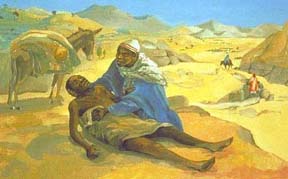
In this weekend's Gospel reading, Jesus tells the parable of The Good Samaritan. It's a story so famous we even have Good Samaritan laws to protect those who lend aid to others. I once preached on this passage saying in part,
The Samaritan comes near to the injured man and when he saw him, he was moved with pity.

Here’s where I have to get a little technical again. I’m sorry, but without it, you just don’t get the full impact of the story. The Greek word for moved with pity is “Splanchnisomai.” It sounds kinda funny when I say it, “Splanchnisomai.” But when Jesus said it, I bet no one was laughing. You see that splanchnisomai is a special word. It’s sort of a theological word as it was reserved to describe the compassion and mercy God has for us. It is a common Biblical word for God’s compassion and mercy. But splanchnisomai is a rare word indeed otherwise. In fact, only Jesus ever uses it to describe human action. Everybody else reserved the word for God alone. Now Jesus has the nerve to say that a dirty rotten scoundrel like a Samaritan can show God-like compassion for someone in need. If that’s not shocking, it should be. The Good SamaritanOf course, the story doesn’t stop there. It just gets worse. The good for nothing Samaritan risks his own safety, spends his own money and a good deal of time to make sure that the Israelite who was beaten by bandits is taken care of. While the crowd is still trying to sort out the images Jesus has tossed together, Jesus asks the lawyer, “Which one of the three, do you think, was a neighbor to the man who fell into the hands of the robbers?” The no-doubt dumfounded legal expert said, “the one who showed him mercy.” There it is again, Mercy. The Samaritan was moved by mercy, showed mercy to the injured man and was his neighbor.

But don’t you see, the story is inside out. It started out with who’s my neighbor. That equation starts with me, or in your case you and works outward. For a good person the concentric circle stretch out farther and farther. You not only include your close family and friends, but can be neighborly to people you don’t even know. That’s just great, but Jesus works the equation the other direction. Jesus starts with the person in need and says the person who is closest is the neighbor. If you see a need, if you know of a need, then you are a neighbor. In fact you may be the nearest neighbor and the one God is looking to to express that Godly compassion and mercy.
The full text of the sermon is online here: The Nearest Neighbor.

peace,
Frank+
The Rev. Frank Logue, Pastor

Labels: ,

0 Comments:

Post a Comment

<< Home

7/07/2007

Shaking off the dust

In tomorrow's Gospel reading, Jesus sends 70 disciples out two by two telling them, "whenever you enter a town and they do not welcome you, go out into its streets and say, `Even the dust of your town that clings to our feet, we wipe off in protest against you."

In an earlier sermon, this reminded me of a true incident from Georgia history. The story is of Lorenzo Dow, a famed Methodist minister and his showdown with an infamous Georgia town. I preached (in part),
When the famed Methodist preacher showed up in Jacksonborough, the rowdies in the town were pretty sure they didn’t want his tea-totalin’ ways taking root in the town. Lorenzo DowThe local Methodist Church offered Dow its pulpit for the night. While a crowd gathered at the church to hear Dow, a second crowd gathered at a whiskey store. Soon after Lorenzo Dow launched into his fire and brimstone sermon, a group stormed up to the church and broke up the meeting by pelting the preacher with rotten eggs. People left in fear of the fight that was sure to follow. The mob returned to the whiskey store to celebrate their victory. Though covered with the stink of rotten eggs, Dow was unbowed. The evangelist followed the angry mob back to the whiskey store where he took up a fireplace tool and broke open a barrel of whiskey, dumping its contents across the floor.
What happened next would be unbelievable if it wasn't a fact of history. The full text of the sermon is online here: Shaking off the Dust.

peace,
Frank+
The Rev. Frank Logue, Pastor

Labels:

0 Comments:

Post a Comment

<< Home

7/02/2007

When in Rome...

Saturnia The natural hot springs at Saturnia

I began my sermon yesterday with:

Most of you know that my wife and daughter and I are just back this Tuesday from 21 days in Italy and France. During that trip, as on other trips abroad, we wanted to fit in, adapting to the local culture best we could. But we kept being spotted as tourists from roughly a mile away. This changed during our stay. All we had to do was drive out into the countryside and take off our clothes.

That’s a true story, but I’ll come back to it. First, we need to consider why it was that everyone knew we were tourists and not only tourists, but...
Follow this link to read the rest of the sermon, When in Rome...

It's a bit of a cheesy intro to the sermon, but I think it worked all in all. Below are some photos from our recent trip to Italy and France that I am sharing here for no particular reason other than I like them. For those of you tired of hearing of my vacation, I have only three more blog posts from the trip before we return to regular programming.

peace,
Frank+
The Rev. Frank Logue

Rome, Italy Two steeples and an antenna in Rome

a neighbor in Todi, Italy A neighbor out for a walk in Todi, Italy where we spent a week

view out a window in our apartment in Provence A waterfall in Provence
The view out our window in Provence and
a waterfall to which we hiked near Sallernes, France


A window in Villecroze, France Window in a vine covered wall in Villecroze, France
near an apartment where we spent a week

Labels: ,

3 Comments:

  • At 7/02/2007 8:38 AM, Anonymous Anonymous said…

    You should have projected the picture above for your sermon yesterday as you can actually spot the tourists from a mile away! :)

    Hearing about your trip has been most enjoyable!

     
  • At 7/02/2007 8:56 AM, Blogger Huw Richardson said…

    Thank you for your travel sharing and your sermons as well.

    This anecdote Roman story reminded me of one day in Dublin (in the mid 90s) when someone asked me a "local" question which I answered correctly. He was visibly surprised at my accent. We developed a friendship because of the fact that I did not "look" nor was I "really" American, but (evidently) quite Irish.

    This might have been exaggerated by the fact I was travelling with a Chinese American.

    Nevertheless I was very proud of being able to shed my native habits

     
  • At 7/02/2007 11:31 AM, Blogger Laura said…

    Love the sermon. I've always like Paul's list of the fruits of the spirit. Truly words you could base a life on.
    The pictures are nice, as well. I'm looking forward to seeing more.


Post a Comment

<< Home

6/16/2007

Go in Peace, to Where?

This weekend's Gospel reading tells of Jesus attending a dinner party in the home of a Pharisee. The Pharisees were Jews seeking to be faithful to God's law, which Jesus clearly wanted. But sometimes they let the letter of the law get in the way of its spirit as happens at this party. Luke writes,
And a woman in the city, who was a sinner, having learned that he was eating in the Pharisee's house, brought an alabaster jar of ointment. She stood behind him at his feet, weeping, and began to bathe his feet with her tears and to dry them with her hair. Then she continued kissing his feet and anointing them with the ointment. Now when the Pharisee who had invited him saw it, he said to himself, "If this man were a prophet, he would have known who and what kind of woman this is who is touching him—that she is a sinner."
Jesus offers her forgiveness and tells her to go in peace. Three years ago, I preached a first-person sermon on this passage. It began with the idea of the host saying, "As dinner parties go, it was a disaster." Then continued from the hosts viewpoint on a dinner party gone wrong and the dangers of following Jesus. That sermon ended,
Go in peace. Really! The nerve. Go where? Where could that woman ever find peace? anointing Jesus' feetIf she really did want forgiveness, if that woman really did want to turn toward God, then she would never be welcome back in this city again. Her old crowd wouldn’t know what to do with her and neither would we, the religious ones. Where could this weeping thing go? Who would offer her peace except for that gaggle of Galileans?

This Jesus needs to think it all through. If God’s love and forgiveness is for everyone, then there is going to have to be some sort of community to receive those forgiven sinners, and the unforgiven ones too.

The Kingdom of God will never be a here-and-now reality unless there is a place where those fallen folks can congregate, support one another. Those forgiven sinners certainly can’t come to my house, or church, until they have proved themselves and I suspect they won’t be welcome in yours either.

Face it. Jesus was too accepting. If he was more like you and me, this movement of his might go somewhere. But I promise you. This is the last time, and I mean it the very last time, I let the likes of him in my gate. And I would advise you to steer clear of this irresponsible teaching. Jesus words sound good at first, but this reckless rabbi would turn the world upside down if anyone actually practices what he preaches.
The full text of the sermon is here: Go in Peace, to Where. A version of this will be next week's religion column for the tribune & Georgian. Being away on vacation, I thought that this first person sermon might make an interesting change up from what I've been writing for the paper. We'll see.

peace,
Frank+
The Rev. Frank Logue, Pastor

Labels:

0 Comments:

Post a Comment

<< Home

6/01/2007

Bill Ehrhardt

The Eulogy from today's Memorial Service for Bill Ehrhardt is now online here: How's Your Dash? And by all accounts, Bill had a heck of a dash.

Labels:

0 Comments:

Post a Comment

<< Home