A Firm Foundation
In tomorrow's Gospel reading, Jesus says "Everyone then who hears these words of mine and acts on them will be like a wise man who built his house on rock. The rain fell, the floods came, and the winds blew and beat on that house, but it did not fall, because it had been founded on rock. And everyone who hears these words of mine and does not act on them will be like a foolish man who built his house on sand. The rain fell, and the floods came, and the winds blew and beat against that house, and it fell— and great was its fall!"
The Rev. Dr. Susanna Metz of the School of Theology at Sewanee has written on this passage saying,
The Rev. Dr. Susanna Metz of the School of Theology at Sewanee has written on this passage saying,
We might say to ourselves, “If I lived in that time, I certainly would believe everything Jesus told me.” But we mustn’t forget that those people were just as human as all of us. Isn’t it true that even today some folks miss the incredibly obvious? Some people – some of us, maybe – are so self -absorbed that they see very little around them. We read about lots of folks who were like that in the scriptures. Most often it’s the Pharisees and Scribes who get pigeon holed like that, but they certainly weren’t the only ones.The full text of her sermon is online here: Proper 4aAnd it’s no different today. We don’t have to look far in our own society to find people who say one thing and do another, or even worse, who try to make us think they’re doing us a favor when they are really lining their own pockets. Jesus is saying to his followers – and to us – make sure your actions and your motives match.
Today’s gospel is a stern reminder that we can’t get away with appearing to do good while we pick and choose who it is we do our good deeds for. Jesus isn’t kidding when he says he won’t be pleased.
Jesus says over and over that all we have to do is hear his words and act on them, hear and believe, hear and obey.And the important thing is to remember that those early Jews already knew what they were supposed to do. Jesus wasn’t giving them a whole new set of rules to live by. He’d already reminded them at the beginning of the Sermon on the Mount that he hadn’t come to abolish the laws they already had, but to fulfill them – to help them live the life they knew more faithfully.
It’s the same for us. We know what we have to do. It’s just hard to do it all the time. Hearing the word of God, hearing what Jesus says to us, isn’t something we do once and then check off our list. We have to keep listening all our lives, learning more and more about how God would have us live.
We have our baptismal promises, we have the words and actions of Jesus, we have the commandments. What Jesus is telling us today is that we need to be faithful, that we need to examine our motives and make sure that what we do and say fits with the life God asks us to live.
Labels: Gospel reading
posted by King of Peace @ Saturday, May 31, 2008
0 comments


 "You have to decide whether your life is a long-distance race or a sprint." Early on, I decided that I could ultimately help more people if I treated my life and ministry as a long distance run (as best I can, realizing my life's length is up to God to determine), rather than burning myself out. I am a limited human being and the best I can do sometimes is to pass by this one person sitting outside my door so that I can have the energy and enthusiasm to answer God's call to minister to the ten, twenty or hundred that will be there tomorrow.
 I looked at it with the eye of my understanding and thought "What may this be?"


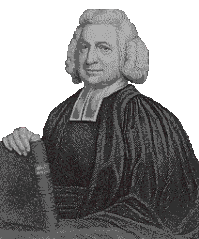 The future co-founder of Methodism was plagued with doubts about the Christian faith.


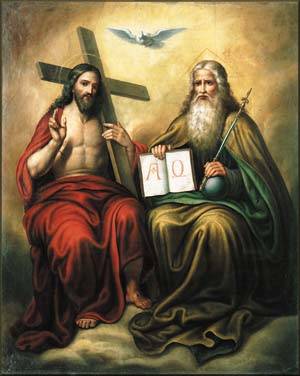
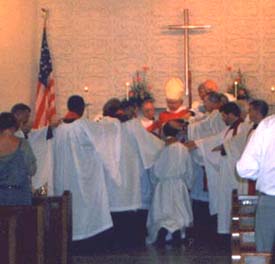 It is not enough for the priests and ministers of the future to be moral people, well-trained, eager to help their fellow humans...the central question is, Are the leaders of the future truly men and women of God, people with an ardent desire to dwell in God's presence, to listen to God's voice, to look at God's beauty, to touch God's incarnate Word, and to taste fully God's infinite goodness?


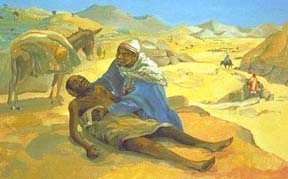 Darley and Batson met with a group of seminarians, individually, and asked each one to prepare a short, extemporaneous talk on a given biblical theme, then walk over to a nearby building to present it. Along the way to the presentation, each student ran into a man slumped in an alley, head down, eyes closed, coughing and groaning. The question was, who would stop and help? Darley and Batson introduced three variables into the experiment, to make its results more meaningful. First, before the experiment even started, they gave the students a questionnaire about why they had chosen to study theology. Did they see religion as a means for personal and spiritual fulfillment? Or were the looking for a practical tool for find meaning in everyday life? Then they varied the subject of the theme the students were asked to talk about. Some were asked to speak on the relevance of the professional clergy to the religious vocation. Others were given the parable of the Good Samaritan. Finally, the instruction given by the experimenters to each student varied as well. In some of the cases, as he sent the students on their way, the experimenter would look at his watch and say, “Oh, you’re late. They were expecting you a few minutes ago. We’d better get moving.” In other cases, he would say, “It will be a few minutes before they’re ready for you, but you might as well head over now.”
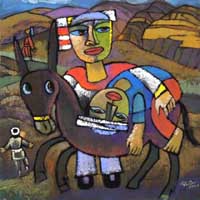 If you ask people to predict which seminarians played the Good Samaritan (and subsequent studies have done just this) their answers are highly consistent. They almost all say that the students who entered the ministry to help people and those reminded of the importance of compassion by having just read the parable of the Good Samaritan will be the most likely to stop. Most of us, I think, would agree with those conclusions. In fact, neither of those factors made any difference. “It is hard to think of a context in which norms concern helping those in distress are more salient than for a person thinking about the Good Samaritans, and yet it did not significantly increase helping behavior,” Darley and Batson concluded. ”Indeed, on several occasions, a seminary student going to give his talk on the parable of the Good Samaritan literal stepped over the victim as he hurried on this way.” The only thing that really mattered was whether the student was in a rush. Of the group that was, 10 percent stopped to help. Of the group who knew they had a few minutes to spare, 63 percent stopped.
.jpg/436px-Good_Samaritan_(Watts).jpg)


.JPG)


 You are the most beautiful, and yet the strongest. You are stable, yet incomprehensible. You are unchanging, yet changing all things. You are never new and never old, yet you are constantly renewing all things. You are always working, yet always at rest. You create great riches on earth, yet you need nothing yourself. You support, nourish and protect all.


 The Christian does not think God will love us because we are good, but that God will make us good because He loves us; just as the roof of a sunhouse does not attract the sun because it is bright, but becomes bright because the sun shines on it.







0 Comments:
Post a Comment
<< Home